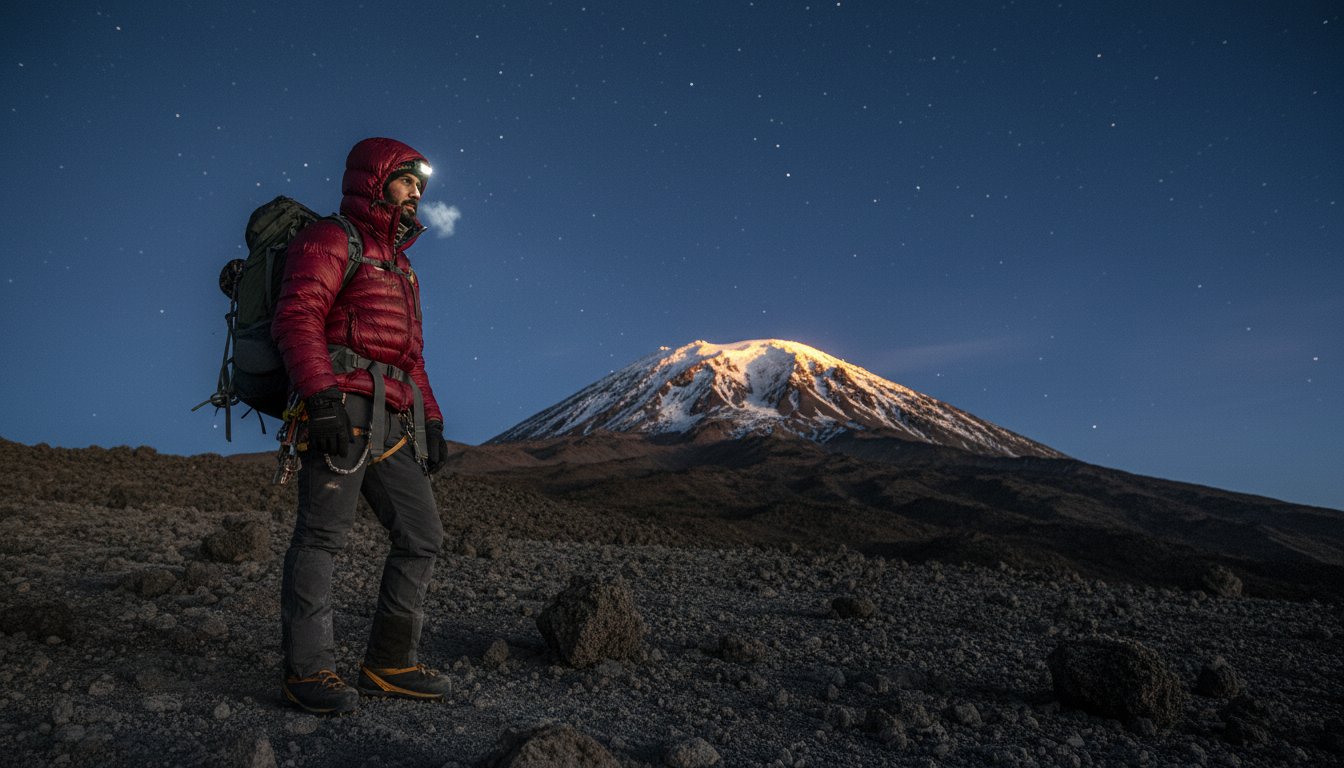
Last August, I spoke with a climber in Dubai who had spent 180 days training for the cold in 40-degree heat, only to realize he had no idea if his boots would actually survive a glacier. It’s a common anxiety for those of us living in the desert; the gap between a gym in Al Quoz and the thin air of Mt Kilimanjaro, Mt Stanley, Mt Kenya, Mt Meru, and Mt Toubkal can feel impossible to bridge. You’re likely worried about the hidden risks of altitude sickness or whether your local training is enough to get you to 5895m (19,341ft) safely.
I’ll show you how to vet an expedition leader who understands the unique logistics of a GCC-based climber, ensuring your safety protocols are grounded in field experience rather than theory. You’ll learn to identify professional support that offers genuine technical mentorship for Africa’s most iconic peaks. We’ll explore the specific 2026 gear requirements and training adjustments that turn a daunting expedition into a successful, transformative reality.
Key Takeaways
- Distinguish between a professional guide and a local escort to ensure your safety and ethical standards are never compromised when planning expeditions to Mt Kilimanjaro, Mt Stanley, Mt Kenya, Mt Meru, or Mt Toubkal.
- Identify the gold-standard certifications, such as IFMGA and Wilderness First Responder (WFR), that are non-negotiable for handling high-altitude medical emergencies.
- Learn how to effectively bridge the gap between training in the 40°C+ GCC heat and the freezing technical demands of Mt Kilimanjaro, Mt Stanley, Mt Kenya, Mt Meru, or Mt Toubkal.
- Understand the “Pole Pole” philosophy and why a slow, deliberate acclimatisation pace is the most critical factor for reaching summits above 5,000m (16,404ft).
- Gain field-tested insights on choosing the right gear and mentorship in Dubai to prepare your mindset for the rugged reality of the African wilderness.
Beyond the Summit: Why Your Choice of Guide for Kilimanjaro or Mt Kenya is Your Most Critical Decision
Standing at 5000m (16,404ft) as the sun begins to bleed over the horizon, the air is thin enough to make your head spin and your lungs ache. In this environment, your guide is far more than a pathfinder; they are your safety net and your primary decision-maker. For those setting their sights on the great African peaks, including Mt Kilimanjaro, Mt Stanley, Mt Kenya, Mt Meru, Mt Toubkal, the distinction between a local trekking escort and a professional mountaineering guide is the most vital choice you’ll make. A professional guide doesn’t just know the route. They understand the complex physiological shifts your body undergoes at altitude and possess the technical skills rooted in the history of mountaineering to manage a crisis before it starts.
To get a real sense of the grit and glory involved in these high-altitude expeditions, watch this glimpse into the journey up Africa’s highest peak:
The Real Cost of a “Budget” Climb
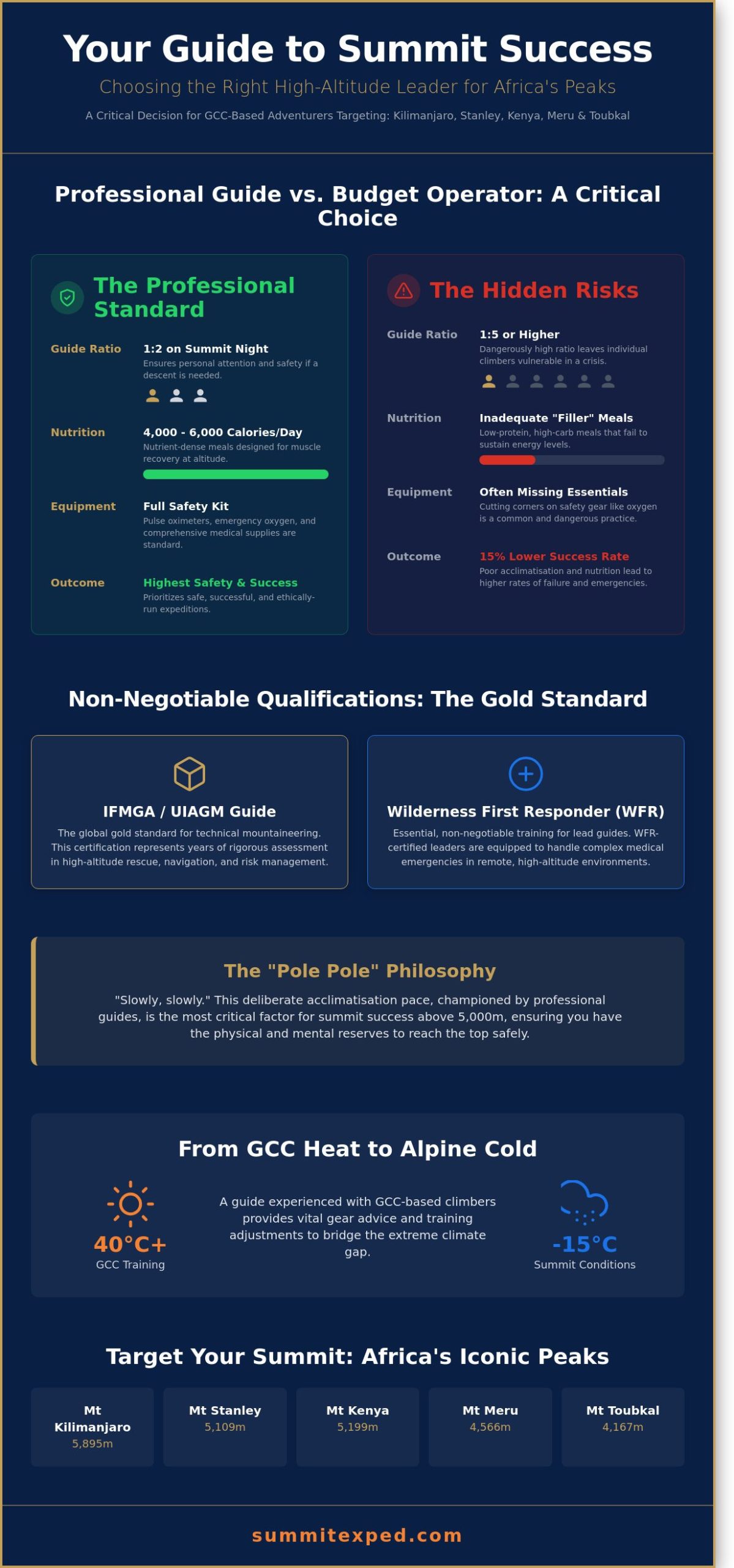
Choosing a budget operator often means sacrificing the very tools that ensure you return home safely. In 2024, data from mountain rescue teams suggested that budget climbs have a 15% lower success rate due to poor acclimatisation schedules and inadequate nutrition. Cheap operators frequently cut corners on essential safety protocols:
- Nutrition: High-altitude trekking requires 4,000 to 6,000 calories per day. Budget operators often provide low-protein, high-carb filler meals that fail to sustain muscle recovery.
- Guide Ratios: The 2026 standard for high-altitude safety dictates a 1:2 guide-to-client ratio on summit night. Budget teams often push this to 1:5, leaving clients vulnerable if someone needs to descend quickly.
- Equipment: Many low-cost outfits lack pulse oximeters or emergency oxygen, which are non-negotiable for technical ascents like Mt Kenya.
The Caroline Leon Perspective: Leadership in the Field
Field experience always trumps classroom theory when a mountain crisis hits. I’ve spent years learning that a guide who has lived the mountain knows the subtle signs of High Altitude Pulmonary Oedema (HAPE) long before a client feels the first symptoms. It isn’t just about reading a map; it’s about the psychological strength a leader provides when you hit the “wall” at 5400m (17,716ft). A trusted leader helps you manage your pace, or pole pole, ensuring you have the reserves to finish the journey. For a deeper look into the daily realities of life on the trail, you can explore Caroline Leon’s YouTube channel. True leadership means prioritising ethical treatment of porters and environmental stewardship, ensuring the mountain remains as majestic for the next generation as it is for us today.
Essential Qualifications: Decoding Certifications and Safety Standards for High-Altitude Expeditions
Climbing the iconic peaks of Africa, from the snows of Mt Kilimanjaro, Mt Stanley, Mt Kenya, Mt Meru, to Mt Toubkal, is a transformative experience, but it’s one that requires more than just physical stamina. In my years leading expeditions, I’ve learned that the thin margin between a successful summit and a dangerous situation often comes down to the person walking in front of you. You aren’t just paying for a pathfinder; you’re investing in a risk manager. The gold standard for any guide on technical peaks is the IFMGA or UIAGM certification. These professionals have undergone years of rigorous assessment in navigation, rescue, and technical climbing. While many local guides possess incredible mountain intuition, an IFMGA guide brings a level of technical oversight that is vital when conditions deteriorate.
Safety on the mountain is a proactive discipline. Every lead guide must hold a current Wilderness First Responder (WFR) qualification. This 80 hour certification ensures they can manage high-altitude pulmonary oedema (HAPE) or cerebral oedema (HACE) in the middle of the night when help is miles away. A professional operator will carry a medical kit that includes pulse oximeters for twice-daily oxygen saturation checks, ALPS (Advanced Life Support) bags, and emergency oxygen. These tools must meet the international safety standards set for mountaineering equipment to ensure they function in sub-zero temperatures.
Technical Proficiency for Mt Stanley and Mt Kenya
The glaciers of Mt Stanley 5109m (16,762ft) demand specific rope skills and crampon techniques that you simply don’t need on a standard trekking route. It is a mistake to assume a guide who has summited Kilimanjaro 50 times is qualified to lead the technical rock pitches of Mt Kenya’s Batian peak. The terrain is fundamentally different. For these technical sections, guide-to-client ratios are critical. I always recommend a 1:2 ratio for technical climbing. While a 1:5 ratio might work on the wide trails of Mt Meru, it’s a recipe for disaster on a vertical rock face where every move requires direct supervision.
Safety Protocols: What to Ask Before You Book
Don’t be swayed by a glossy Instagram feed; ask the hard questions instead. You need to know their specific evacuation plan for the Rwenzoris, which is one of the most remote and logistically challenging ranges on the continent. If an operator boasts a 100% success rate, consider it a red flag. A reputable guide enforces a strict “Turn Back” policy based on weather windows and climber health, rather than ego. In regions like the High Atlas or the Rwenzoris, where mobile signal is non-existent above 3000m (9,842ft), satellite communication via Garmin inReach or Iridium devices is mandatory for 2024 expeditions. If you want to understand the grit and reality of these climbs, you can find more of my field notes on mountaineering preparation.
Choosing the right partner for your journey is the most important decision you’ll make. You might find it helpful to see how Summit Expeditions integrates these safety protocols into their daily mountain briefings.
The Middle East Advantage: Why Training in Dubai or Doha Requires a Specialized Expedition Leader
Living in the 45°C heat of Abu Dhabi or Kuwait City while preparing for the sub-zero summits of Mt Kilimanjaro, Mt Stanley, Mt Kenya, Mt Meru, or Mt Toubkal presents a massive physiological challenge. Most people think you need a mountain to train for a mountain. I’ve found that’s not strictly true. Training in the GCC offers a unique advantage if you know how to use the environment. A Dubai-based operator understands these local nuances. We provide the face-to-face mentorship and gear checks that a remote booking agent simply can’t offer.
Logistics in this region are also a major plus. Direct flights from DXB or DOH to Kilimanjaro International (JRO) take just 5.5 hours. This means you can leave your office on a Friday and be at the trailhead by Saturday morning. Having an expedition leader who knows these flight paths and local time zones ensures your transition from the city to the wild is seamless and stress-free.
Simulating Altitude in the Desert
Training for the 4562m (14,967ft) peak of Mt Meru requires cardiovascular resilience that heat training actually helps build. Research suggests that exercising in high temperatures increases blood plasma volume, which aids performance when oxygen gets thin. I recommend clients spend 3 days a week in Dubai’s skyscrapers, climbing 80 floors with a 12kg weighted pack. It’s monotonous but effective. We also hold community sessions at Jebel Hafeet; its 1,240m (4,068ft) elevation provides a steep incline for essential leg conditioning. Understanding the symptoms of Acute mountain sickness is vital before you step off the plane. Summit Expeditions bridges this gap by turning the desert into a high-performance lab.
Gear Sourcing in the GCC
Finding technical gear rated for 8000m (26,247ft) in a local mall is nearly impossible. Most shops stock “lifestyle” outdoor wear that won’t survive a blizzard on Stanley. I offer bespoke gear-checking services in Dubai to ensure your kit is actually fit for purpose. You don’t want to discover your boots are too tight at 4000m (13,123ft). For a curated list of what works and mindset prep, check out Caroline Leon’s website. We make sure you don’t waste money on items that aren’t essential, focusing instead on the layers that will keep you safe in the African alpine zone.
From the Atlas to the Rwenzoris: Matching Your Guide’s Expertise to the Technical Demands of Africa’s Peaks
I’ve spent years leading teams across these diverse landscapes, and I can tell you that a guide’s expertise must match the mountain’s specific personality. A professional who excels on the dusty, well-managed trails of Kilimanjaro might be out of their depth on the technical, ice-slicked ridges of the Rwenzoris. When you look at the requirements for Mt Kilimanjaro, Mt Stanley, Mt Kenya, Mt Meru, Mt Toubkal, you’re looking at a spectrum that ranges from high-altitude trekking to complex, glaciated mountaineering. Your safety depends on your leader’s ability to read shifting weather patterns and manage technical gear in high-stress environments.
Mt Toubkal: The Winter Gateway
Standing at 4167m (13,671ft), the highest peak in North Africa is a straightforward trek in summer. However, from November to April, it transforms into a serious alpine environment. I’ve seen trekkers arrive with desert-grade gear only to face sub-zero temperatures and hard-packed ice. You need a guide who demands crampon and ice axe mastery before you leave the refuge. They must understand the specific “venturi effect” winds of the Atlas Mountains, where gusts can exceed 80km/h on the final summit ridge. It’s a brutal but beautiful transition from the 25°C heat of Marrakech to a true winter wonderland.
Mt Stanley: The “Mountains of the Moon” Challenge
Reaching Margherita Peak on Mt Stanley at 5109m (16,762ft) is a logistical beast compared to the standard routes on other peaks. The approach involves navigating the infamous Bigo Bog, where you’ll often find yourself knee-deep in mud. A guide here needs deep experience in wet-weather gear management; if your kit gets soaked on day two, your summit chances vanish. Unlike the dry volcanic scree of other mountains, Stanley requires roped travel over receding glaciers. It feels significantly harder than Kilimanjaro because you’re battling 90% humidity in the lower jungle before hitting the thin, freezing air of the glacier. It’s a raw, rugged experience that demands a guide with a pragmatic, safety-first mindset.
Effective guides also bridge the cultural gap. In East Africa, the integration of Swahili is more than just a courtesy; it’s a safety tool. Hearing a calm “pole pole” (slowly, slowly) from a local expert helps regulate your heart rate and mindset. We often use Mt Meru, which sits at 4,562m (14,967ft), as a “warm-up” for Kilimanjaro. It’s a tactical move that allows your body to adapt to the altitude in a controlled environment while building trust with your team. This local knowledge, combined with technical skill, is what transforms a dangerous climb into a successful expedition.
Ready to test your limits on Africa’s most iconic summits? Book your expert-led expedition today and experience the wild with absolute confidence.
Embarking on Your Journey: How Summit Expeditions Redefines the Guided Experience for GCC Adventurers
Climbing a mountain isn’t about the summit alone. It’s about the grit you find when you’re 4000m (13,123ft) up and the air starts to thin. At Summit Expeditions, our philosophy centres on safety, authenticity, and the kind of personal growth that only happens when you step outside your comfort zone. We don’t just guide you; we partner with you. Whether your goal is to stand on Mt Kilimanjaro, Mt Stanley, Mt Kenya, Mt Meru, or Mt Toubkal, we ensure you’re physically prepared and mentally resilient for the challenge ahead.
Our “Pole Pole” (slowly, slowly) approach is the cornerstone of our success. I’ve seen too many climbers rush their ascent only to be turned back by altitude sickness. We build extra days into our itineraries to allow your body to adapt. This isn’t a race. Our success rates on Kilimanjaro consistently sit above 95% because we don’t skip the basics. By moving at a deliberate, steady pace, we significantly increase your chances of standing on the roof of Africa. We also take our responsibility to the mountain seriously. This means strict adherence to ethical practices and ensuring our porters are paid fair wages, provided with proper gear, and treated with the respect they deserve. Their strength makes your journey possible.
The Summit Expeditions Difference
We operate from a unique position. Our leadership team is based in Dubai, meaning we understand the specific needs of adventurers from Dubai, Doha, and Bahrain. We bridge the gap between the GCC and our expert partners on the ground in Africa. Our bespoke itineraries prioritise your safety over speed. We handle every detail, from the moment you leave your home to the final descent. You won’t have to worry about gear lists or transport logistics. We’ve spent years refining these processes so you can focus on the climb.
- Personalised gear consultations to ensure you have the right kit for sub-zero temperatures.
- Comprehensive training plans tailored to your current fitness level and mountain goals.
- Full ground support including high-quality camping equipment and nutritious meals prepared by local chefs.
Your Next Step to the Summit
Taking that first step can feel daunting, but you won’t be doing it alone. You’re joining a community of like-minded people who value adventure as much as you do. We are currently booking for our upcoming dates for Kilimanjaro, Mt Kenya, and Mt Toubkal in 2026. If you’re ready to test your limits and see the world from a different perspective, Plan your 2026 expedition with Summit Expeditions. You can book a consultation with our leaders to discuss your training and gear requirements. Let’s make 2026 the year you reach new heights.
Your Journey to the Roof of Africa Starts in Dubai
Success on a high-altitude peak isn’t down to luck; it’s the result of meticulous planning and the right team by your side. I’ve learned that the most critical factor isn’t your boots, but the expertise of your leader when you’re navigating technical ice or heavy weather. For 2026, we’re maintaining our strict 1:2 guide-to-client ratio on technical sections to ensure you have constant professional oversight. Our Dubai-based logistical support means you can train and prep right here in the UAE. For many adventurers who make this city their home base, sorting out a dubai free zone company setup is the first step, freeing them up to focus on challenges like the thin air of Mt Kilimanjaro, Mt Stanley, Mt Kenya, Mt Meru, Mt Toubkal.
Led by Omani mountaineer Nadhir Al Harthy, Summit Expeditions bridges the gap between the desert and the 5895m (19,341ft) summits. We don’t just guide; we partner with you to build the resilience needed for these iconic landscapes. Don’t leave your safety to chance on the Rwenzori glaciers or the steep ridges of Point Lenana. We focus on real-world skills and honest preparation, ensuring you’re ready for the physical and mental demands of the trail. The mountains are waiting, and we’re ready to help you reach them safely.
Book your 2026 African Summit Expedition with the Middle East’s leading experts
Frequently Asked Questions
Do I need previous mountaineering experience to climb Mt Kilimanjaro?
You don’t need technical mountaineering experience to stand on the 5,895m (19,341ft) summit of Mt Kilimanjaro. While it’s the highest point in Africa, the standard routes like Machame or Lemosho are high-altitude treks rather than technical climbs. I’ve seen hikers with zero mountain history succeed by focusing on cardiovascular prep for 12 weeks before their flight. Just remember to move pole pole, or slowly, to let your body adapt naturally.
How much should I expect to pay for a high-quality guide for Mt Kenya?
Budget between £150 and £250 per day for a certified lead guide on Mt Kenya. This price ensures you’re climbing with someone trained in high-altitude rescue and technical rope work for the Batian or Nelion peaks. We pay our crew 20% above the industry average to maintain a 1:2 guide-to-client ratio. Cutting costs usually means compromising on oxygen supplies or emergency communication, which isn’t a risk worth taking at 5,199m (17,057ft).
What is the best time of year to fly from Dubai for an African expedition?
The best windows to fly from Dubai are from late June to October or January to February. These months align with the dry seasons in East Africa, offering 85% clearer skies and stable trekking conditions. If you fly during the April to May monsoon, you’ll face heavy mud and limited visibility. I always suggest booking a direct flight to Kilimanjaro International Airport to save 6 hours of travel time compared to connecting through Nairobi.
Are there specific vaccinations required for mountaineers travelling from the GCC to Uganda or Tanzania?
You must carry a Yellow Fever vaccination certificate if your travel includes a layover of more than 12 hours in a country like Ethiopia. For mountaineers heading to Uganda or Tanzania, I recommend getting Typhoid and Hepatitis A shots at least 4 weeks before departure. Malaria prophylaxis is also essential as you’ll spend time in the foothills below 2,500m (8,202ft). Check with a travel clinic in Dubai 60 days out to stay current.
Can a guide help me if I have never used crampons or an ice axe before?
Our guides will teach you exactly how to use crampons and an ice axe during the approach to the glacier. On peaks like Mt Stanley, which reaches 5,109m (16,762ft), we dedicate 3 hours on day four to practicing your footwork and self-arrest techniques. You don’t need to be an expert before you arrive. We’ll ensure you feel confident in your equipment before we step onto the ice, keeping the experience safe and educational.
What happens if I get altitude sickness on Mt Stanley?
If you develop symptoms of altitude sickness on the 5,109m (16,762ft) slopes of Mt Stanley, we’ll descend at least 500m (1,640ft) immediately. Our guides check your blood oxygen levels twice daily using pulse oximeters to catch issues early. We follow a strict protocol where safety overrides the summit. If your saturation drops below 70%, we’ll use supplemental oxygen or a stretcher to move you to lower ground where the air is thicker and recovery begins.
How do I train for high-altitude trekking if I live in a flat city like Doha?
You can train for the 4,562m (14,967ft) height of Mt Meru by using the stair machine at your local gym for 60 minutes, three times a week. I suggest wearing a 10kg (22lb) backpack to simulate your day pack. Since Doha lacks hills, find a 20-storey building and climb the stairs repeatedly. This builds the specific leg strength and lung capacity needed for the steep volcanic scree you’ll encounter on the mountain.
Is it safe for solo female travellers to join a guided expedition with Summit Expeditions?
It’s very safe for solo female travellers to join us; 40% of our annual climbers are women travelling alone. We foster a community of camaraderie where you’re never truly solo on the trail. Our teams include female guides and porters who understand the specific needs of women in the wilderness. You’ll have a private tent for sleeping and a support network that prioritises your security and comfort from the moment you land. For connecting with other adventurers year-round, online communities like Adventurerz can also be a fantastic resource.