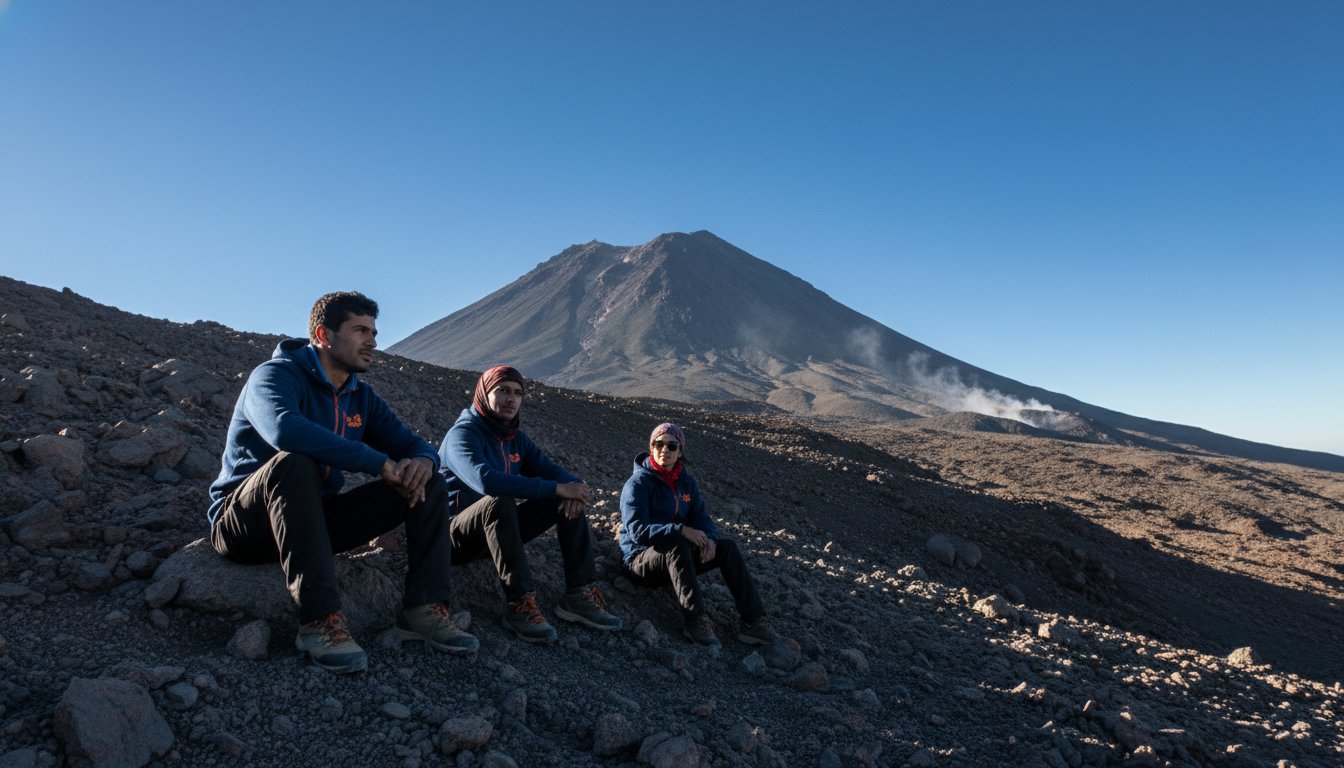
The biggest threat to your summit success isn’t the 5,610m (18,406ft) altitude or the sulfurous vents of a volcano; it’s often the fifteen other people standing in your breakfast tent. When you’re planning to tackle the iconic trio of Damavand, Mount Ararat and Jebel Shams, you’ve likely spent at least 12 weeks training on the dunes or the Jebel Hafeet road. It’s a massive investment of time and energy. You don’t want your hard work sidelined by a group dynamic that doesn’t match your pace or safety expectations.
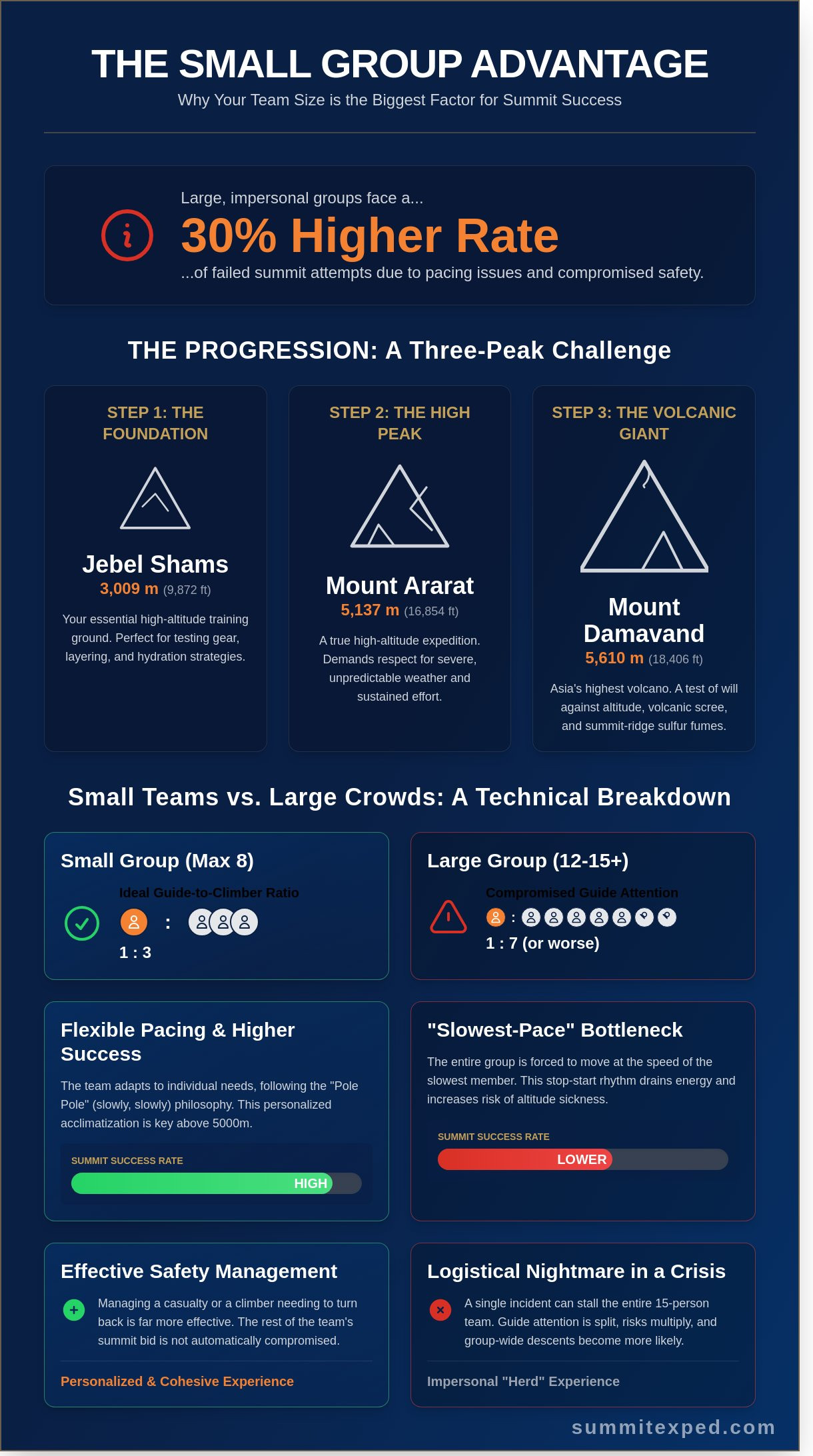
In my experience leading expeditions across the Middle East, I’ve seen how large, impersonal groups can compromise safety protocols and lead to a 30% higher rate of failed summit attempts. I’ll show you exactly why a smaller, more intimate team allows for the personalised training and flexible pacing you need to reach the top safely. We’ll look at how group size dictates everything from your hydration strategy to your chances of a successful descent, ensuring your next holiday isn’t wasted on a “herd” experience.
Key Takeaways
- Understand why the technical progression across **Damavand, Mount Ararat and Jebel Shams** is vital for success and why Jebel Shams at 3009m (9,872ft) is your essential first step.
- Learn how small group sizes prevent the “slowest-pace” bottleneck on the steep volcanic scree of **Damavand, Mount Ararat and Jebel Shams**, allowing for precise summit timing to avoid the worst sulfur fumes.
- Discover the logistical reality of high-altitude safety and why managing a casualty on **Damavand, Mount Ararat and Jebel Shams** is far more effective in an intimate team of eight than in a large commercial crowd.
- Get actionable tips on training in the GCC heat to prepare your lungs and legs for the transition to the alpine cold of the Middle East’s highest volcanic peaks.
The Middle East Triple Crown: Damavand, Mount Ararat, and Jebel Shams
For hikers based in the UAE or the wider Gulf, the “Triple Crown” represents the ultimate progression in regional mountaineering. It isn’t just a list of peaks to tick off. It’s a transformative journey that takes you from the familiar limestone heat of the Hajar Mountains to the thinning, sulfur-heavy air of the Iranian and Turkish highlands. While many see these as similar trekking objectives, the reality is that Mount Damavand, Mount Ararat and Jebel Shams require vastly different physical and mental strategies. You are moving from weekend hiking into the world of genuine high-altitude expeditions.
To see the raw scale of these peaks and the environment you’ll be facing, this video captures the reality of the terrain better than any description:
Mount Damavand and Mount Ararat: The Volcanic Giants
Damavand is a beast of a mountain. At 5610m (18,406ft), it’s the highest volcanic peak in Asia, and it lets you know it. The final summit ridge is famous for its active fumaroles. These vents release thick sulfur fumes that can catch your breath and sting your eyes. If the wind isn’t in your favour, that last 200 metres feels like a battle of will. Mount Ararat stands at 5137m (16,854ft) and, while it lacks the sulfur, it demands immense respect for its weather patterns. Storms can roll in across the Turkish plains with zero warning.
The biggest hurdle for most climbers is the psychological shift. You aren’t just “going for a walk.” You’re managing a body that is slowly starving for oxygen. Success on these peaks comes down to a “pole pole” or slowly, slowly approach. I’ve seen many fit athletes fail because they tried to power through the altitude. On these giants, your ego is your biggest enemy.
Jebel Shams: Oman’s Roof of the World
At 3009m (9,872ft), Jebel Shams is the highest point in the GCC. For those of us living in Dubai, it’s our most valuable training tool. Don’t mistake it for a casual outing. While the Balcony Walk is a beautiful, flat tourist trail, the North Summit route is a serious undertaking involving a 1000m (3,280ft) elevation gain. It’s the perfect place to test your gear.
- Boot check: If your footwear rubs at 3000 metres, it will be a disaster at 5000 metres.
- Layering: Use the Jebel Shams wind to practice your layering transitions without stopping for too long.
- Hydration: Learn how your body responds to exertion in a dry, high-altitude environment.
Training here allows you to iron out the kinks in your system before committing to the bigger expeditions. If you want to see how I pack for these varied climates, you can find more advice on my personal site. Mastering the Triple Crown of Damavand, Mount Ararat and Jebel Shams is about more than just fitness; it’s about becoming a student of the mountain.
Small Group vs. Large Group Expeditions: The Technical Reality
In my 15 years of leading expeditions, I’ve seen how the sheer number of bodies on a trail changes the physics of a climb. When you’re tackling the steep, shifting volcanic scree common to Damavand, Mount Ararat and Jebel Shams, group size is the single biggest factor in your summit success. Large commercial teams of 12 or 15 people often move with a heavy, sluggish momentum. If one person struggles at 4000m (13,123ft), the entire line stalls. This stop-start rhythm is exhausting. It drains your energy and makes it nearly impossible to maintain a steady heart rate. I always advocate for a 1:3 guide-to-climber ratio. It’s the gold standard. It ensures that if someone needs to turn back, the rest of the team isn’t forced to compromise their own journey.
Pacing and Physiological Success
Large groups frequently force a rigid pace that triggers altitude sickness in those who might have succeeded with an extra hour of rest. I’ve learned that the “Pole Pole” philosophy is just as vital on these Middle Eastern peaks as it is in the Himalayas. Slower is almost always faster. Small teams allow us to build personalised acclimatisation schedules. We don’t have to follow a “one size fits all” plan that fails once you cross the 5000m (16,404ft) mark. If you’re feeling strong, we move. If you need a breather, we take it. This flexibility is why I share more detailed training insights on my YouTube channel for those prepping for these specific altitudes.
Managing Volcanic Hazards
The summit push on Damavand is a unique challenge due to the active sulfur vents near the peak. Moving 15 people through these toxic fumes is a logistical nightmare. It’s slow, and exposure time increases. In contrast, a team of 4 can navigate these zones in minutes. On Mount Ararat, high winds often reach 60km/h, making verbal communication nearly impossible in a long line of climbers. Small teams have higher summit success rates on Damavand because they can pivot quickly when sulfur levels or wind speeds shift unexpectedly. Protecting Mount Damavand’s natural heritage means moving through it with minimal impact and maximum safety. If you’re ready to test your limits in a more intimate setting, you might want to explore our upcoming expedition dates.
Safety and Risk Awareness on High-Altitude Peaks
There is a dangerous myth in mountaineering that there is safety in numbers. While a large group might feel like a community, it often creates a logistical anchor that compromises everyone’s safety. On high-altitude treks like Damavand, Mount Ararat and Jebel Shams, a 20-person team is a nightmare if someone gets injured. If a climber develops High Altitude Pulmonary Edema (HAPE) at 5000m (16,404ft), it takes at least four healthy people to manage a manual carry-down. In a massive group, the ratio of capable hands to casualties shrinks rapidly, leaving the team vulnerable in a crisis.
Regional weather patterns also demand local intuition. On Mount Ararat, 5137m (16,854ft), the weather can shift from clear skies to a whiteout in less than 20 minutes. A guide managing 15 people cannot move the group fast enough to outpace a storm. Small teams of four to six climbers maintain the agility needed to reach high camps or descend to safety before the sudden snowfalls trap the expedition. My experience has shown that being nimble is often the best form of protection against the unpredictable nature of the mountains.
The Guide’s Perspective on Safety
I focus on the “quiet climber” syndrome. In large, boisterous groups, the person who stops talking or lags behind is often missed. This silence is usually the first sign of HACE or HAPE. At Summit Expeditions, we maintain a 1:4 guide-to-client ratio. I monitor team health using pulse oximeters to check O2 saturation twice daily. If your saturation levels drop below 70 percent at 4000m (13,123ft), we don’t guess; we follow a clinical protocol to ensure you descend safely before a headache turns into a medical emergency.
Gear and Technical Support
Equipment failure is a leading cause of failed summits in budget-focused tours. I’ve seen 10-year-old tents shred during a gusty night on Damavand, 5610m (18,406ft), because the fabric was UV-damaged and brittle. Small teams allow us to invest in premium communal gear, including four-season tents and reliable mess facilities that keep you warm and dry. For a deep dive into the specific kit I trust for these regions, check out Caroline Leon’s YouTube channel. Having a properly rated sleeping bag isn’t a luxury; it’s the baseline for survival when the temperature hits -20°C on the summit push.
Preparing from the GCC: From Desert Heat to Alpine Cold
Living in Dubai or Abu Dhabi means your body is tuned to 40°C humidity and sea-level oxygen. Transitioning to the 5610m (18,405ft) summit of Damavand is a massive physiological shock. It isn’t just the thin air that catches people out; it’s the “thermal shock” of leaving the desert and hitting sub-zero temperatures on a summit night. You’ll move from a world of constant air conditioning to a glacier where the wind chill can drop to -15°C. Managing this shift requires more than just a heavy jacket. You need a strategy that begins months before you reach the airport.
The logistics for GCC residents are actually quite simple. FlyDubai and Air Arabia offer direct two-hour flights to Tehran for Damavand. For Ararat, most climbers fly via Istanbul to Iğdır (IGD) or Van (VAN). While the travel is easy, the physical preparation must be rigorous to handle the “Triple Crown” progression of Damavand, Mount Ararat and Jebel Shams.
The logistics of such an expedition are complex, much like the operational challenges many of us face in our professional lives. For businesses in Saudi Arabia tackling digital transformation, you can check out BridgeWellTek for enterprise-level cloud solutions.
The Training Blueprint
- Vertical Gain: Since we lack natural elevation in the UAE, use the towers. I’ve spent hundreds of hours in the stairwells of Dubai Marina, carrying a 12kg pack up 80 floors. It builds the specific eccentric leg strength needed for the 1500m (4,921ft) descent on Ararat.
- Hydration: GCC residents often live in a state of mild dehydration. High-altitude air is incredibly dry. You’ll lose significant fluids just by breathing. I recommend increasing your baseline water intake by 1.5 litres daily for three weeks before your trip.
- The Long Day: Ararat’s summit day can last 12 to 14 hours. Practice “time on feet” by doing 20km walks in the Al Qudra desert or the Hajar foothills.
Oman as a Training Hub
Jebel Shams is the secret weapon for any climber based in the Middle East. At 3009m (9,872ft), it provides the only real “altitude hit” within a four-hour drive of the UAE. It’s the perfect place to test your layering system and see how your body handles a steep 1000m (3,280ft) vertical gain in a single afternoon. Crossing the border at Mezyad or Hatta is straightforward for residents, making it an ideal weekend training ground. You can find more detailed training tips on Caroline Leon’s website to help fine-tune your mountain fitness.
Ready to bridge the gap between the desert and the peaks? Book your GCC-led expedition today.
Choosing Your Path: The Summit Expeditions Difference
Selecting an operator for Damavand, Mount Ararat and Jebel Shams isn’t just about comparing price tags. It’s about who is making the calls when the wind picks up or your oxygen saturation starts to dip. I’ve spent enough time at 5,000m (16,404ft) to know that the difference between a successful summit and a dangerous retreat usually comes down to the support system you have behind you. We limit our expeditions to a maximum of eight climbers. This isn’t a random number; it’s the limit where a guide can still look every person in the eye each morning and know exactly how they’re coping with the altitude.
Our Omani heritage gives us a distinct advantage across these regional peaks. On Jebel Shams, the highest point in Oman at 3,009m (9,872ft), we don’t just follow a trail. We navigate based on a deep, local understanding of the limestone terrain and the shifting desert weather patterns. This regional expertise translates directly to our logistics in Turkey and Iran, where we’ve spent the last 10 years building relationships with local teams who prioritise safety over speed. You aren’t just a client on a manifest; you’re part of a team that I’ve personally vetted.
Why We Prioritise Small Teams
Intimate groups allow us to focus on the nuances of high-altitude performance that large “budget” tours simply ignore. When you’re part of an eight-person team, we can tailor nutrition and hydration plans to your specific needs. I’ve seen too many climbers fail because they were forced into a “one size fits all” pace. In our groups, we move together, building a camaraderie that often lasts long after the descent. We also maintain a 100% focus on sustainable mountain practices, ensuring that our presence on Damavand, Mount Ararat and Jebel Shams leaves no trace for the climbers who follow in 2026 and beyond.
- Expert Leadership: Every expedition is led by professionals who understand the physiological demands of the Triple Crown.
- Safety First: We carry comprehensive medical kits and satellite communication on every leg of the journey.
- Tailored Support: From gear checks to acclimatisation schedules, every detail is managed to maximise your success.
Your Next Milestone
If you’re looking at Damavand or Ararat for your 2026 season, you need to set realistic expectations. These aren’t just treks; they’re serious high-altitude undertakings that require physical grit and mental resilience. For many of my climbers, Jebel Shams serves as the perfect training ground before they transition to the Seven Summits. It’s about building a foundation of skills that will keep you safe on much higher peaks. Don’t settle for a cut-price experience that compromises on your safety or your chances of reaching the top. Explore our upcoming regional expeditions and take the first step toward your next major peak with a team that has been there before.
Take the First Step Toward the Triple Crown
I’ve spent enough time on high-altitude ridges to know that a bloated group size can stall an expedition before it even hits the steep sections. When you’re tackling Damavand, Mount Ararat and Jebel Shams, your safety depends on a guide’s ability to monitor your pace and acclimatisation in real-time. That’s why we prioritise a 1:3 guide-to-client ratio. It isn’t just a safety margin; it’s the technical reality required to reach the 5610m (18,406ft) summit of Damavand safely. Moving from the 45°C desert heat of the GCC to the sub-zero winds of Turkey or Iran requires precise preparation and local expertise.
Summit Expeditions was founded by Omani mountaineer Nadhir Al Harthy to provide exactly that level of specialised support. We don’t just lead treks; we share the hard-won lessons of the Middle East’s highest peaks to ensure you’re ready for every rock scramble and frozen morning. You’ve done the dreaming, now it’s time to focus on the logistics that actually get you to the top. Book your expert-led expedition to Damavand or Ararat today and let’s start the journey. The mountains are waiting, and I can’t wait to see you out there.
Frequently Asked Questions
Is climbing Mount Damavand harder than Kilimanjaro?
Damavand is physically more demanding than Kilimanjaro despite being slightly lower at 5610m (18,405ft). While Kilimanjaro at 5895m (19,341ft) is a long trek, Damavand throws active sulphur vents and steeper, looser terrain at you. I’ve seen fit trekkers struggle on Damavand’s final 400m (1,312ft) because the volcanic gases sting your lungs. You’ll need better conditioning for the Iranian peak to handle the 35 degree scree slopes.
Do I need technical mountaineering gear for Mount Ararat?
You don’t need ropes or harnesses for Mount Ararat, but you must carry crampons and an ice axe for the final glacier push. The summit sits at 5137m (16,854ft) and is permanently covered in ice. During my last climb in July 2023, the wind chill dropped temperatures to -15°C (5°F), making sturdy B2 boots and 12-point crampons non-negotiable for safety on the upper slopes.
How much does a guided expedition to Jebel Shams cost from Dubai?
A professional two day guided trip from Dubai to Jebel Shams typically costs between 1,800 AED and 2,500 AED per person. This price covers 4×4 transport, wild camping gear, and three meals. If you’re looking at the 3009m (9,872ft) summit via the W4 trail, ensure your guide includes a satellite phone. Cheaper 1,200 AED options often skip essential safety protocols or experienced lead guides.
Can I climb Damavand and Ararat in the same trip?
You can definitely climb Damavand and Mount Ararat in a single 14 day expedition. This combination is brilliant for acclimatisation since you’ll already be “mountain fit” after the first peak. While we often discuss Damavand, Mount Ararat and Jebel Shams as separate goals, the first two sit geographically close enough to tackle back-to-back. It’s an efficient way to tick off two iconic peaks while only paying for one set of flights.
What is the best month to climb Jebel Shams to avoid the heat?
The best window for Jebel Shams is between November and March when daytime temperatures hover around 15°C (59°F). In mid-winter, night temperatures at the 3009m (9,872ft) plateau can drop to 2°C (35.6°F), so bring a 0°C rated sleeping bag. Avoid June to August; temperatures on the lower access trails often exceed 45°C (113°F), which makes the 1,200m (3,937ft) ascent dangerous for even the most experienced hikers.
What happens if I get altitude sickness on a small group expedition?
If you show signs of Acute Mountain Sickness (AMS), our protocol is an immediate descent of at least 500m (1,640ft). In a small group of six people, we have the flexibility to split the team without ruining everyone’s summit bid. One guide stays with you while the others continue. We monitor oxygen saturation levels twice daily; anything below 75% at 4000m (13,123ft) means we start heading down immediately.
How do I get a climbing permit for Damavand as a UAE resident?
UAE residents must obtain a climbing permit through the Iran Mountaineering Federation, which currently costs 50 USD. You’ll usually pay this in cash at the Polour Mountain Complex before starting your trek. I recommend using a registered local agency to handle the paperwork 30 days in advance. This avoids 4 hour delays at the base camp and ensures your insurance covers high-altitude trekking above 5000m (16,404ft).
Before any major international expedition, it’s also prudent to handle personal legalities. Ensuring you have a notarized power of attorney or other essential documents in place can provide peace of mind for you and your family. For UAE residents preparing for such trips, Insta Notary Services can assist with these official requirements.
Is Jebel Shams safe for solo trekkers or should I join a group?
I always recommend joining a group for Jebel Shams because the W4 trail is notoriously easy to lose in low visibility. While the 3009m (9,872ft) peak isn’t technical, 15% of solo hikers encounter navigation issues near the canyon rim. A group provides a vital safety net if you twist an ankle on the sharp limestone. Having a team of four or more people ensures you have support for the 10 hour round trip.