In 2024, I spoke with a climber in Dubai who had spent over 55,000 AED on gear and permits, only to be told his chances of reaching the top were less than 35% once he actually arrived at base camp. It’s a frustrating reality when the glossy brochures you see in the GCC don’t match the grit of the mountain, which is why having mountaineering expedition success rates explained is vital before you pack a single bag. You likely feel the weight of making such a massive investment of time and money, especially when conflicting data from different operators makes it impossible to know what to believe.
I’m here to ensure you understand these figures with total honesty, moving past the marketing fluff to the factors that actually determine your outcome. We’ll look at why training at sea level in the 40°C humidity of the Middle East requires a specific physiological pivot to succeed at 6,000m (19,685ft) or higher. This guide provides a roadmap for choosing the right peak for 2026, actionable tips for heat-to-cold transitions, and a clear definition of what a successful journey looks like when safety is the priority. The summit is only half the story.
Key Takeaways
- Redefine what it means to succeed by prioritising a safe return and personal growth over a “summit at all costs” mentality that often compromises safety margins.
- See how mountaineering expedition success rates explained through field data reveal that simple adjustments, like an extra day at 4000m (13,123ft), can significantly boost your summit potential.
- Compare the reality of different routes and peaks, from the 8-day Lemosho path on Kilimanjaro to the grit required for the 50% success rate on Aconcagua at 6961m (22,838ft).
- Learn how to bridge the gap between the Dubai heat and the mountain cold by using a specific 6-month training protocol designed for GCC-based climbers.
- Get practical advice on choosing your next expedition based on technical ability and guide-to-client ratios rather than just following the crowd.
Redefining Success: Why the Summit is Only Half the Story
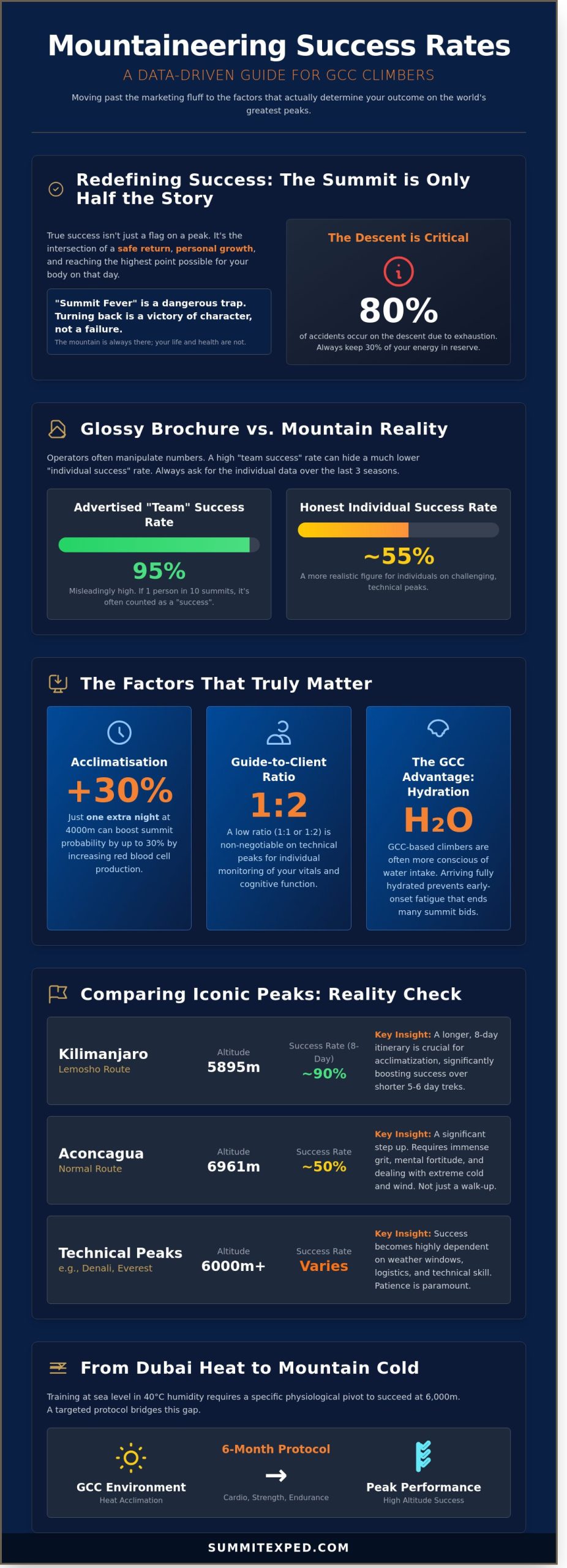
Success isn’t just a flag on a peak. It’s the intersection of a safe return, personal growth, and reaching the highest point possible for your body on that specific day. When mountaineering expedition success rates explained are analyzed, there’s often an unhealthy obsession with the summit. If an operator claims a 100% summit rate, I see a dangerous lack of safety margins. It suggests clients were pushed beyond their physical limits, likely at the expense of their long-term health.
I’ve seen climbers risk everything for a photo at the top. This “summit fever” is a trap that clouds judgment. Turning back at 5500m (18,044ft) because the clouds are rolling in or your lungs feel heavy is a victory of character. My philosophy is simple: the mountain is always there, but your toes and your life are not. True expertise is knowing when to stop.
The Binary Trap: Summit vs. Safe Return
Statistics often ignore “assisted” summits. If a climber is short-roped or uses excessive oxygen to mask altitude sickness, the data still counts it as a win. This ignores the reality of the descent, where 80% of accidents occur due to exhaustion. Success is the ability to return home with the lessons of the mountain intact.
- Safety Margins: Always keep 30% of your energy in reserve for the trek down.
- Risk Awareness: A summit reached through reckless risk is a failure of leadership.
- Personal Growth: What you learn about yourself at 6000m (19,685ft) matters more than the peak.
How Success Rates are Calculated (and Why They Lie)
Operators often manipulate numbers to attract GCC climbers. They might cite “team success,” meaning if one person out of ten reaches the top, the whole trip is marked successful. Individual success rates are usually much lower, often hovering around 50% to 60% on technical peaks. Some companies even exclude “no-shows” or those who left early due to illness to inflate their records. These forced summits lead to long-term safety issues and preventable injuries. When you’re researching, ask for the individual success rate over the last three seasons to get an honest picture of your chances. You can find more about my approach to honest climbing at caroline-leon.com.
The Critical Success Factors: What Really Gets You to the Top?
Success isn’t just about grit; it’s about the math of the mountain. When we look at how mountaineering expedition success rates explained in technical terms, the most significant variable is almost always acclimatisation. Data from high-altitude physiological studies suggests that adding just one extra night of rest at 4000m (13,123ft) can increase your summit success probability by as much as 30%. This extra time allows your body to produce more red blood cells, which are the oxygen-carrying engines you’ll need when the air gets thin.
In Tanzania, we live by the phrase “Pole Pole.” It means slowly, slowly. It’s not just a cultural quirk; it’s a physiological necessity. By keeping your pace low, you maintain a steady blood oxygen saturation level. If you’re coming from Dubai or Riyadh, you already have a secret weapon: your habit of pre-hydration. Desert-dwellers are often more conscious of water intake, and starting an expedition with a fully hydrated system prevents the early-onset fatigue that ruins many summit bids.
The guide-to-client ratio is another non-negotiable factor. While a 1:5 ratio might work for a low-altitude trek, high-stakes environments require more eyes on the ground. A 1:1 or 1:2 ratio means your guide can monitor your breathing, gait, and cognitive function every single minute. That individual attention is the best insurance policy you can buy.
The Role of Logistics and Professional Leadership
High-quality camp setups prevent “energy leakage.” If you’re shivering in a poorly insulated tent or eating sub-par food, you’re burning calories that should be saved for the final push. A leader who’s stood on the summit 20 times knows how to spot a storm before the barometer even drops. They always have a “Plan B” for every camp, ensuring that a blocked route or a broken stove doesn’t end the trip. If you want to see how these logistics look in the field, you can check out my gear and prep guides at caroline-leon.com.
Weather Windows and the “Luck” Variable
Modern forecasting has transformed mountaineering expedition success rates explained by data on peaks like Denali and Everest. We no longer guess; we wait for a specific window. This requires immense patience. If you’re stuck in a tent for three days during a storm, stay mentally sharp by focusing on small tasks. Don’t let the “tent-bound” blues sap your motivation. You need that mental fire when the window finally opens. Success often belongs to the climber who can wait the longest without losing their edge.
- Acclimatisation: Spend at least two nights between 3500m (11,482ft) and 4500m (14,763ft).
- Pacing: Keep your heart rate in a zone where you can still hold a conversation.
- Hydration: Aim for 4-5 litres of fluid daily to combat the drying effect of high-altitude air.
Comparing Success Rates Across the World’s Iconic Peaks
Success on a mountain isn’t a roll of the dice. It’s a calculation based on preparation and patience. When we look at mountaineering expedition success rates explained through the lens of the world’s most famous summits, the data reveals a clear link between time spent on the mountain and the likelihood of reaching the top. Statistics tell a story of how we respect the altitude.
Kilimanjaro: Why Route Choice Dictates Success
I’ve seen many climbers choose the shortest path to save time, but the data proves this is a mistake. The 5-day Marangu route often sees success rates dip below 60% because the ascent is too aggressive for most bodies to handle. Contrast this with the 8-day Lemosho route, where our teams consistently achieve 90% success or higher. Those extra three days are the difference between a miserable retreat and a triumphant sunrise at Uhuru Peak. For my GCC clients, I always recommend the 8-day Lemosho route. It allows for better acclimatisation and builds the psychological momentum needed to tackle the Barranco Wall with confidence.
The 50% Reality of Aconcagua
Aconcagua stands at 6961m (22,838ft) and remains one of the most underestimated peaks in the “Seven Summits” circuit. Despite being a non-technical trek, the success rate hovers around 50%. The “Stone Sentinel” is famous for the Viento Blanco, a fierce wind that can stop an expedition in its tracks. Most failures here aren’t due to lack of fitness; they’re due to the cold and the sheer physical toll of carrying heavy loads at high altitude. It’s a brutal test of endurance that requires a different level of grit than a 5000m (16,404ft) peak.
Technical Peaks: Ama Dablam and the 6,000m Barrier
Success rates drop significantly once technical climbing is required above 6000m (19,685ft). Ama Dablam, sitting at 6812m (22,349ft), requires a “success mindset” that prioritises skill over simple hiking. You aren’t just walking; you’re using fixed lines, jumars, and crampons on steep ice.
- Previous experience on peaks like Island Peak or Lobuche East is the best predictor of success.
- Technical gear requirements, including double boots and specific harness setups, are non-negotiable.
- The 6000m (19,685ft) barrier is where physical fatigue meets technical demand.
Everest: The Shift in Commercial Data
Over the last 20 years, Everest success rates have shifted dramatically due to commercialisation. In the early 2000s, success rates were often below 40%. Today, they frequently reach 60% to 70% for well-supported commercial teams. This change stems from more accurate weather forecasting and a higher ratio of Sherpa support to clients. While the mountain is more accessible, the mountaineering expedition success rates explained in modern contexts still highlight that 1 in 3 climbers may not reach the summit. Safety protocols and oxygen management are now the primary drivers of these improved figures.
The GCC Advantage: Preparing for High Altitude in Dubai and the Middle East
Living in the GCC presents a unique set of challenges when you are eyeing a 6000m (19,685ft) peak. It is easy to assume that the desert is the least ideal place to prepare for a glacier, but your environment is actually a secret weapon. When mountaineering expedition success rates explained through the lens of physical readiness are analysed, the GCC climber often brings a level of thermal tolerance that others lack. Training for -20°C while the mercury hits 40°C in Dubai requires a specific kind of mental fortitude. This “heat to cold” transition isn’t just about gear; it’s about the psychological resilience you build by pushing through the humidity of a coastal summer.
Training in the heat builds a unique cardiovascular efficiency that aids altitude acclimatisation. This metabolic adaptation is a significant factor in your overall performance once you hit the thin air of the Himalayas or the Andes. Your body becomes more efficient at cooling itself and managing stress, which translates directly to the sustained effort required on a summit push. Success on a mountain is rarely just about lung capacity; it is about how well your body handles discomfort, and few environments teach discomfort better than a July afternoon in the Middle East.
Overcoming the “Desert to Glacier” Transition
Practical preparation involves using the local landscape to mimic mountain demands. Jebel Hafeet in Al Ain, rising to 1,240m (4,068ft), offers a consistent incline that is perfect for weighted pack laps. If you are based in the city, the skyscrapers are your best training tool. A 60-storey stair climb in a weighted vest mimics the slow, rhythmic grind of a high-altitude ascent. I recommend focusing on “weighted stair climbs” to build the specific eccentric leg strength needed for the descent. You can find detailed breakdowns of these routines in my training vlogs from the UAE.
Local Training Hubs in Abu Dhabi and Kuwait City
Modern facilities have changed the game for climbers in the region. Hypoxic chambers in Dubai and Abu Dhabi allow you to pre-condition your lungs to thin air while still at sea level, simulating altitudes up to 5000m (16,404ft). In Kuwait City, Doha, and Bahrain, community groups are increasingly active, providing the camaraderie and shared knowledge essential for long-term preparation. Connecting with these local networks ensures you aren’t training in a vacuum. For a tailored approach to your specific expedition goals, visit caroline-leon.com for personal coaching and mindset preparation.
Ready to put your desert training to the ultimate test on the Roof of Africa? Book your Kilimanjaro expedition with our expert team today.
How to Maximise Your Expedition Success Rate on Your Next Climb
Getting to the summit is a choice, but getting down is mandatory. When you see mountaineering expedition success rates explained in various reports, you’ll notice the highest numbers belong to those who treat preparation like a full-time job. It isn’t about luck; it’s about meticulous planning and knowing your limits before the mountain tests them for you. I’ve seen many climbers fail simply because they chose a peak based on its fame rather than their own technical ability. Be honest with yourself about your skills before you commit to an 8000m (26,247ft) objective.
Selecting the Right Expedition Partner in Dubai
In the UAE, we have a unique climbing community, and choosing the right partner here is vital. Don’t just book a faceless operator online. Ask your guide: “What is your evacuation protocol?” and “Who is your lead medic?” At Summit Expeditions, we focus on small team sizes, typically capped at eight climbers. This ensures a higher success rate because we can move faster and make safer decisions. Attending local pre-expedition briefings in Dubai allows us to check your kit and your mindset long before we ever reach 5000m (16,404ft). For more on my personal approach to mountain safety, you can visit caroline-leon.com.
The 6-Month Preparation Protocol
A structured 6-month timeline is the most effective way to beat the statistics found in mountaineering expedition success rates explained. This isn’t just about gym sessions; it’s about building a resilient engine. Following this timeline will significantly improve your chances of a safe return.
- Month 1-2: Focus on your base. Get a full health check-up and start 3 to 4 hours of weekly “Zone 2” cardio. This is the pole pole (slowly, slowly) phase of training where you build aerobic capacity.
- Month 3-4: This is for specific strength. Start weighted hiking in the Hatta hills or using stair machines in Dubai with a 15kg (33lb) pack. Focus on leg endurance and core stability.
- Month 5-6: Tapering and final gear testing. Test every strap and buckle. If your boots feel tight in the UAE heat, they’ll be unbearable at 7000m (22,965ft). Spend this time on mental preparation and refining your nutrition strategy.
Investing in the right gear is non-negotiable. Don’t compromise on your boots or your down layers. High-altitude environments are unforgiving, and your equipment is your primary life support. When you combine the right gear with a solid training protocol and an expert local partner, you aren’t just hoping for success. You’re engineering it.
Take the First Step Toward Your Highest Peak
Standing at the top of a 5895m (19,341ft) peak is a feeling that stays with you forever, but that moment is built on months of quiet discipline. We’ve looked at how mountaineering expedition success rates explained by the numbers only tell part of the story; the rest is written in your training and your choice of team. Success depends on respecting the acclimatisation process and building a solid foundation of fitness before you ever leave the GCC. I’ve seen many climbers struggle simply because they lacked a personalised strategy for the thin air.
Our approach at Summit Expeditions focuses on those vital details. Led by Omani mountaineer Nadhir Al Harthy, we keep our group sizes capped at 10 participants to ensure every climber receives the safety oversight they deserve. We also bridge the gap between the desert and the glacier with expert-led training sessions in Dubai and Abu Dhabi. These sessions aren’t just about sweat; they’re about teaching you the technical skills that make the difference when you’re tired and cold. You don’t have to figure it out alone.
Join our next expedition and start your journey to the summit
The mountain doesn’t change for us, so we change for the mountain. I can’t wait to see you out there on the trails.
Frequently Asked Questions
What is considered a “good” success rate for a mountaineering expedition?
A success rate between 75% and 85% is typically considered excellent for most high-altitude commercial expeditions. These numbers fluctuate based on the mountain’s technical difficulty and the team’s preparation levels. On a peak like Aconcagua, the overall park success rate often sits near 40%, so seeing a team hit 80% reflects superior logistics and acclimatisation protocols. We always aim for these higher margins through meticulous planning.
Why do so many people fail to summit Mount Kilimanjaro?
Most failures on Mount Kilimanjaro stem from choosing short, 5-day itineraries that don’t allow for proper acclimatisation. Statistics from Kilimanjaro National Park show that 5-day routes often see success rates below 30%, whereas 8-day routes jump to over 85%. Pushing too fast leads to Acute Mountain Sickness, forcing climbers to descend before they ever reach the 5895m (19,341ft) summit. Taking it “pole pole” is the only way to win.
How does age affect my chances of summiting a 6000m peak?
Age is rarely the deciding factor for a 6000m (19,685ft) peak, provided you have a solid cardiovascular base. Data from various Himalayan expeditions indicates that climbers in their 40s and 50s often have higher success rates than those in their early 20s. This is usually because older climbers possess the mental patience to maintain a steady pace and better understand their body’s signals during the long trek. Experience often trumps raw youth.
Can I train for a mountaineering expedition while living in the Dubai heat?
You can absolutely train in Dubai by focusing on weighted step-ups and stair climbing in climate-controlled environments. When the 45 degree Celsius summer heat hits, move your endurance sessions indoors to maintain a heart rate between 130 and 150 beats per minute. I’ve found that three months of consistent, heavy pack training in the UAE prepares the legs perfectly for the rugged terrain of a major expedition. Use the stairs in your apartment block; it’s the best local tool.
Is it possible to summit Everest without previous high-altitude experience?
Attempting Mount Everest without prior experience at 6000m (19,685ft) or 7000m (22,966ft) is dangerous and highly discouraged. Success rates for inexperienced climbers on 8000m (26,247ft) peaks are significantly lower, and the risk of fatal error increases by 50% without basic technical skills. You need to understand how your body reacts to thin air on smaller peaks before committing to the world’s highest mountain. Safety should never be traded for ego.
What are the most common reasons for expedition failure besides weather?
Poor hygiene and rapid ascent are the leading causes of failure when the weather remains clear. Approximately 60% of non-weather evacuations result from gastrointestinal infections or preventable altitude sickness. Understanding mountaineering expedition success rates explained involves looking at these small details, like hand sanitisation and slow pacing. If you don’t manage your energy and health in the lower camps, you won’t have the reserves needed for summit day.
How much does the choice of climbing route affect my success rate?
Route choice is arguably the most critical factor in your success, often making a 40% difference in summit outcomes. On Kilimanjaro, the 8-day Lemosho route boasts a success rate near 90%, while the 5-day Marangu route struggles to hit 50%. Longer routes provide the “climb high, sleep low” opportunities your body requires to produce the extra red blood cells needed for high-altitude survival. Choosing the right path is a strategic decision, not just a scenic one.
What happens if I don’t reach the summit during a Summit Expeditions trip?
Your safety is our absolute priority, and we’ll always choose a safe descent over a risky summit. If you don’t reach the peak, our team ensures you descend safely to a lower camp with a dedicated guide for support. We don’t view a missed summit as a failure but as a vital part of the mountain experience. The mountain will always be there for a second attempt, and your well-being comes first. Asante sana for trusting our expertise.