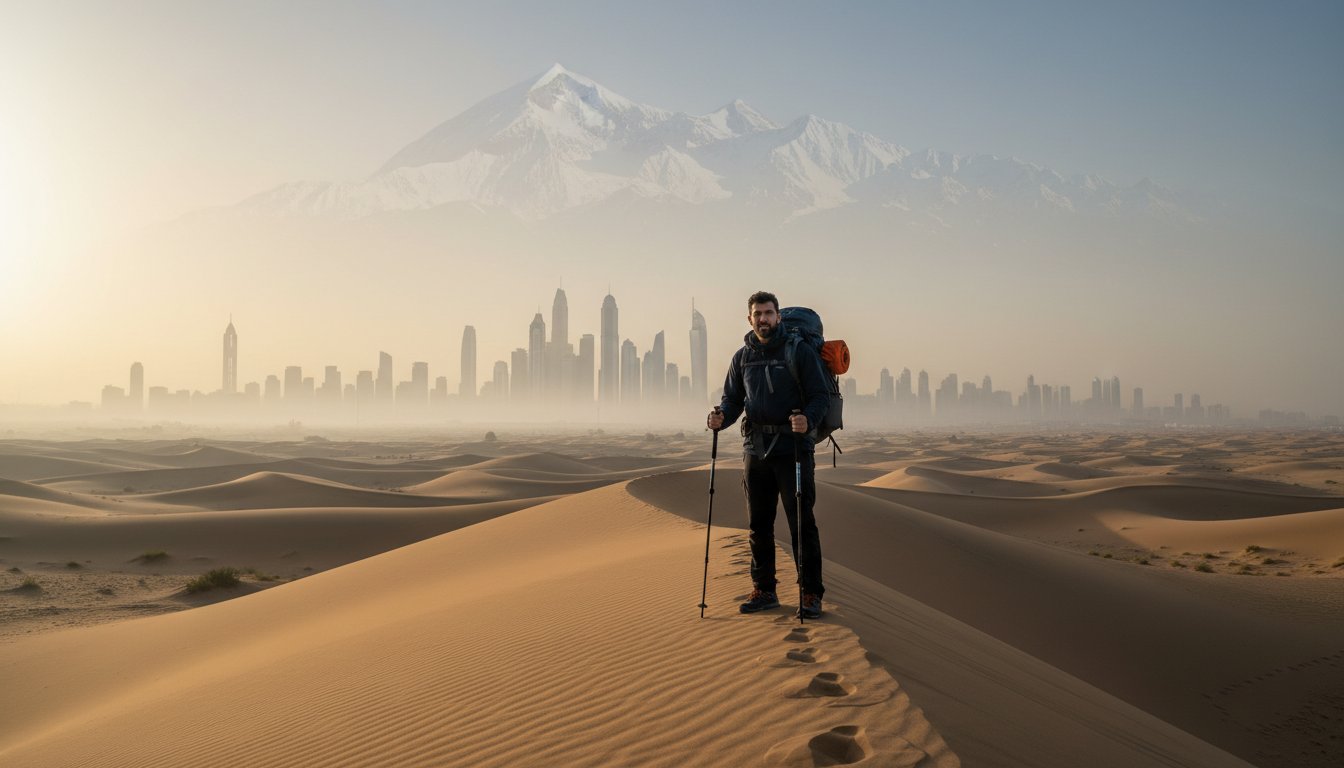
You don’t need a single mountain in your backyard to successfully stand at 5,364m (17,598ft) above sea level. Living in the GCC, it’s easy to feel like the odds are stacked against you when you’re staring at a flat horizon while planning a journey to the Himalayas. I’ve spent years helping adventurers from Dubai and Riyadh prepare for high-altitude peaks, and I know that the lack of vertical gain at home is often the biggest mental hurdle. If you’re worried that training for everest base camp trek in a desert climate won’t prepare you for the Khumbu Valley, you’re not alone. Most of my strongest climbers start exactly where you are, wondering if a treadmill and a few flights of stairs will ever be enough.
I’m sharing a realistic, field-tested framework designed specifically for trekkers in the Middle East to conquer the trail with total confidence. This isn’t just theory; it’s the same 12 to 16 week training schedule I’ve used to help hundreds of sea-level residents build the mountain legs required for Nepal. You’ll learn how to hack your local environment, manage the fear of altitude sickness, and arrive at the trailhead feeling physically ready for the challenge of a lifetime. We’ll break down the exact movements and mindset shifts needed to turn the sand and skyscrapers of the Gulf into the ultimate training ground.
Key Takeaways
- Learn how to transform Dubai’s flat urban landscape into a high-altitude training ground using the ‘Desert Mountaineer’ strategy and targeted stair climbing.
- Master the three essential pillars of training for everest base camp trek—aerobic base, functional strength, and endurance—to thrive at altitudes of 5,000m (16,404ft).
- Discover why your trekking boots should never stay in the box until Nepal and how to break them in locally to avoid debilitating blisters on the trail.
- Understand the physical reality of covering 130km over 14 days and the specific exercises needed to protect your knees and back from sustained impact.
- Find out how our community training walks and expert briefings in the UAE bridge the gap between GCC life and the rugged reality of the Khumbu Valley.
Understanding the Physical Demands of the Everest Base Camp Trek
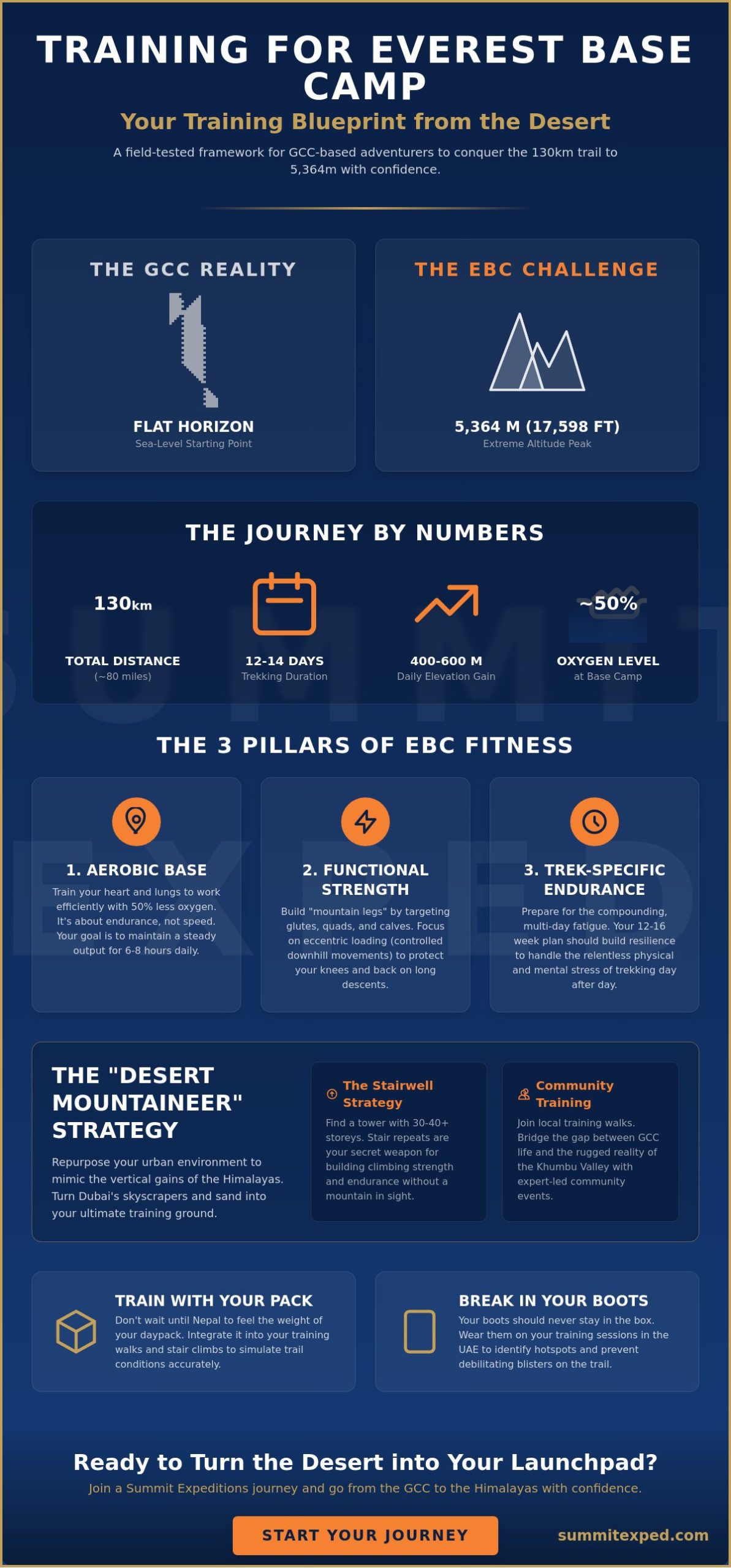
I’ve spent years moving through high-altitude environments, and if there’s one thing I’ve learned, it’s that the Khumbu Valley doesn’t care how fast you can run a 10k on a treadmill in Dubai. The Everest Base Camp trek is a test of endurance rather than speed. It covers approximately 130km (80 miles) over 12 to 14 days, starting from the moment you step off that small plane in Lukla. This is a “trekking peak” experience, meaning it’s accessible but requires a deep reservoir of physical and mental grit.
You’ll be gaining between 400m (1,312ft) and 600m (1,968ft) in elevation almost every day. This isn’t just walking; it’s a constant cycle of ascent and descent over rocky, uneven terrain. Effective training for everest base camp trek success means preparing your body for this relentless, multi-day effort. You aren’t just training for one big day; you’re training for the fatigue that hits on day ten when you’re still 5,000m (16,404ft) above sea level.
To better understand the specific physical requirements, watch this helpful video:
The Reality of Trekking at 5,364m (17,598ft)
At the base camp itself, oxygen levels drop to nearly 50% of what you’re used to at sea level. Your heart and lungs have to work twice as hard just to keep you moving at a snail’s pace. This is why “flat fitness” often fails. You might be a strong runner, but without “mountain legs” developed through incline training, the steep stone steps of the Khumbu will leave you breathless. Your cardiovascular system needs to be efficient at processing limited oxygen, which is a different kind of stamina than sprinting. It’s about maintaining a steady, rhythmic output for six to eight hours a day.
Common Physical Challenges on the Trail
Beyond the thin air, you’ll face the “Khumbu Cough,” a dry, persistent cough caused by the freezing, arid mountain air. It’s a physical strain that can wear you down as much as the walking. Multi-day fatigue also sets in around day six or seven, affecting your balance and making every step feel heavier on your joints. While your fitness gets you up the hill, high altitude acclimatisation is the silent partner that ensures you actually reach the finish line safely. Consistency in your training for everest base camp trek is what builds the resilience needed to handle these compounding pressures. Focus on strength in your glutes and calves to protect your knees during the long descents.
Building a Training Plan in Dubai and the GCC: Overcoming Flat Terrain
Living in the GCC presents a unique challenge for any mountaineer. We have the world’s tallest buildings, yet our natural landscape is famously horizontal. To prepare for the Himalayas, you need to adopt what I call the Desert Mountaineer strategy. This means repurposing our urban infrastructure and air-conditioned gyms to mimic the relentless vertical gains of the Solu-Khumbu region. Success on the trail isn’t about finding a mountain; it’s about building the specific leg strength and aerobic capacity to handle one.
Most trekkers focus solely on the ascent, but the descent is where your knees and joints will feel the most strain. In Nepal, a typical day might involve descending 1,000m (3,280ft) over uneven stone steps. If you’ve only trained on flat ground, your quads will fail you by day three. Your training for everest base camp trek must prioritise eccentric loading to protect your body during those long downhill sections.
The Stairwell Strategy: Your Secret Weapon
Find a residential or office tower in Dubai Marina or Abu Dhabi with at least 30 to 40 storeys. Stair repeats are the single most effective way to build mountain fitness in the desert. Don’t just take the lift down. Walking down the stairs mimics the impact of the trail. Start with three rounds of a 30-storey building and work your way up. By month three, you should be doing these sessions with a weighted pack. Start with 5kg and gradually increase to 12kg to simulate your daily gear and the added physical toll of altitude.
Indoor Training for Outdoor Success
When the humidity in Doha or Riyadh makes outdoor training impossible, the StepMill is your best friend. Focus on Zone 2 aerobic base building by keeping your heart rate between 120 and 140 beats per minute. This builds the endurance needed for six-hour trekking days. To prepare for the rocky Himalayan paths, incorporate Bosu ball lunges and single-leg squats into your routine. These exercises strengthen the stabiliser muscles in your ankles, reducing the risk of a roll on the trail. For more detailed advice on building a resilient mindset alongside your physical prep, you can explore my coaching resources.
Don’t neglect the weekends. Use the 10km hiking trail at Mushrif Park to break in your boots or head to Jebel Hafeet in Al Ain. At 1,249m (4,098ft), it offers the vertical gain necessary to test your lungs. Remember that training in a 21°C gym is very different from trekking at 5,364m (17,598ft). Practise your hydration strategy during these hot weekend sessions, as staying hydrated in the dry mountain air is just as critical as it is in the Gulf summer.
The Three Pillars of EBC Fitness: Cardio, Strength, and Endurance
Preparing for the Himalayas isn’t about being the fastest person in the gym. I’ve seen roughly 30% of otherwise fit athletes struggle at the 5,000m (16,404ft) mark because they focused on the wrong metrics during their preparation. When you’re training for everest base camp trek, you’re building a body that can withstand the relentless, rhythmic grind of the trail. Success depends on three specific pillars: a deep aerobic base, functional strength to protect your joints, and the mental grit to keep moving for 6 to 8 hours daily. My primary advice is to ignore high-intensity interval trends; we want to build a reliable diesel engine rather than a fragile drag racer. Focus on ‘low and slow’ training to ensure your body learns to move efficiently over long distances.
Developing Your Aerobic Engine
Your aerobic base is what allows you to keep breathing when the air thins out in the Khumbu. Most of your sessions should stay in Zone 2, which is roughly 70-80% of your maximum heart rate. At this pace, you should be able to hold a full conversation without gasping for air. If you’re training in the GCC, this might involve long sessions on a stationary bike or swimming laps at the local sports centre to avoid the 40°C heat. For high-altitude trekkers, the aerobic threshold is the highest intensity at which your body can still primarily use oxygen to produce energy, delaying the point where you gasp for breath in thin air.
- Aim for 3 to 4 sessions per week of steady-state activity.
- Incorporate long-distance walking on weekends to build essential time-on-feet.
- Cycling is an excellent way to build leg stamina without the high impact of running.
Strength Training for the Khumbu
The trek to base camp involves thousands of uneven steps on varied terrain. You need functional strength to protect your knees and lower back from the constant impact. We focus on movements that mimic the mountain. Weighted step-ups, goblet squats, and Romanian deadlifts are staples in my programmes. These exercises build the stability needed to carry a 10kg (22lb) daypack for 12 consecutive days without straining your spine. Don’t forget eccentric leg strength, which is the “braking” power required for the long descents. It’s often the difference between a successful finish and ending the trip with painful, inflamed knees.
Your core acts as the bridge between your legs and your pack. Planks and rotational movements help you stay balanced when navigating rocky moraines or crossing high suspension bridges. Remember that training for everest base camp trek is a marathon, not a sprint. Start your preparation at least 16 weeks before your departure date to allow your connective tissues to adapt to these new loads. This lead time ensures you arrive in Nepal feeling empowered and ready for the journey of a lifetime.
Gear Integration and Mental Preparation for the Khumbu Valley
You wouldn’t wear a tuxedo to a desert ultra, so don’t wear gym shoes for your mountain prep. Your boots are your most critical asset. If you’re training for everest base camp trek while living in the UAE or across the GCC, you’re likely hitting the stairs at Mushrif Park or using a treadmill. Do it in your trekking boots. Every single time. Breaking them in now prevents the agony of blisters when you reach Namche Bazaar at 3,440m (11,286ft). Your feet need to become accustomed to the weight, the stiffness, and the specific pressure points of your footwear long before you step off the plane in Lukla.
The 10kg (22lb) Rule
Over a 12-week block, you need to build up to carrying a 10kg (22lb) pack comfortably. Start with 3kg (6.6lb) in week one and add 1kg (2.2lb) every week. This isn’t just about leg strength; it’s about how that weight shifts your centre of gravity on uneven terrain. Since we lack rocky trails in the city, use a balance board while wearing your pack to engage those vital stabiliser muscles. If you can, head to Ski Dubai for a ‘cold room’ session. Testing your layering system in -4°C (24.8°F) helps you identify if your gloves are too thin or if your base layers chafe before you’re at 5,000m (16,404ft).
Mindset: The ‘Pole Pole’ Philosophy
In the Himalayas, speed is your enemy. We use the ‘pole pole’ (slowly, slowly) approach to ensure proper acclimatisation. It can be frustrating for high achievers from the GCC used to a fast-paced life. You need to find a rhythm where your breath matches your steps. Inhale on one step; exhale on the next. It sounds simple, but maintaining this for seven hours a day requires immense discipline. For a deeper look at the psychological shifts required for these heights, I’ve shared my personal experiences on my YouTube channel.
Mental resilience also means simulating ‘bad days’. Don’t wait for perfect conditions to train. If you’re feeling sluggish after a long day at the office or the humidity is peaking, that’s exactly when you should head out. The Khumbu Valley won’t always give you bluebird skies; you’ll face freezing winds, dust, and exhaustion. This mental conditioning is just as vital as the physical training for everest base camp trek because it teaches your brain to keep moving when the oxygen gets thin at 5,364m (17,598ft).
Ready to test your limits with a team that understands the grit required for the Khumbu? Join our next expedition and train with the experts.
Joining a Summit Expeditions Journey: From the Desert to the Himalayas
The transition from the sea-level humidity of the GCC to the thin, crisp air of the Khumbu Valley is a profound shift. I’ve spent years watching adventurers make this leap, and the most successful ones are those who don’t just train their bodies, but also build a community before they ever step foot in Nepal. Our 2026 expeditions are designed to bridge this gap. We don’t just meet you at the airport in Kathmandu; we start the journey with you in the UAE. Through pre-expedition briefings and community training walks on the rocky trails of Jebel Jais and the steep inclines of Jebel Hafeet, we ensure your training for everest base camp trek is grounded in reality.
Preparation isn’t only about physical output. It’s about understanding the logistics and the environment you’re entering. We provide clear, transparent guidance on the Everest Base Camp trek cost, covering everything from permits to the essential gear required for the unpredictable Himalayan weather. This clarity allows you to focus entirely on the experience rather than worrying about hidden expenses or gear failures at 4,000m (13,123ft).
The Value of Expert Leadership
Solo trekking has its place, but the high-altitude environment of the Himalayas demands a level of safety and local insight that only expert leadership can provide. Our team relies on the deep wisdom of our Sherpa partners, many of whom have lived in the Khumbu for generations. This isn’t just about finding the path; it’s about monitoring your oxygen levels, managing your pace, and ensuring ethical standards for our porters. We take pride in our sustainable approach, ensuring that the communities we visit are respected and supported. When you finally stand on the rocky summit of Kala Patthar at 5,545m (18,192ft) to witness the sunrise over the top of Mount Everest, you’ll do so knowing your journey was safe, ethical, and meticulously planned.
Your Next Steps to the Base of the World
Taking the first step toward your 2026 expedition is a commitment to yourself. To begin, secure your spot on one of our scheduled departures and start your medical clearance process early. High-altitude trekking requires a clean bill of health and specialised insurance that covers helicopter evacuation up to 6,000m (19,685ft). For those who feel they need a more tailored approach to their physical preparation, you can visit caroline-leon.com for personalised coaching options designed to refine your training for everest base camp trek. Once your flights to Kathmandu are booked, the dream starts to feel very real. We’ll be there to guide you from the dunes to the highest peaks on Earth.
Take Your First Step Toward the Khumbu
Preparing for the Himalayas from the GCC requires getting creative with the landscape you’ve got. Focus on your three pillars: building a solid aerobic base, strengthening your legs for long descents, and training your mind for the thin air above 5000m (16,404ft). I’ve seen many trekkers struggle because they didn’t break in their boots or practice with a 10kg (22lb) pack on Dubai’s stairwells. Real-world training for everest base camp trek isn’t just about fitness; it’s about consistency and understanding how your body reacts to sustained effort over 12 days of trekking.
You don’t have to navigate these logistics alone. Summit Expeditions offers a unique bridge between the Middle East and Nepal. Led by Omani mountaineer Nadhir Al Harthy, our team provides specialised support tailored to adventurers based in this region. We maintain a 98% success rate by combining professional safety protocols with deep local knowledge of the Khumbu Valley. Whether it’s your first time at altitude or you’re looking to push your limits, we’re here to ensure you’re prepared for every step toward the 5364m (17,598ft) mark.
Start your journey to the Khumbu with Summit Expeditions
The mountains are waiting, and with the right preparation, you’ll find they’re more rewarding than you ever imagined.
Frequently Asked Questions
How many months before the trek should I start training?
You should begin your training for everest base camp trek at least 4 to 6 months before your departure date. This window allows for a 12 week progressive build in aerobic capacity and strength without risking burnout or overtraining injuries. If you are starting from a sedentary lifestyle, I recommend adding an extra 8 weeks to establish a baseline of movement before hitting the hills or the gym.
Do I need to do high-altitude simulation training in a gym?
High-altitude simulation isn’t mandatory, but it can provide a 15% to 20% advantage in pre-acclimatisation if used correctly. In Dubai, facilities like altitude chambers allow you to train in oxygen-depleted air. However, focusing on your heart rate zones and building mountain legs through weighted step-ups is far more critical for success than spending hours in a mask. Consistency in your aerobic base is what ultimately gets you to the top.
What is the most common physical reason people fail to reach EBC?
The primary physical reason 15% to 20% of trekkers fail to reach base camp is Acute Mountain Sickness (AMS) caused by ascending too quickly or poor cardiovascular conditioning. While the altitude affects everyone differently, those with a lower aerobic threshold often struggle to recover overnight at 4,000m (13,123ft). This leads to cumulative fatigue, making the final push to 5,364m (17,598ft) physically impossible for their bodies to sustain.
Can I do the Everest Base Camp trek if I have a knee injury?
You can trek with a previous knee injury provided you have completed a 12 week rehabilitation programme and have medical clearance. I’ve led many climbers who manage joint issues by using high-quality trekking poles and focusing on eccentric leg strength during prep. Poles reduce the impact on your knees by up to 25% on steep descents, which is where most injuries flare up in the Himalayas.
How much weight should I be able to carry in my daypack?
You need to be comfortable carrying between 6kg and 8kg (13lbs to 17lbs) in your daypack for up to 7 hours a day. This weight includes your 3 litres of water, rain gear, camera, and snacks. During your training for everest base camp trek, start with a 3kg (6.6lbs) pack and gradually increase the weight by 1kg (2.2lbs) every two weeks until you surpass your expected expedition weight.
Is it better to focus on cardio or strength for the Himalayas?
Cardio should make up about 70% of your programme, but strength training is what protects your joints on the descent. Focus on Zone 2 aerobic training, which is a pace where you can still hold a conversation. Complement this with two sessions a week of functional strength, specifically targeting your glutes, calves, and core. This balance ensures you have the engine to climb and the stability to stay safe.
How do I simulate the cold conditions of Nepal while training in Dubai?
Simulating the cold in the 40°C (104°F) heat of Dubai is difficult, so I suggest using the 22,500 square metre indoor ski slope at Ski Dubai for kit testing. Spend a few hours walking in your full trekking layers to ensure your gear doesn’t chafe and that you understand how to manage your body temperature. It’s also a great way to break in your boots in a cold environment before you reach Lukla.
What should my training look like in the final two weeks before departure?
The final 14 days are for tapering, which means reducing your training volume by 50% in the first week and 80% in the final week. Your focus must shift to mobility, hydration, and sleep. Don’t try to cram in extra miles now. You won’t gain fitness in the last fortnight, but you can certainly arrive at the airport exhausted or injured if you don’t let your body recover fully.