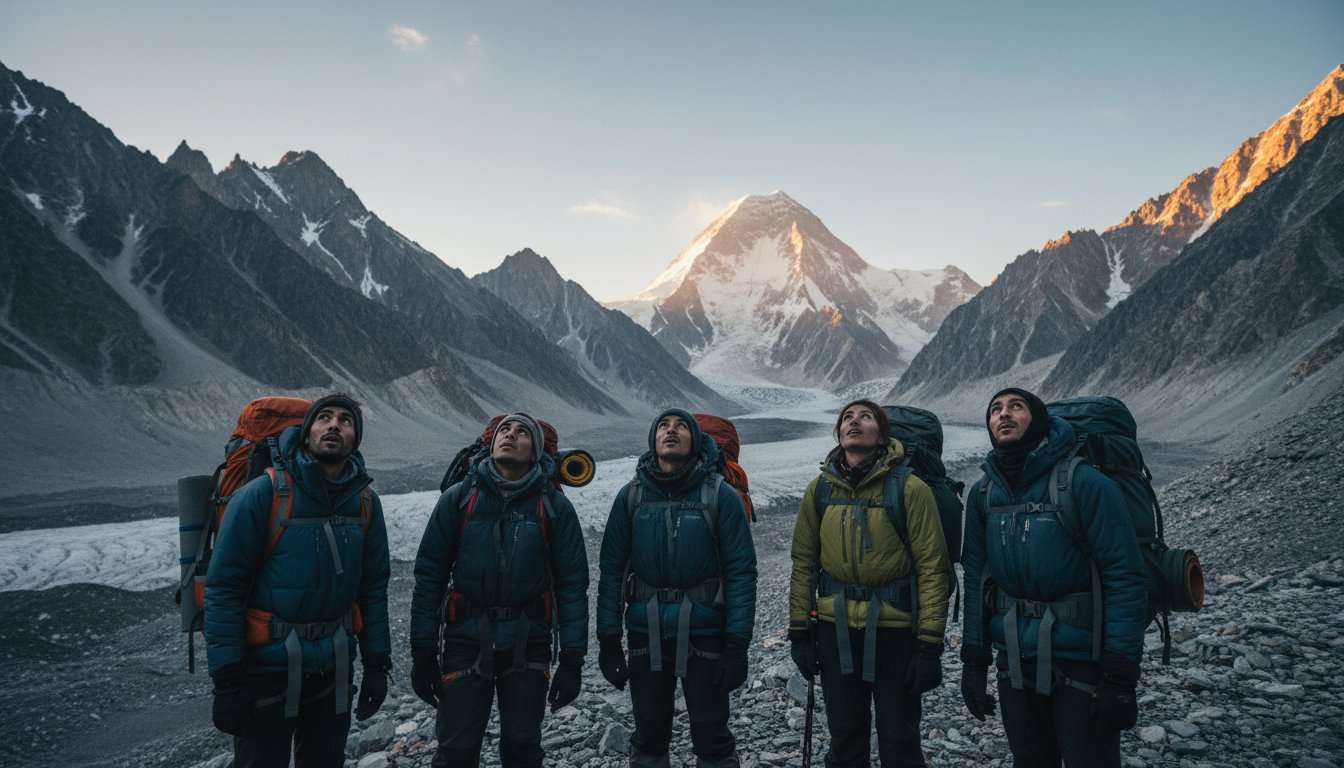
If you want a mountain that still feels like a wilderness rather than a busy thoroughfare, you won’t find it on the crowded trails of Nepal. I know that for many of us living in the Middle East, the dream of a high-altitude expedition often feels at odds with the “tourist” vibe of modern Everest. You want to test your limits on raw, unforgiving terrain where the silence is only broken by the crack of shifting ice. It’s a common frustration to seek adventure only to find a queue, but the Karakoram Range offers a different story entirely.
This guide breaks down exactly why the k2 base camp trek is the superior, untamed alternative for 2026 and how you can realistically prepare for it from the desert. I’ll share how to bridge the gap between training in the dunes of Dubai and trekking across the Baltoro Glacier. We’ll explore everything from navigating flight logistics out of DXB to the specific gear required for reaching Concordia at 4,600m (15,091ft) and standing at the base of the world’s most savage mountain at 5,150m (16,896ft).
Key Takeaways
- Understand why the “Throne Room of the Mountain Gods” offers a more rugged, authentic mountaineer’s experience than the busy, commercialised trails of Everest.
- Learn the tactical realities of navigating the route to Concordia, where you will stand at 4,600m (15,092ft) amidst the world’s most spectacular convergence of high-altitude peaks.
- Discover how to effectively train for the k2 base camp trek while living at sea level in the Middle East by utilising the Hatta mountains and Jebel Jais for endurance blocks.
- Identify the critical gear upgrades required for the Karakoram wilderness, specifically why standard trekking kits often fail during extended nights spent camping on live glaciers.
- Gain insight into the essential safety protocols—from satellite tracking to medical oxygen—that distinguish a professionally led expedition from a basic porter-led tour.
K2 Base Camp Trek vs. Everest: Choosing Your 2026 Himalayan Adventure
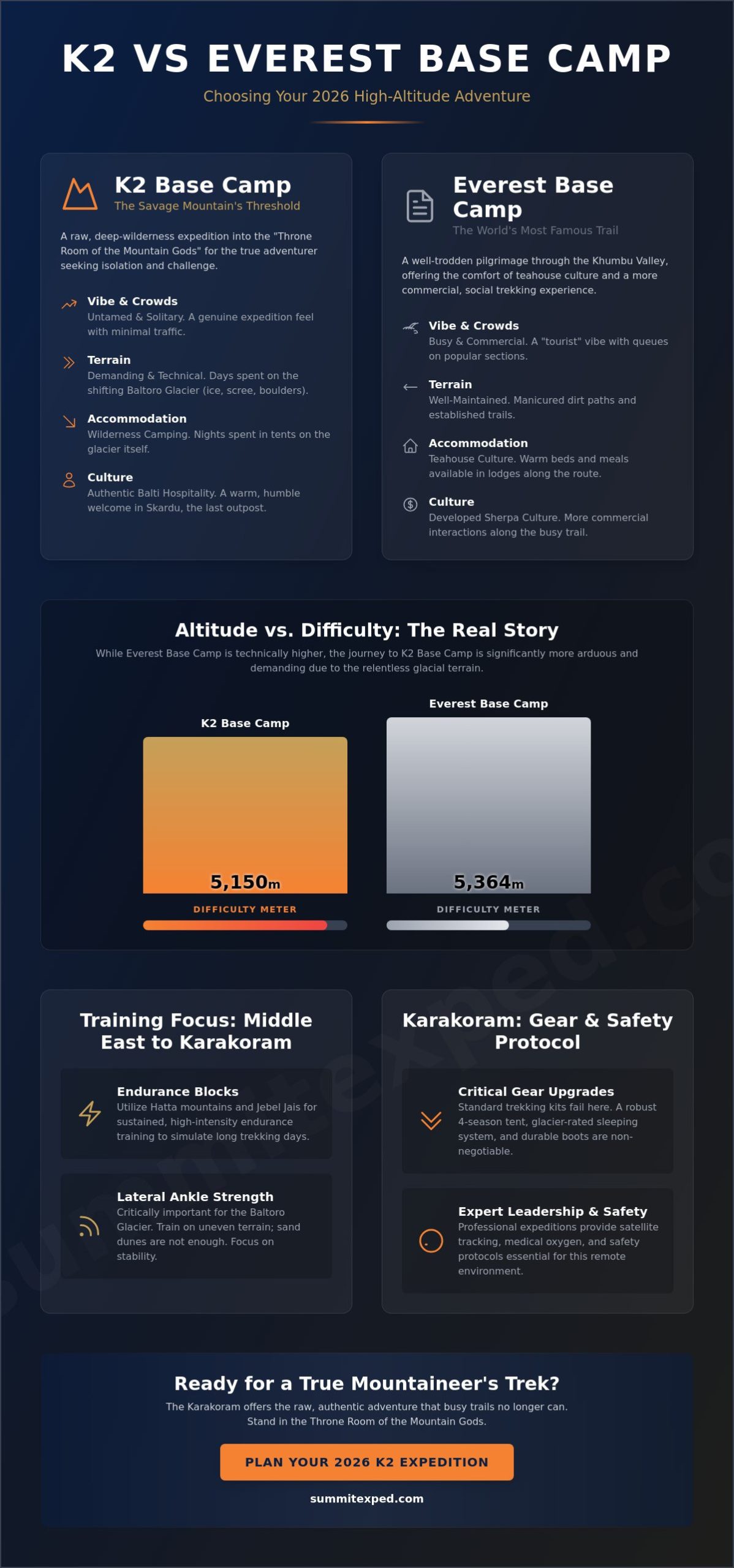
Choosing between Everest and the k2 base camp trek isn’t just about picking a peak; it’s about deciding what kind of experience you want to have in the wild. I’ve spent years leading teams through both the Khumbu Valley in Nepal and the Karakoram in Pakistan, and the psychological shift between them is massive. Everest is a pilgrimage through a well-developed “teahouse culture” where you can find a warm bed and a slice of apple pie at the end of the day. In contrast, K2 is a raw, deep-wilderness expedition. It leads you into the “Throne Room of the Mountain Gods,” a place where the scale of the granite spires makes everything else feel small.
The numbers often surprise people. While Everest Base Camp sits higher at 5364m (17,598ft), the journey to reach K2 Base Camp at 5150m (16,896ft) is significantly more demanding. You’re trading the manicured trails of Nepal for the chaotic, shifting surface of a glacier. You’ll hear people call K2, the Savage Mountain, and that reputation starts long before you reach the foot of the peak itself. It’s a mountaineer’s trek, designed for those who don’t mind the isolation of a tent and the absence of Wi-Fi for two weeks.
The Raw Terrain of the Baltoro Glacier
Walking on the Baltoro Glacier is a lesson in constant focus. Unlike the dirt paths of the Everest region, you’re spending days navigating a moving river of ice covered in loose scree and boulders. This terrain is taxing because every step requires micro-adjustments from your muscles. I always tell my Dubai-based clients that they need to prioritise lateral ankle strength in their training. If you’ve only trained on flat treadmills or the soft sand of the dunes, the Baltoro will find your weaknesses quickly. You’re camping in the wild, sleeping on the ice, and waking up to the sound of the glacier groaning beneath you. It’s an authentic, gritty experience that makes the eventual sight of the k2 base camp trek finish line feel like a massive personal victory.
Cultural Immersion in Baltistan
The journey begins in Skardu, a town that feels like the last outpost of civilisation before the high peaks take over. The hospitality of the Balti people is legendary; it’s a warm, humble welcome that differs from the more commercial Sherpa culture in Nepal. You’ll feel the “expedition feel” immediately as we organise hundreds of kilograms of supplies and meet the porters who make this journey possible. This isn’t just a hike; it’s a logistically complex mission that requires respect for the local environment and its people. Understanding these nuances is a key part of Himalayan Mountaineering, where the success of the trip relies as much on cultural connection as it does on physical fitness.
Navigating the Karakoram: The Reality of the Route to Concordia
The journey begins in Askole, the last outpost of civilisation before you step into a world defined by rock and ice. This isn’t a manicured trail like those found in parts of Nepal. You’ll spend days navigating the lateral moraine and the shifting, debris-covered surface of the Baltoro Glacier. Understanding the geology of the Karakoram Range helps you appreciate why this terrain is so restless. Huge granite towers like the Trango Towers dominate the skyline early on, but the real prize is Concordia. Often called the “Throne Room of the Mountain Gods,” this is where the Baltoro and Godwin-Austen glaciers collide. Standing here, you’re surrounded by four of the world’s 14 peaks over 8000m (26,247ft). It’s a humbling place that makes the k2 base camp trek feel like a true pilgrimage.
Just before reaching base camp, you’ll visit the Gilkey Memorial. It’s a quiet, sobering site marked by metal plates and cairns that catch the light against the grey rock. It honours those who lost their lives on K2. It isn’t meant to scare you, but it serves as a necessary reminder of the respect this environment demands. Safety isn’t just about gear; it’s about a mindset that acknowledges the mountain’s power.
Acclimatisation Strategies for the Karakoram
We use the Swahili phrase “Pole Pole” (slowly, slowly) because the principle is universal for survival at height. In the Karakoram, you’re jumping from roughly 3000m (9,842ft) at the start to over 5000m (16,404ft) at Concordia. Your body needs time to create red blood cells and adapt to the thinning air. Don’t rush the daily stages. Most trekkers fail because they treat the approach like a race. If you’re coming from sea level in Dubai, read my guide on High Altitude Acclimatization to understand the science behind the struggle.
The Gondogoro La Pass: To Cross or Not to Cross?
The Gondogoro La is where the k2 base camp trek transforms from a trek into a genuine technical challenge. At 5650m (18,537ft), the pass requires the use of fixed lines, harnesses, and crampons. It’s an optional exit route, but it’s steep and physically demanding. You’ll likely start your ascent at 1:00 am to avoid rockfall once the sun hits the slopes. The reward is a panoramic view of K2, Broad Peak, and the Gasherbrums that few humans ever witness.
Caroline’s Tip: The weather window in the Karakoram is much tighter than in the Himalayas. High winds can shut down the pass for days. I’ve seen groups wait a week only to be turned back by heavy snow. Always have a backup plan for the return journey via the Baltoro. If you’re unsure about your technical skills, reach out to me for a chat about your preparation.
Tactical Preparation for Dubai and Middle East Adventurers
Preparing for a k2 base camp trek while living at sea level in the Gulf requires a specific, tactical approach to training. You aren’t just preparing for the thin air at 5150m (16,896ft); you’re also managing the physiological shock of moving from 40°C desert heat to sub-zero glacial nights. I’ve found that the best way to bridge this gap is through consistent, weekend-long endurance blocks. Don’t just go for a quick stroll. You need to spend six to eight hours on your feet, carrying a pack that weighs at least 12kg (26lbs), to simulate the relentless nature of the Baltoro Glacier.
The Hatta mountains and Jebel Jais are your primary training grounds. Jebel Jais, sitting at 1,934m (6,345ft), offers the best opportunity for sustained uphill efforts. While it doesn’t provide the oxygen deprivation of the Karakoram, it builds the essential “mountain legs” required for the 14-day expedition. I often advise my clients to focus on the descent as much as the ascent. The rugged, rocky terrain of the UAE’s wadis is a fantastic mimic for the uneven, shifting stones you’ll navigate for days on end in Pakistan.
Simulating Altitude in the Desert
Living in a high-rise city like Dubai or Kuwait City provides a hidden training advantage: stairwells. Climbing 100 floors in a Burj Khalifa-style tower with a weighted vest is one of the most effective ways to build the vertical “engine” needed for the trek. It’s boring, but it works. Additionally, don’t underestimate the power of sand dune hiking in Al Qudra or the Empty Quarter. Hiking on soft sand requires the same micro-stabilisation muscles as walking on loose glacial moraine. If you can maintain a steady pace in the humidity of a coastal summer, your cardiovascular base will be rock-solid by the time you reach Islamabad.
Logistics: From the Gulf to the Glacier
The logistics of a k2 base camp trek are surprisingly streamlined for Middle East residents. Direct flights from Dubai (DXB) or Doha (DOH) to Islamabad take approximately 3.5 hours, making the initial journey far less taxing than for those flying from Europe or the Americas. For most expats and GCC residents, the Pakistan E-visa system is efficient, usually taking 7 to 10 working days to process. Once in Islamabad, the next step is the flight to Skardu. This is often called the most scenic flight in the world, as you pass Nanga Parbat, but it’s notoriously weather-dependent.
You must always have a “Plan B” for the Skardu flight. If the clouds roll in, the flight is cancelled, and you’ll face a 20-hour drive along the Karakoram Highway. It’s a long journey, but the views of the Indus River are a worthy consolation. Managing these local transitions, from the desert heat to the mountain chill, is where Summit Expeditions’ expertise becomes invaluable. We ensure that your transition from the city to the glacier is handled with the precision that only comes from years of leading expeditions in the Karakoram.
Essential Gear: Packing for the Raw Karakoram Wilderness
Many trekkers assume their Everest kit is sufficient for the k2 base camp trek. I’ve seen this mistake often. The reality is that the Karakoram is far more abrasive and unforgiving than the Khumbu. You aren’t walking on well-trodden dirt paths here; you are navigating roughly 65 kilometres (40 miles) of shifting moraine and glacial ice. Your gear needs to survive a 14-day battering against granite and grit. Preparing for the k2 base camp trek requires a shift in mindset regarding your equipment durability.
Footwear is your biggest point of failure. I insist on stiff-soled, B1 or B2 rated boots. Soft trekking shoes might feel comfortable for the first two days, but by day five on the Baltoro Glacier, the constant flexing over uneven rocks will fatigue your arches and bruise your soles. Your feet are your only transport. Don’t compromise on support. Likewise, you must manage the two hidden enemies of Pakistan: dust and sun. The lower valleys are heat traps where fine glacial silt gets into every zipper and camera lens. A simple buff and a wide-brimmed hat aren’t just accessories; they are essential health tools to prevent the infamous ‘Baltoro Cough’ and severe altitude sunburn.
Camping on a glacier is a unique challenge. Standard sleeping mats often fail because the ice literally sucks the heat from your body through conduction. During my 2023 expedition, I saw several trekkers cut their trips short due to exhaustion from cold-induced insomnia. You need an insulated mat with an R-value of at least 4.5 to stay warm when the ground temperature drops well below freezing.
Layering for Temperature Extremes
The Karakoram is a land of contradictions. You will face 35°C (95°F) heat in the dusty valleys near Askole and -15°C (5°F) winds at Concordia. Most people focus on the cold, but the dry air is the real thief. It wicks moisture off your skin instantly, making you feel colder than you are. I always pack high-quality moisture-wicking layers to manage this rapid evaporation. My three non-negotiables are a lightweight merino hoody for sun protection, a 1000-fill power down jacket for the ‘Throne Room’, and a pair of heavy-duty polarized glacier goggles to prevent snow blindness.
Tech and Power in the Wild
Charging electronics at 5000m (16,404ft) is surprisingly effective if you have the right kit. The sun is incredibly intense in Northern Pakistan. A 21W solar charger strapped to your pack usually provides enough juice for a large power bank. For communication, don’t rely on local SIM cards once you hit the ice. SCOM is the local provider in Skardu, but in the deep Karakoram, a satellite device like a Garmin inReach is your only reliable lifeline for safety. You can see my full breakdown of field-tested electronics on my YouTube channel.
Why Expert Leadership Matters: Booking Your 2026 K2 Expedition
Choosing your team for the k2 base camp trek isn’t just about finding the lowest price. It’s about who’s making the calls when the wind picks up at 5000m (16,404ft) and the trail across the glacier vanishes. I’ve seen the difference between local porter-led groups and expert-guided expeditions firsthand. While local porters are the backbone of the Karakoram, they often lack the medical training or technical equipment to manage high-altitude emergencies. Our 2026 expeditions bridge that gap by combining local wisdom with international safety standards.
Risk management in Pakistan is a complex beast. We don’t just carry a basic first aid kit; we bring advanced medical bags, emergency oxygen, and pulse oximeters to monitor your acclimatisation daily. We use satellite tracking systems to keep our base team updated on our exact coordinates at all times. We also believe that the people carrying our gear deserve the same level of care. Our commitment to ethical trekking means every porter receives fair wages, proper mountain gear, and full medical insurance. It’s a standard we’ve maintained since 2018, ensuring our impact on the Balti communities is positive and sustainable.
The Safety Protocol Difference
We prioritise a strict 1:4 guide-to-client ratio on high-risk sections like the Gondogoro La pass. This ensures you’re never left struggling alone on a fixed line. In the remote Karakoram, evacuation is a logistical puzzle involving military helicopters. We handle these realities with pre-arranged permits and clear communication protocols. You can learn more about how we rank these challenges in our guide to the best treks in the world.
Your Journey Starts in Dubai
The trek doesn’t begin in Islamabad. For our Middle East adventurers, it starts months earlier in the UAE. We host pre-trek briefings and community training hikes at Jebel Jais or Wadi Shawka to build your mountain legs. I personally conduct gear checks and fitness assessments to make sure you’re ready for the 14-day journey through the Karakoram. This preparation ensures that when you land in Skardu, you’re confident and capable. If you’re ready to test your limits on the k2 base camp trek, join our next expedition for an experience that will change your perspective on what’s possible.
Take Your First Step Toward the Karakoram
Standing at Concordia, where the glaciers collide at 4600m (15,092ft), isn’t just about reaching a destination. It’s about the discipline of the journey. We’ve explored why the Karakoram demands more than Everest, from the technical rock of the Baltoro to the mental resilience needed for the raw wilderness. You now have the gear list and the tactical training plan tailored for our Middle East climate. Now, it’s about who you trust to lead you. Nadhir Al Harthy and I personally oversee every detail, bringing specialized logistics that bridge the gap between Dubai and the high mountains. Our 100% safety record on high-altitude treks isn’t an accident; it’s the result of meticulous planning and field experience. The k2 base camp trek in 2026 is your chance to step into a landscape few will ever see. Don’t wait for the perfect moment, because the mountains don’t wait for anyone. We’re ready to help you bridge the gap between the desert and the ice.
Book Your 2026 K2 Base Camp Expedition with Summit Expeditions
The peaks are calling, and I’d love to see you out there on the trail.
Frequently Asked Questions
How difficult is the K2 Base Camp trek compared to Everest?
The K2 Base Camp trek is significantly more demanding than the journey to Everest because of the sustained travel over the shifting Baltoro Glacier. While Everest features well-trodden trails and tea houses, K2 requires 14 days of camping on ice and rock. You’ll navigate 65km (40 miles) of glacial moraine where the path changes daily. Expect to walk 6 to 8 hours most days, often at altitudes exceeding 4000m (13,123ft).
What is the best time of year to trek to K2 Base Camp in 2026?
The prime window for your 2026 expedition falls between late June and mid-August when the snow has cleared from the high passes. During these 60 days, the weather remains stable enough to traverse the 5585m (18,323ft) Gondogoro La safely. Outside this period, winter conditions or heavy monsoon rains make the Baltoro Glacier impassable for most trekking groups. I’ve found that July offers the most consistent visibility of the Karakoram giants.
Is it safe for women to trek to K2 Base Camp?
Pakistan is remarkably welcoming for solo female trekkers and all-women groups, provided you respect local customs in the villages of Baltistan. In 2024, female participation in Karakoram expeditions rose by 15 percent, reflecting the growing confidence in local security protocols. Always travel with a licensed guide and wear modest clothing that covers your shoulders and knees. This simple cultural alignment ensures your journey remains focused on the mountains rather than unwanted attention.
Do I need technical mountaineering skills for the K2 trek?
You don’t need technical mountaineering skills or rope work for the standard k2 base camp trek, but you must be a confident hiker. The terrain involves scrambling over loose scree and navigating uneven glacial ice for over 100km (62 miles). If your itinerary includes the Gondogoro La at 5585m (18,323ft), you’ll need basic training in using crampons and a trekking pole. Most of the challenge is physical endurance rather than technical climbing.
How much does the K2 Base Camp trek cost for Middle East residents?
Budget between 4,000 and 6,000 USD for a high-quality, fully supported expedition starting from Islamabad. This figure, based on 2024 industry averages, covers your domestic flights, permits, and a team of porters to carry your 15kg (33lb) kit bag. Residents in Dubai or Doha should factor in an additional 500 to 800 USD for return flights to Pakistan. Remember that choosing the cheapest option often compromises safety standards and porter welfare.
What happens if I get altitude sickness on the Baltoro Glacier?
Immediate descent is the only cure if you develop symptoms of Acute Mountain Sickness (AMS) while trekking on the Baltoro Glacier. Our protocol involves dropping at least 500m (1,640ft) in elevation as soon as persistent headaches or nausea occur. Because the glacier is remote, we carry portable oxygen and satellite phones for emergency evacuations. In 2023, roughly 5 percent of trekkers required assisted descent, highlighting why we maintain a strict “climb high, sleep low” schedule.
Can I see K2 from the base camp, or do I need to go further?
Unlike Everest, where the summit is hidden from base camp, K2 looms directly over you at 8611m (28,251ft) from its namesake camp. The most iconic 360-degree view actually occurs at Concordia, located about 10km (6 miles) before you reach base camp. Here, you’re surrounded by four of the world’s 14 peaks above 8000m (26,247ft). Most trekkers spend two nights at Concordia to soak in this unique geological amphitheatre.
Is a visa required for Pakistan if I am living in Dubai or Qatar?
Residents of Dubai or Qatar must apply for a Trekking Visa through the Pakistan Online Visa System at least 4 to 6 weeks before departure. This process requires a Letter of Invitation (LOI) from a licensed Pakistani tour operator. As of 2024, citizens from 126 countries can access a simplified “Visa in Your Inbox” system for a fee of approximately 60 USD. Ensure your passport has at least 6 months of validity remaining from your date of entry.