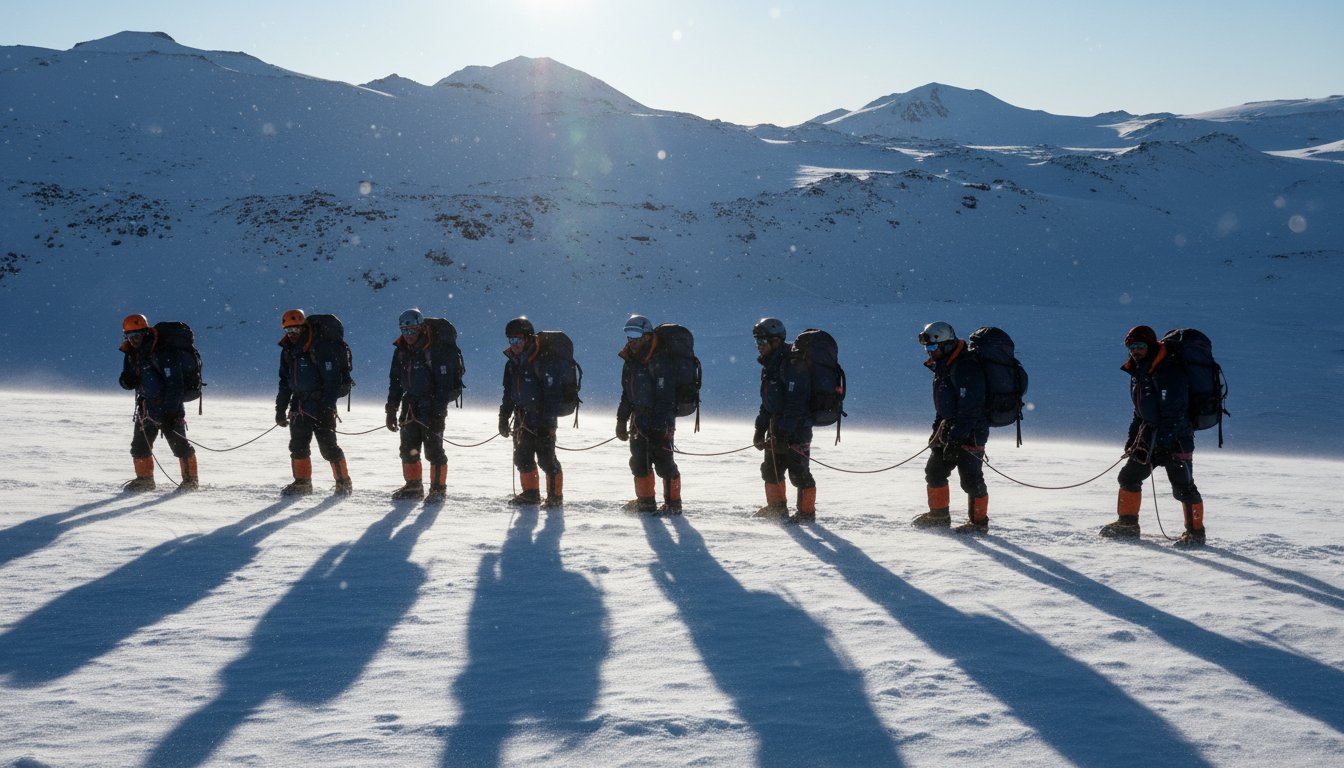
In August 2024, a climber named Sarah discovered exactly what it feels like to transition from 45°C (113°F) desert heat to a -20°C (-4°F) summit push in just three days. You likely feel a sense of uncertainty about whether training on sand dunes or the Hatta hills can truly prepare you for a 5642m (18,510ft) peak, and you’re right to be cautious about the safety and logistics of the Caucasus in 2026. It’s a common concern for those of us living in the GCC, where the closest we get to a glacier is often the local indoor ski slope. This guide provides everything you need to know about Mt Elbrus so you can manage that same intense shift with the professional ease of a seasoned mountaineer.
I’ll share a clear roadmap for your expedition, covering everything from tailored Middle East training protocols and essential gear to the technical nuances of the North and South routes and the subtle skills needed for a successful traverse.
Key Takeaways
- Discover why Mt Elbrus is the crown jewel of the Seven Summits and learn the critical differences between the West summit at 5,642m (18,510ft) and the East peak.
- Compare the logistical ease of the South Route against the raw wilderness of the North to decide which path suits your experience level and appetite for adventure.
- This guide provides everything you need to know about Mt Elbrus training, including how to adapt your fitness regime in the GCC heat using weighted carries and stair-climbing discipline.
- Navigate the specific 2026 visa requirements for UAE and GCC residents while ensuring your kit bag is meticulously packed with essential high-altitude gear.
- Understand why a “Pole Pole” or slow and steady approach is vital for acclimatisation and how our local Middle East expertise ensures you are supported every step of the way.
What is Mt Elbrus? Understanding the Roof of Europe
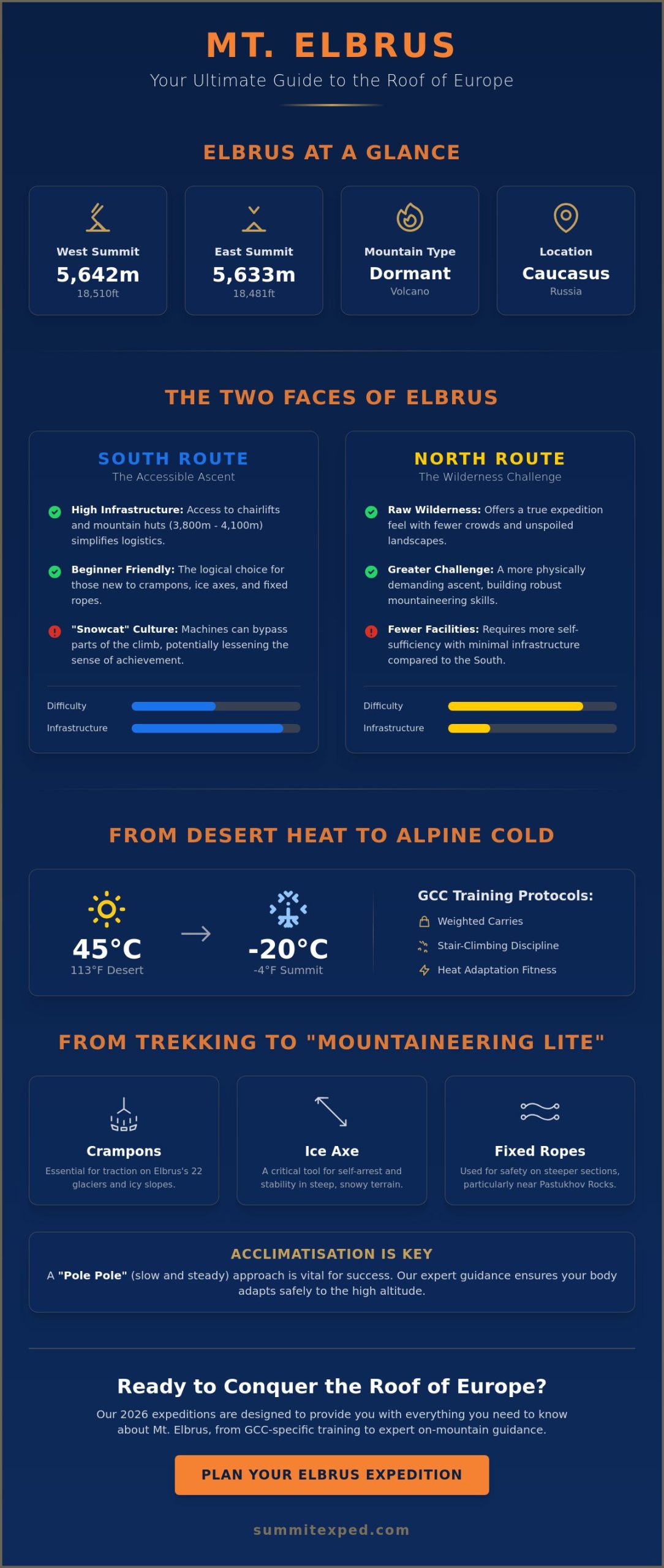
Mt Elbrus isn’t just another peak to tick off a list; it is a massive, dormant volcano that dominates the horizon of the Caucasus Mountains. When people ask me for everything you need to know about Mt Elbrus, I always start with its twin summits. The West Summit stands at 5,642m (18,510ft), while the East Summit reaches 5,633m (18,481ft). Because it sits higher than any other peak on the continent, it holds the title of the highest point in Europe and remains a coveted member of the Seven Summits.
The geography here is fascinating because the Caucasus range straddles the border between Europe and Asia. This creates a unique cultural and physical landscape that feels significantly more “wild” than the well trodden paths of Kilimanjaro. While many consider it a walk up, the weather and the terrain demand respect. You can find more detailed geographical data on Mount Elbrus to understand its scale, but nothing compares to seeing that double headed peak for the first time from the Baksan Valley.
To better understand the reality of climbing this peak, watch this helpful video:
The Geology of a Sleeping Giant
Elbrus is a volcano that last erupted around 50 AD, but it hasn’t lost its fire entirely. The mountain is cloaked in 22 separate glaciers that flow over ancient lava flows, creating a rugged and icy terrain. One of the most visceral experiences of the climb happens near the saddle, the low point between the two summits. You’ll often notice a distinct sulphur smell. It is a pungent reminder that you’re standing on a sleeping giant. This volcanic heat can also create unstable snow conditions, making professional guidance essential for navigating the crevasses safely.
Why GCC Climbers Choose Elbrus as Their Second Summit
For the adventure community in Dubai and Doha, Elbrus is the logical next step after Kilimanjaro. It represents a mental shift from trekking to “mountaineering lite.” You aren’t just walking anymore; you’re learning to use crampons, ice axes, and fixed ropes. It provides a manageable introduction to technical gear without the extreme commitment of an 8,000m peak.
The logistics also make sense for those living in the GCC. With direct flights from major hubs like Dubai to the Mineralnye Vody region, you can be at the base of the mountain in less than half a day’s travel. It’s a world away from the desert heat, offering a transformative experience that tests your grit. If you’re curious about the specific skills I teach my teams before we head out, you can find my training tips over at caroline-leon.com. Providing everything you need to know about Mt Elbrus means being honest about the cold, the wind, and the sheer joy of standing on the roof of Europe.
The Two Faces of Elbrus: South vs North Routes
Choosing your path on the highest peak of the Caucasus mountains depends entirely on what kind of suffering you enjoy. I’ve spent years guiding on these slopes, and I can tell you that while Elbrus is often called a “walk up,” it’s a massive physical undertaking where the weather acts as the ultimate gatekeeper. Everything you need to know about Mt Elbrus starts with understanding the two distinct personalities of its primary routes.
The South Route: Chairlifts and Huts
The South is the most popular choice for a reason. You have access to the Barrels or the more modern Heart of Elbrus huts, which sit between 3800m (12,467ft) and 4100m (13,451ft). It’s the logical pick if you’re still getting comfortable with crampon work or moving on fixed ropes. In 2026, we’ve seen a shift toward higher safety standards, with mountain rescue teams strictly monitoring the fixed lines near the Pastukhov Rocks at 4700m (15,420ft). However, the ‘Snowcat’ culture is a real point of contention here. While many operators offer machines to bypass the first few hours of the summit push, I always advocate for walking every metre. True satisfaction comes from the effort, not the lift. If you’re looking to build a solid foundation, my high-altitude prep guides cover the specific footwork you’ll need for this terrain.
The North Route: The Purist’s Choice
If you want to feel the weight of history, the North is your route. You’ll follow the exact line taken by Kilar Khashirov during the first ascent in July 1829. There are no chairlifts or snowcats here. You carry your own gear from base camp to high camp, which requires roughly 20% more physical endurance than the South. It’s a raw, wilderness experience where the silence is only broken by the crunch of your boots on the glacier. The physical demands are higher because you’re starting from a lower elevation and managing your own logistics. This route doesn’t just test your legs; it tests your ability to thrive in a true expedition environment without the safety net of modern infrastructure.
The real secret of Elbrus isn’t the climb up; it’s the traverse between the East and West summits. Most climbers lose their nerve at the ‘Saddle’ at 5416m (17,769ft). The wind often whips through this gap at speeds exceeding 60km/h, creating a wind chill that can freeze exposed skin in minutes. If you haven’t trained your mental resilience as much as your quads, this is where the mountain wins. Everything you need to know about Mt Elbrus involves respecting that final 200m (656ft) stretch of exposed terrain. In 2026, we are seeing more climbers attempt the full traverse, but only those with a 12 week solid training block behind them tend to succeed.
Training in the Desert: Preparing for the Caucasus in the GCC
There is a distinct irony in sweating through a 40°C Dubai afternoon while preparing for the -20°C winds of the Caucasus. It feels counter-intuitive to train for ice in a desert, but the heat is actually a powerful tool for building cardiovascular resilience. To succeed, you need a 6-month roadmap focused on weighted carries and strict stair-climbing discipline. This guide provides everything you need to know about Mt Elbrus training from a sea-level, high-heat environment.
One subtle insight I often share with my teams is the importance of training your thermal regulation. In the GCC, we are used to sweating freely to cool down. On the mountain, sweat is a liability. If your base layers become damp during the ascent, that moisture will freeze the moment you stop moving at 5,000m (16,404ft). You must practice layering during your local hikes to ensure you stay dry and warm. For more on managing your body at height, see our guide on High Altitude Acclimatization: A Guide for Dubai & Middle East Adventurers.
Physical Conditioning in Dubai and Abu Dhabi
You don’t need a mountain range to build mountain legs. The stairs in JLT clusters or the sandy inclines of Mushrif Park offer excellent vertical gain. I spent months carrying a 20kg pack up and down these urban inclines to build the necessary slow-twitch muscle fibres. On weekends, head to Jebel Jais in Ras Al Khaimah or the trails in Hatta. The loose scree and rocky terrain there are perfect for practicing technical footwork on surfaces that shift under your boots. I also suggest booking a VO2 max test at a clinic in Doha or Dubai. Knowing your peak oxygen consumption helps us tailor your heart rate zones for the long summit push.
The Mental Game: Visualisation and Grit
The physical climb is only half the battle. When a whiteout hits and visibility drops to zero, your heart rate will spike. You have to train your mind to stay calm in these moments through visualisation. My personal tip is simple: your “why” must be stronger than the cold. If you are climbing for an Instagram post, you will likely turn back when the wind reaches 50km/h. You must accept that a summit is never guaranteed. Even with perfect fitness, the mountain always has the final word. This mindset shift is a core part of everything you need to know about Mt Elbrus before you head to the airport.
Logistics and Gear: The 2026 Expedition Checklist
Getting to the base of the Caucasus is often the first mountain you have to climb. In 2026, the logistics of reaching Russia from the Gulf require more than just a plane ticket; they demand meticulous planning. Everything you need to know about Mt Elbrus starts with the paperwork. For UAE and GCC residents, the Russian e-visa system remains the most efficient route, typically taking four to six days to process. However, expats must ensure their residency visas have at least six months of validity remaining. Don’t leave this until the final week. I’ve seen climbers stuck at DXB because of a simple typo on their invitation letter.
Flying from the Gulf to Mineralnye Vody
Direct flights from Dubai (DXB) to Mineralnye Vody (MRV) via carriers like flydubai have made the journey significantly easier for 2026 expeditions. If you are flying from Doha (DOH), you will likely connect through Istanbul or Moscow. Once you land at MRV, it’s a three to four-hour drive to the Baksan Valley. This journey takes you through the heart of Balkar culture. You will notice the landscape shift from flat plains to the jagged, vertical world of the mountains. At Summit Expeditions, we monitor local conditions daily to ensure our transport routes remain secure and efficient for every team.
Technical Gear for the Elbrus Summit
The gear you pack determines your success on the 5642m (18,510ft) peak. I enforce a strict double boot rule for my teams. Even in mid-summer, the temperatures on the summit plateau can drop to -20°C. Single mountaineering boots simply don’t offer enough insulation; the Caucasus will take its toll on your toes if you skimp on footwear. You need a 4-season boot with a removable liner to ensure your feet stay dry and warm during the long summit push.
Layering is another area where Dubai-based adventurers often struggle. It’s easy to fall into the Dubai sweat trap by over-dressing at the start of the climb. You begin sweating in the lower sections, and that moisture freezes as you gain altitude. Use a high-quality moisture-wicking base layer followed by a breathable mid-layer. Your high-altitude down jacket should only come out of the pack when you stop or hit the higher, wind-exposed ridges. For more on how this peak fits into a larger goal, check out my guide on Climbing the Seven Summits: The Ultimate Guide for Adventurers in Dubai and the Middle East.
My top leader’s lesson? Never underestimate the power of a simple buff. It protects your lungs from the dry, freezing air and prevents the “high-altitude cough” that ruins many expeditions. When you’re providing everything you need to know about Mt Elbrus, I always tell my climbers that small, cheap items often save the day. You’ll also need C2 rated crampons, a walking ice axe, and a climbing harness for the fixed rope sections near the summit saddle.
Summiting with Summit Expeditions: The Caroline Leon Experience
Living in the GCC provides a unique set of challenges for mountaineers. We train in 40-degree heat and then expect our bodies to perform in sub-zero temperatures. I’ve designed our Elbrus expeditions specifically to bridge this gap. Our Middle East roots mean we understand the transition from the desert to the snow better than anyone else. This isn’t just about providing a guide; it’s about a shared journey from the flat sands of Dubai to the highest point in Europe. Everything you need to know about Mt Elbrus starts with choosing a partner who understands your specific training environment and physiological needs.
We’ve adapted the ‘Pole Pole’ philosophy from our Tanzanian roots for the Caucasus. This slow and steady approach is vital for success on the long, glaciated slopes of Elbrus. By maintaining a rhythmic, manageable pace, we ensure your heart rate stays stable, which is the most effective way to prevent altitude sickness. We don’t rush the mountain. We respect it. This method has consistently proven to be the difference between a mid-climb retreat and a successful summit photo.
Safety and Success Rates
Safety isn’t a buzzword for us; it’s the foundation of every decision we make. We maintain a strict 1:3 guide-to-client ratio. This ensures that at 5,000m (16,404ft), you have eyes on you at all times. If you’re struggling with your crampon technique or your breathing, a guide is right there to assist. We integrate expert local Balkar guides with our international leadership to provide a blend of deep local knowledge and Western safety standards. Our protocols include carrying medical oxygen on all summit attempts and having pre-established emergency descent plans for every stage of the climb. We leave nothing to chance.
Next Steps for Your Adventure
If you’re ready to move beyond the hiking trails of the UAE and step into the world of high-altitude mountaineering, our 2026 roster is now open. This is your chance to transform from a trekker into a mountaineer under expert guidance. You can get a better sense of what the climb actually looks like by visiting Caroline’s YouTube channel, where I share raw footage from our previous ascents. If you’re looking to build your skills even further, check out our guide on Himalayan Mountaineering: A Guide for Explorers in Dubai & the Middle East.
The mountain is calling, and the view from the top is a world away from the city skyline. Book a personal consultation with me today to discuss your fitness levels, gear requirements, and how we can get you ready for the summit. Don’t let another year pass just dreaming about the peaks. Let’s make 2026 the year you stand on the roof of Europe. Everything you need to know about Mt Elbrus is that it’s achievable with the right team behind you.
Your Path to the Roof of Europe
Standing at 5642m (18,510ft) isn’t just about the physical climb. It’s about the six months of preparation you put in while the GCC summer hits 45 degrees Celsius. We’ve covered the technical differences between the South and North routes and how to adapt your desert training for the Caucasus snow. This guide provides everything you need to know about Mt Elbrus, but the real work starts when you commit to the journey. My 2026 expeditions are built on verified safety protocols and my personal experience as a world-record holder to ensure you’re fully supported.
We focus on specialised training plans that turn the sand dunes of the UAE into the perfect conditioning ground for the Russian slopes. Don’t leave your success to chance. I’ve spent 15 years refining these paths so you can focus on the breathtaking view from the summit. It’s a challenging road, but you won’t walk it alone. Whether you’re a first-time climber or a seasoned trekker, the right preparation makes all the difference.
Begin your Elbrus journey with a personal consultation from Caroline Leon
The mountain is waiting. I look forward to seeing you at the top.
Frequently Asked Questions
Is Mt Elbrus dangerous for beginners?
Yes, Mt Elbrus presents serious risks including extreme wind and sudden whiteouts that can disorient even the fittest climbers. While it’s technically straightforward, 80% of mountain accidents occur due to rapid weather shifts or poor navigation. I always tell my teams that the mountain doesn’t care about your fitness if you aren’t prepared for temperatures that can drop to -20°C without warning. Proper guidance is essential for safety.
Do I need a visa to climb Mt Elbrus if I live in Dubai?
Most UAE residents and GCC nationals require a Russian visa to enter the country for an expedition. Since 2023, many nationalities can apply for an e-visa, which usually takes 4 days to process. Check your specific passport requirements at least 6 weeks before departure. I’ve found that sorting your paperwork early saves massive amounts of stress when you should be focusing on your physical training and mental preparation.
What is the best month to climb Mt Elbrus in 2026?
July and August are the optimal months for a successful summit in 2026 because the weather is traditionally more stable. During this window, you’ll find the most reliable snow conditions and longer daylight hours. If you want to avoid the peak crowds of mid-summer, late June offers a quieter experience. Just be aware that the weather is slightly more unpredictable during the early shoulder season on the mountain.
How hard is Mt Elbrus compared to Mt Kilimanjaro?
Elbrus is significantly more demanding than Kilimanjaro because it requires crampons, ice axes, and navigating glaciated terrain. While Kilimanjaro is a high-altitude trek, Elbrus is a true mountaineering expedition. You’ll face steeper gradients and much colder conditions, making it a natural progression for those who have already reached 5,895m (19,341ft) in Tanzania. It’s a step up in both technical skill and environmental intensity.
Can I climb Mt Elbrus without previous mountaineering experience?
You can climb Elbrus without prior technical skills, provided you have a high level of physical fitness and a willingness to learn. This guide covers everything you need to know about Mt Elbrus, including the basic crampon and ice axe techniques we teach on the lower slopes. I’ve seen many fit hikers succeed; however, you must be comfortable with cold, steep environments and follow your guide’s instructions closely.
How much does a Mt Elbrus expedition cost from the Middle East?
Expedition costs vary based on the route and level of support, but you should budget for flights from hubs like Dubai or Doha. According to 2024 industry data, standard guided packages typically range from 1,500 to 3,000 USD, excluding international airfare. Always factor in an extra 500 USD for gear rentals and personal expenses. Getting your gear right is a vital investment in your safety and overall comfort.
What happens if the weather turns bad on summit night?
We turn back immediately if the wind speeds exceed 40 kilometres per hour or visibility drops below 50 metres (164ft). Safety is my absolute priority, and we always build spare summit days into our 9 day itineraries. Pushing through a storm at 5,000m (16,404ft) is never worth the risk. The mountain will always be there tomorrow, and coming home safely is the only true definition of a successful climb.
Is there mobile reception on Mt Elbrus?
You’ll find surprisingly good 4G signal at the base camps and even up to the Barrels Hut at 3,700m (12,139ft). Coverage becomes spotty as you push higher toward the Pastukhov Rocks at 4,700m (15,420ft). I recommend getting a local SIM card at the airport so you can share your progress with family back in the GCC. It’s a great way to stay connected before you enter the higher wilderness zones.