What if the mountain you’re training for isn’t actually the one that holds the record? If you’ve spent any time researching your next big objective, you’ve probably hit the confusing wall of data regarding Asia’s Highest Volcano. It’s a common frustration for climbers in our community. We want to know exactly what we’re signing up for before we commit our leave days and gear budget. Whether you’re based in Dubai or Riyadh, the logistics of reaching 5,610m (18,406ft) can feel like a mountain of their own.
I understand the hesitation. Dealing with the travel logistics to Iran while ensuring your safety standards aren’t compromised by a budget operator is a valid concern. This article provides the definitive answer to the Damavand versus Kunlun debate and gives you a clear framework for selecting an expedition team that prioritises your life as much as the summit. I’ll share the specific training tweaks I used to prepare for the thin air and sulphur vents of the Alborz Mountains while living at sea level in the desert. We’re going to break down everything from visa requirements for GCC residents to the subtle gear adjustments needed for Damavand’s unique volcanic terrain.
Key Takeaways
- Understand the geographic significance of Mount Damavand at 5609m (18,402ft) and why it is officially recognised as Asia’s Highest Volcano.
- Learn how to simulate high-altitude conditions while training in the GCC, ensuring your body is ready for the thin air before you leave the desert.
- Discover the critical differences between local and international guide structures to help you prioritise safety and professional logistics on the mountain.
- Master a strategic approach to acclimatisation on the Alborz slopes to turn a gruelling physical challenge into a successful and sustainable summit.
- Explore the value of pre-expedition team building in Dubai to establish the trust and technical skills required for the Iranian wilderness.
Mount Damavand: Identifying Asia’s Highest Volcano
When I first saw the silhouette of Mount Damavand, I was struck by its incredible symmetry. It rises sharply from the Alborz Range in Iran, just south of the Caspian Sea, reaching a massive 5609m (18,402ft). This isn’t just another peak; it’s officially recognized as Asia’s Highest Volcano and the highest point in the entire Middle East. To my eyes, it looked like a more rugged, untamed version of Japan’s Mount Fuji, standing as a solitary sentinel over the landscape.
The comparison often reminds climbers of other bucket-list destinations. For those whose adventures also take them to Japan, resources like jasumo.com offer detailed guides for exploring the country beyond its mountains.
To see how this giant compares to other massive peaks around the globe, watch this short video:
Damavand vs. Kunlun: Settling the Height Controversy
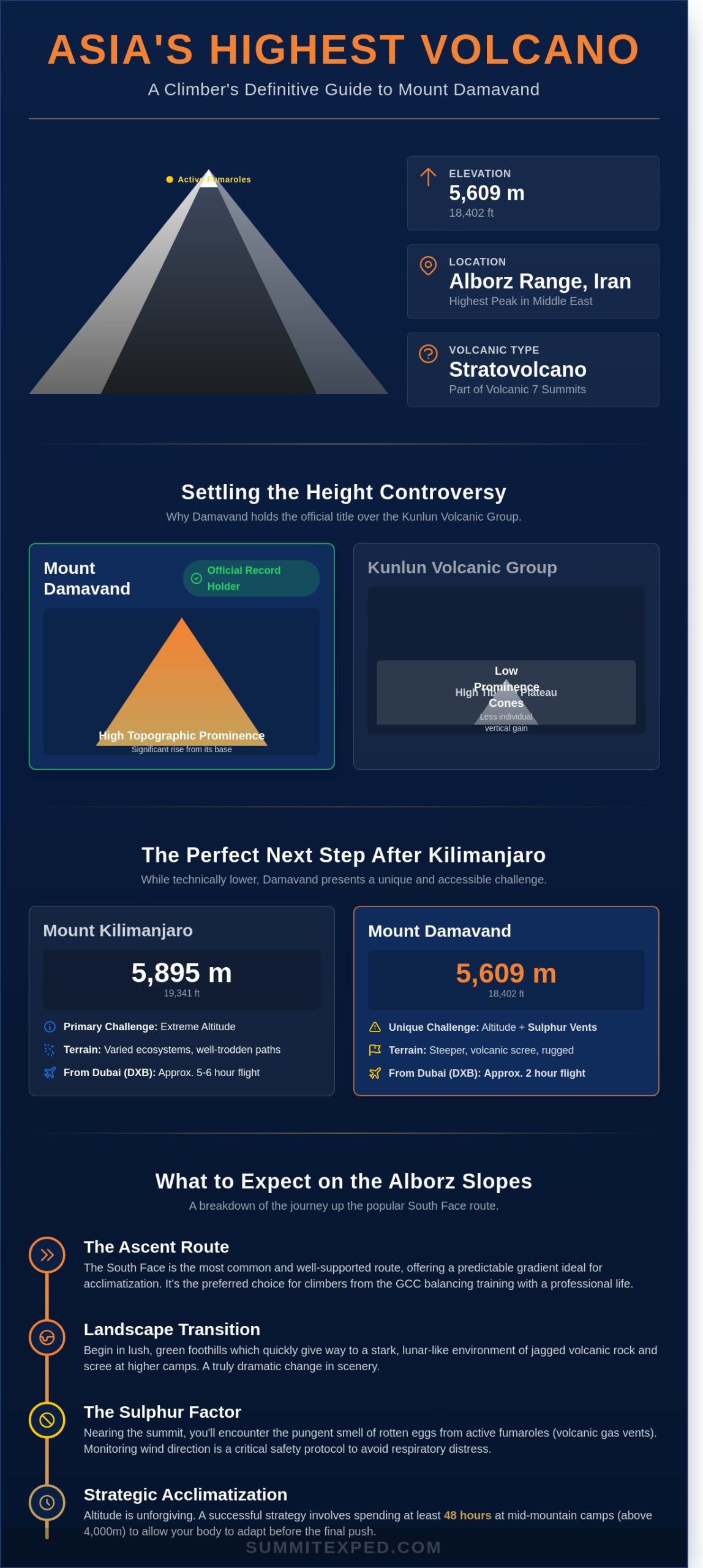
You might encounter older sources or forum threads citing the Kunlun Volcanic Group in Tibet as the highest. This confusion mostly stems from a 2008 claim by researcher John Seach. While the Kunlun group sits on a very high plateau, its individual volcanic cones don’t match the singular topographic prominence of Damavand. The scientific consensus is clear. Damavand remains the official representative for the Volcanic Seven Summits in Asia. It’s a massive stratovolcano that demands respect for its actual vertical gain, not just the elevation of the ground it sits on.
Why Damavand is the Perfect Next Step After Kilimanjaro
Many climbers I work with at Caroline Leon expeditions have already stood on the roof of Africa. Kilimanjaro sits at 5895m (19,341ft), which is technically higher than Damavand’s 5609m (18,402ft). However, Damavand offers a unique challenge: the sulphur factor. As you approach the summit, you’ll encounter active volcanic vents releasing pungent gases. It’s a sensory experience that Kili simply doesn’t provide. For those of us living in Dubai or across the GCC, the proximity is a game changer. You can swap the long haul to Tanzania for a short flight to Tehran, making it a highly accessible high-altitude objective.
- Total Elevation: 5609m (18,402ft).
- Location: Mazandaran Province, Iran.
- Difficulty: Non-technical but physically demanding due to scree and gas.
- Flight time from Dubai: Approximately 2 hours.
I’ve found that the transition from the African plains to the rugged Alborz mountains helps climbers build a more diverse skill set. You learn to manage your breathing through the sulphur and navigate steeper, more volcanic terrain. It’s the ultimate test for your next big mountaineering milestone.
The Damavand Experience: What to Expect on the Alborz Slopes
Mount Damavand offers four primary lines of ascent: the South, West, North, and North-East routes. For most climbers travelling from the UAE or wider GCC, the South face is the preferred choice. It provides the most reliable infrastructure and a more predictable gradient for those balancing a busy professional life with high-altitude ambitions. We never recommend rushing the 5000m (16,404ft) mark. Even though Asia’s Highest Volcano is often labelled a “trekking peak,” the altitude is unforgiving. A solid acclimatisation strategy involves spending at least 48 hours at mid-mountain camps to let your red blood cells catch up with your ambition.
The landscape transition is one of the most striking features of the climb. You begin in the lush, green foothills of the Alborz range, but this quickly gives way to a stark, lunar-like environment. By the time you reach the higher camps, the soil is replaced by jagged volcanic rock and scree. Near the summit, the air changes. You’ll smell the distinct scent of rotten eggs from active vents. Monitoring wind direction is a critical safety protocol; inhaling heavy sulphur fumes at 5600m (18,373ft) can cause immediate respiratory distress. This Damavand volcano profile from Oregon State University provides excellent context on the mountain’s geological activity and its place in local legend.
The South Face: The Standard Route Explained
- Polour Hut to Bargah Sevom: Your journey starts at 2200m (7,218ft) before moving to the base camp at 4200m (13,780ft). The transition is beautiful but physically demanding.
- The Bargah Sevom Refuge: Don’t expect a five-star hotel. It’s a functional stone building that provides essential shelter. It gets crowded during the peak months of July and August, so mental flexibility is as important as physical fitness.
- Summit Day: This is a relentless 1400m (4,593ft) vertical gain. It’s a test of pure grit that usually begins in the dark, cold hours of the early morning.
Technicality vs. Physicality
Damavand is not a technical climb in the summer. You won’t need ropes or harnesses, but the physical endurance required is immense. I’ve seen many fit athletes struggle because they underestimated the cold. Temperatures at the summit can drop to -20°C (-4°F) even in the height of summer. If you’re planning a winter expedition, the mountain transforms into a serious mountaineering challenge requiring crampons and ice axes. Most failures on Asia’s Highest Volcano stem from poor pacing rather than a lack of skill. If you want to see how I prepare my own kit for these conditions, you can find my gear breakdowns at caroline-leon.com.
Local vs. International Mountain Guides: Choosing Your Team
Selecting your team for Asia’s Highest Volcano is the most critical decision you’ll make before leaving Dubai. You’re usually faced with a choice between booking a budget-friendly local Iranian operator or joining an international expedition. Both paths have merits; however, the gap in safety standards can be vast. Your choice dictates your comfort, your cultural experience, and your safety at 5610m (18,406ft).
Pros and Cons of Hiring a Local Iranian Guide
Local guides offer an undeniable depth of knowledge. They know every ridge on the path and provide an authentic window into Persian culture. Booking locally can save you between 40% and 60% compared to international rates, which directly supports the regional economy. The downside is that gear quality and safety protocols vary wildly. I’ve seen local teams operating without basic medical tools like pulse oximeters or emergency oxygen. On a peak exceeding 5000m (16,404ft), these omissions are dangerous. Language barriers and “on-the-fly” logistics can also turn a simple itinerary change into a stressful ordeal for the climber.
The Advantage of an International Guide Company
International teams prioritise standardised safety protocols that many local outfits haven’t adopted yet. When you climb with a professional organisation, you’re paying for Western-standard medical kits, satellite communications, and rigorous evacuation plans. They also handle the bureaucratic maze of Iranian visas and permits. This is a major relief for many GCC-based expats. Beyond logistics, you’re climbing with a cohort of like-minded adventurers from the Dubai or Doha community. This shared background creates a unique bond before you even reach the mountain.
The mountain itself is a place of immense natural and cultural significance. The UNESCO World Heritage Centre highlights its unique flora and thermal springs, marking it as a site of global importance. Protecting this environment while staying safe requires a specific balance that only experienced leaders can provide.
Summit Expeditions uses a “Middle Way” approach. We combine the unmatched terrain knowledge of local Iranian experts with the oversight of international leaders. This ensures you get the cultural immersion of a local trek without compromising on the high-altitude safety standards I insist upon for every expedition. We bridge the gap; we provide the prep sessions in Dubai you need to face Asia’s Highest Volcano with total confidence. We don’t just guide you; we partner with you on the journey.
Preparation from the Desert: Training in Dubai for Damavand
Training for Asia’s Highest Volcano while living at sea level requires more than just grit; it needs a strategy that mimics the thin air you’ll face at 5609m (18,402ft). Dubai offers a unique laboratory for this. While Jebel Jais stands at 1934m (6,345ft), the real work happens in the humidity and the local stairwells. High humidity forces your heart to work harder. This builds a massive cardiovascular engine. When you finally hit the dry, crisp air of Iran, your lungs will feel more efficient than those training in temperate climates.
I’ve spent years moving between the desert and the peaks. The biggest mistake I see is people overestimating their fitness because they can run a 10k on the flat. Mountains are different. You need vertical gain. Using altitude chambers in Dubai gyms for three sessions a week can jumpstart your red blood cell production. It isn’t a silver bullet, but it helps your body handle the physiological stress of the Alborz range before you even land in Tehran.
Don’t ignore the high-rises. Climbing 40 to 60 floors with a 10kg pack builds the specific “mountain legs” needed for the long summit push. It’s repetitive and boring, but it’s the closest you’ll get to the sustained effort of a 1000m (3,280ft) ascent day.
The 12-Week Damavand Training Plan
- Weeks 1-4: Build your base. Spend 4 hours every weekend hiking the trails in Hatta with a light pack. Keep your heart rate in Zone 2 to improve aerobic efficiency.
- Weeks 5-8: Increase the load. Start repeats on Jebel Hafeet. Aim for two full ascents in a single session to simulate the repetitive strain of high-altitude trekking.
- Weeks 9-12: Taper your physical output. Focus on mental resilience. You can learn more about mindset on my YouTube to prepare for the mental “wall” you’ll likely hit at 5000m (16,404ft).
Gear Check: What to Buy in the UAE
Cotton is your enemy on a mountain. It holds sweat, freezes, and leads to rapid heat loss. Invest in high-quality merino wool layers. You’ll need to break in B1 or B2 boots on the rocky terrain of Ras Al Khaimah long before you step foot on Asia’s Highest Volcano. A subtle insight from the field: the UV at 5000m (16,404ft) is roughly 45% stronger than at Kite Beach. Bring a zinc-based sunblock and Category 4 glacier glasses or you risk snow blindness during the final summit approach.
Ready to test your training on the peak? Join our next guided expedition to Damavand.
Summiting with Confidence: The Summit Expeditions Approach
We don’t believe in just “guiding” you to the top of Asia’s Highest Volcano. Our philosophy is rooted in mentorship. I’ve spent years on 8,000-metre peaks and the slopes of Kilimanjaro, and the biggest lesson I’ve learned is that a successful summit depends on the skills you build before you ever leave home. We want you to thrive at altitude, not just survive it. That’s why we focus on teaching you how to move, how to breathe, and how to listen to your body when the air gets thin.
Living in the UAE gives us a unique advantage. You won’t be meeting your team for the first time at a chaotic airport in Tehran. We host pre-expedition meetups in Dubai where you can check your gear, discuss the itinerary, and build rapport with your teammates over a coffee. This local connection removes the “unknown” factor that often causes pre-climb anxiety. We handle the logistical heavy lifting, from securing climbing permits to arranging private transport from the city to the base of the Alborz mountains. You focus on your fitness; we manage the red tape.
Safety Protocols and Lived Expertise
Safety isn’t a buzzword for us; it’s a data-driven process. We conduct daily health checks using O2 saturation monitors and heart rate tracking to identify early signs of Acute Mountain Sickness (AMS) before they become serious. By the time we reach 4,200m (13,780ft), we have a clear picture of how everyone’s body is acclimatising. We advocate for a “Pole Pole” pace. This deliberate, slow rhythm is why we maintain a summit success rate of over 95% on Mount Damavand. It’s about longevity, not speed.
Damavand is more than just a peak to tick off a list. It’s a gateway to high-altitude mountaineering. The lessons you learn here about gear management and pacing will serve you on every future expedition, whether you’re eyeing Aconcagua or the Himalayas. We bring our global experience back to the Alborz to ensure you’re climbing with a team that understands the nuances of 5,000-metre peaks.
Join Our Next Expedition
Climbing Asia’s Highest Volcano is a significant milestone. We have upcoming departures scheduled for July and August, which are the prime windows for stable weather. If you aren’t sure about your current conditioning, our team provides personalised fitness assessments to help you prepare. You can book your Damavand summit climb with our expert team to begin your journey toward the roof of Iran. Let’s get you ready for the mountain.
Take Your First Step Toward the Alborz Summit
Standing at 5,610m (18,406ft), Mount Damavand is a formidable objective that requires more than just grit. It’s a significant physical transition from the sea-level heat of Dubai to the thinning air of Asia’s Highest Volcano. We’ve covered the importance of choosing a team that understands GCC-specific logistics and why a structured acclimatisation plan is non-negotiable. Success isn’t about rushing the ascent; it’s about respecting the mountain’s rhythm and your body’s response to the altitude.
I’ve spent years leading high-altitude climbs, and I’ve ensured that Summit Expeditions operates with a 100% safety record across all our expeditions. Under my leadership, we specialise in bridging the gap between the desert and the peak, managing the complex logistics so you don’t have to. You don’t need to navigate the sulphur vents or the steep rocky scrambles of the Alborz alone. We’re here to be your partners in this achievement, providing the expert guidance required for a successful summit.
Start your journey to Asia’s highest summit with Summit Expeditions
The view from the top is life-changing. I can’t wait to see you there.
Frequently Asked Questions
Is Mount Damavand active or dormant?
Mount Damavand is a potentially active stratovolcano, though it hasn’t erupted in roughly 7,300 years. You’ll notice the distinct smell of sulphur and see active fumaroles emitting steam as you approach the 5,610m (18,406ft) summit. These volcanic gases are a constant reminder of the peak’s power. I always advise climbers to pack a buff or mask to help filter the air when the wind shifts these fumes toward the trail.
How hard is it to climb Asia’s highest volcano compared to Kilimanjaro?
Climbing Asia’s highest volcano is physically more demanding than Kilimanjaro because the trails are significantly steeper and the volcanic terrain is often loose underfoot. While Kilimanjaro stands higher, the 5,610m (18,406ft) summit of Damavand presents unique challenges like the Sulphur Hill section. In my experience, the final 300m (984ft) of the ascent requires much more mental grit than the steady slopes of Africa’s highest peak.
Do I need a visa to climb Damavand if I live in Dubai?
Most Dubai residents and GCC expats require an electronic visa which usually takes 5 to 10 working days to process. If you hold a passport from one of the 28 countries recently granted visa-free entry as of 4 February 2024, the process is even simpler. We handle the authorisation codes for our climbers to ensure there are no hiccups at the border. Always check your specific passport requirements 30 days before your flight.
What is the best month to climb Mount Damavand?
The optimal window to climb Asia’s highest volcano is between July and August when the snow has receded and the weather is most stable. During these two months, daytime temperatures at the 4,200m (13,780ft) base camp hover around 15°C (59°F), making for manageable trekking conditions. I’ve found that climbing outside this window often requires crampons and ice axes, which adds a layer of technicality that summer trekkers can usually avoid.
Can beginners climb Mount Damavand?
Beginners can certainly reach the summit of Damavand if they have a solid baseline of cardiovascular fitness and a professional guide. It’s a non-technical trek, meaning you don’t need ropes or harnesses, but the 1,400m (4,593ft) vertical gain on summit day is punishing. I recommend a 12 week training block focusing on weighted stair climbs and weekend hikes in the Hajar Mountains to prepare your legs for the descent.
How much does it cost to climb Damavand with an international guide?
An all-inclusive expedition with an international guide typically costs between $1,800 and $2,600 depending on the group size and itinerary length. This fee covers your permits, professional mountain guides, 4×4 transfers, and all meals while on the mountain. Beware of budget operators charging less than $1,000; they often compromise on safety gear like oxygen cylinders and satellite phones, which are essential at 5,610m (18,406ft). Investing in quality ensures your safety.
What are the symptoms of altitude sickness on Damavand?
Symptoms of Acute Mountain Sickness (AMS) on Damavand usually start with a persistent headache, nausea, or a sudden loss of appetite above 3,500m (11,483ft). Around 70 percent of climbers will experience mild symptoms during their first 24 hours at altitude. We monitor your oxygen saturation levels twice daily using a pulse oximeter. If your resting heart rate stays 20 percent above your baseline, we’ll slow the pace immediately to allow for better acclimatisation.
Is it safe for women to climb in Iran with Summit Expeditions?
Iran is exceptionally safe for solo female travellers, and our Summit Expeditions teams provide an extra layer of security and cultural guidance. You’ll need to follow local customs, such as wearing a headscarf in public areas, but these rules are relaxed once we reach the higher camps. I’ve led dozens of women on this route and the hospitality from the local Iranian mountain community is consistently the highlight of the entire trip.