Your ability to crush a 15km trek through the Hajar Mountains in 40°C heat doesn’t mean you’re ready for the technical ice of an Alpine ridge. It’s a hard truth I’ve seen over 150 climbers face when they eye up their first major European peak. You’ve put in the hours on the gym stairs and the local trails, but the jump to Mont Blanc (France/Italy), The Matterhorn (Switzerland/Italy) & Mt Elbrus (Russia) requires more than just raw fitness; it requires a guide who understands your specific starting point. I’ve spent over 10 years leading expeditions and I know that the uncertainty of transitioning from desert hiking to technical mountaineering is real.
This article provides an expert-led checklist to help you vet mountain guide companies with confidence. We’ll walk through the essential questions to ask about safety protocols, technical gear requirements, and how to ensure your team respects the unique training challenges of GCC-based adventurers. It’s about finding a partner, not just a service provider. By the end, you’ll have a clear framework to choose a team that will help you reach a summit like Elbrus at 5,642m (18,510ft) and, more importantly, get you back down safely.
Key Takeaways for Mont Blanc (France/Italy), The Matterhorn (Switzerland/Italy) & Mt Elbrus (Russia)
- Learn how to bridge the gap between trekking peaks and technical mountaineering, specifically for iconic summits like Mont Blanc (France/Italy), The Matterhorn (Switzerland/Italy) & Mt Elbrus (Russia).
- Identify the critical differences between the raw altitude and technical demands found on Mont Blanc (France/Italy), The Matterhorn (Switzerland/Italy) & Mt Elbrus (Russia).
- Master the seven essential questions to vet any guide company for Mont Blanc (France/Italy), The Matterhorn (Switzerland/Italy) & Mt Elbrus (Russia), focusing on IFMGA certifications and safety ratios.
- Discover practical ways to simulate high-altitude stress and the -20°C alpine chill of Mont Blanc (France/Italy), The Matterhorn (Switzerland/Italy) & Mt Elbrus (Russia) while training in the +40°C heat of the GCC.
The European Triple Crown: Why Mont Blanc, the Matterhorn, and Mt Elbrus are the Next Step for GCC Climbers
If you’ve stood on the summit of Kilimanjaro or trekked into Everest Base Camp, you’ve felt that distinct shift in your perspective. The initial curiosity about high altitudes usually transforms into a hunger for more technical challenges. For the growing community of climbers based in Dubai and Doha, the transition to the European peaks is the most logical progression. While trekking peaks rely on stamina, the mountains of Europe demand a new set of skills, moving from simple walking to the complex history of mountaineering where crampons, ice axes, and rope work become your primary tools.
This journey often leads to what we call the Triple Crown: Mont Blanc (France/Italy), The Matterhorn (Switzerland/Italy) & Mt Elbrus (Russia). These three peaks offer a diverse education in Alpinism. I’ve found that climbers from the GCC are uniquely positioned for these challenges because they often have the resources to invest in high-quality training and the drive to escape the desert heat for the high-altitude chill of the Alps and the Caucasus.
To better understand the visual majesty of these regions, watch this helpful video:
Defining Your Objective: Altitude vs. Technicality
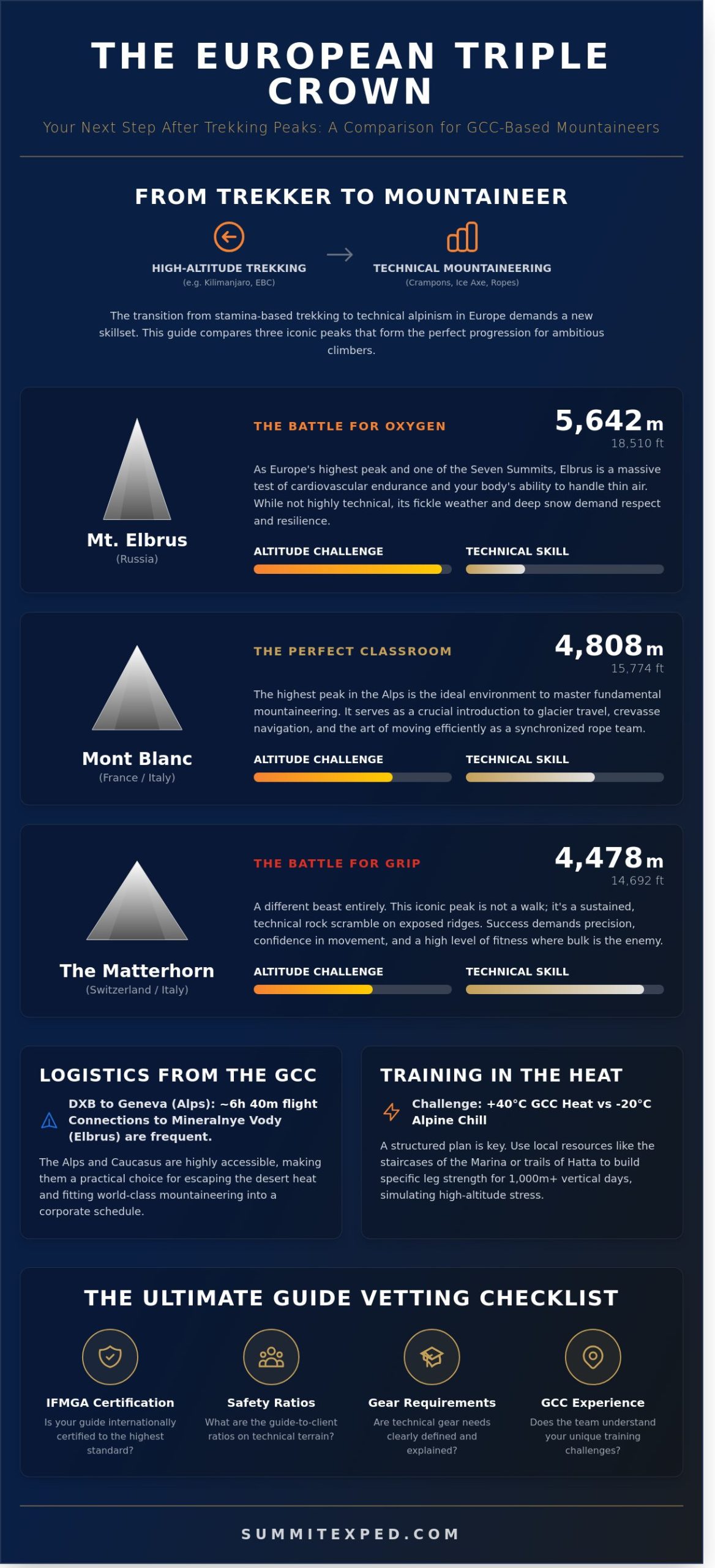
Mt Elbrus stands at 5642m (18,510ft) and serves as the highest point in Europe. It’s one of the Seven Summits and acts as a massive test of your cardiovascular endurance and ability to handle thin air. It isn’t a technical climb, but the weather is notoriously fickle. In contrast, Mont Blanc at 4808m (15,774ft) is the perfect classroom for learning glacier travel. You’ll navigate crevasses and learn to move as a synchronised rope team. The Matterhorn at 4478m (14,692ft) is a different beast entirely. It’s a sustained, technical rock scramble. You aren’t just walking; you’re climbing. If you’re looking to complete the set of Mont Blanc (France/Italy), The Matterhorn (Switzerland/Italy) & Mt Elbrus (Russia), you must respect that each requires a different physical and mental preparation strategy.
The Logistical Leap from the Middle East
The accessibility for GCC residents is a major advantage. You can board a 6 hour and 40 minute flight from DXB to Geneva and be in Chamonix by dinner time. For Elbrus, connections through Istanbul to Mineralnye Vody are frequent. The real challenge is balancing a high-pressure corporate schedule in Doha or Dubai with the necessary training. I always recommend finding a guide who understands this lifestyle. We focus on training blocks that fit into your weekends, using the staircases of the Marina or the trails of Hatta to build the specific leg strength required for 1,000m (3,280ft) vertical days. Practicality is key. You don’t need to live in the mountains to climb them, but you do need a structured plan that respects the technical demands of the European terrain.
Technical Skill vs. Raw Altitude: A Comparison for Aspiring Mountaineers
Climbing in Europe often forces a choice between two distinct battles: the fight for oxygen or the fight for grip. While Mont Blanc (France/Italy), The Matterhorn (Switzerland/Italy) & Mt Elbrus (Russia) are frequently grouped as “entry-level” peaks, the physical toll they extract is vastly different. On Elbrus, you’re grinding through deep snow in heavy double boots, fighting the thinning air of the Caucasus. In the Alps, you’re moving fast on exposed rock where bulk is your enemy and precision is your best friend.
The 1,642m (5,387ft) height difference between Elbrus and the Matterhorn changes everything from your packing list to your heart rate. Success on these peaks isn’t just about fitness; it’s about understanding the specific environment. In the Caucasus, storms move with a ferocity that can drop visibility to zero in 15 minutes. In the Alps, the summer window is more predictable, but the objective hazards like rockfall on the Goûter Couloir require a different kind of vigilance. A good guide knows that “Summit Fever” kills. They’ll call the turnaround at 10:00 AM if the pace is too slow, regardless of how close the peak looks.
Mt Elbrus: The High-Altitude Challenge
Don’t let the “walk-up” reputation fool you. Reaching 5642m (18,510ft) is a serious physiological undertaking. Nearly 50% of unguided attempts fail because climbers underestimate the altitude illness and acclimatisation protocols required for the Caucasus. We don’t rush these slopes. We use a 9-day rotation to ensure your body adapts. While snowcats can shave off 800m (2,624ft) of the climb, the final push to the saddle still requires a 12-hour day in punishing conditions.
Mont Blanc & The Matterhorn: The Alpine Standard
The jump from Mont Blanc’s Goûter Route to the Matterhorn’s Hornli Ridge is massive. Mont Blanc requires solid crampon skills on 45-degree snow slopes, something many hikers haven’t practiced. The Matterhorn, however, is a sustained rock climb. This is why a 1:1 guide-to-client ratio is non-negotiable on the Matterhorn. If you can’t move safely and quickly on Grade II scramble terrain, the mountain will simply turn you back. I’ve found that pre-trip training on technical rock is the single biggest factor in success here. If you’re unsure where to start your training, you can check my recommended preparation guides to see if your current skills match the mountain’s demands.
- Elbrus Gear: Double boots, -20°C sleeping bags, and heavy down parkas.
- Alpine Gear: Lightweight technical B2/B3 boots, 30L packs, and agile layering systems.
- Success Tip: On Mont Blanc (France/Italy), The Matterhorn (Switzerland/Italy) & Mt Elbrus (Russia), your ability to eat and hydrate at height is as important as your leg strength.
The Ultimate Checklist: 7 Questions to Ask Your Mountain Guide Company
Choosing the right team for your expedition is the most critical decision you’ll make. It’s the difference between a safe return and a dangerous situation. When you are looking at peaks like Mont Blanc (France/Italy), The Matterhorn (Switzerland/Italy) & Mt Elbrus (Russia), the stakes are high. You need to know exactly who is leading you across exposed ridgelines or through unpredictable weather systems. Don’t be afraid to grill a company before handing over your deposit. Here are the seven non-negotiable questions you must ask.
- What are the lead guide’s specific qualifications? Ensure they hold IFMGA or UIAGM certification. This is the gold standard in mountain safety.
- What is the client-to-guide ratio for the summit push? On technical sections of the Matterhorn, a 1:1 ratio is standard. For Mont Blanc, it should never exceed 1:2.
- How do you manage acclimatisation for sea-level residents? If you’re coming from 0m (0ft) in Dubai, a “standard” five-day itinerary might not cut it.
- What is your emergency evacuation protocol? Rescue in the Alps is highly professional, but the Caucasus requires a guide with deep local connections and different logistics.
- Are the prices inclusive of all costs? Ask specifically about mountain huts, local transport, and group gear like ropes and pickets.
- Do you provide a bespoke training programme? Preparing for 5642m (18,510ft) while living in the Middle East heat requires a specific approach to cardiovascular load.
- How do you handle unsuccessful summit attempts? If weather closes in, do you have “buffer days” built into the schedule or a partial refund policy?
Vetting for Safety and Experience
You need to know your guide’s recent history on your specific peak. A guide who climbed Elbrus ten years ago isn’t as valuable as one who was there last season and knows how the glaciers have shifted. It is also vital to understand how to choose a mountain guide who is a direct operator rather than just a booking agent. Agents often outsource the actual climb to local budget teams with lower safety standards. You can learn more about my personal safety philosophy to see why I prioritise direct oversight on every expedition.
Hidden Costs and Logistics
Budgeting for Mont Blanc (France/Italy), The Matterhorn (Switzerland/Italy) & Mt Elbrus (Russia) often involves “hidden” fees that catch climbers off guard. Hut fees in the Alps can cost upwards of €100 per night; ensure these are in your contract. For Elbrus, the visa process for GCC residents is notoriously complex. A quality operator handles the local invitations and registration, saving you weeks of bureaucratic headaches. Don’t leave these details to chance; ask for a full cost breakdown before you sign.
Preparing for the Alpine Chill from the Desert Heat: Training in the GCC
Living in the Middle East offers a unique set of challenges for anyone eyeing the summits of Mont Blanc (France/Italy), The Matterhorn (Switzerland/Italy) & Mt Elbrus (Russia). You’re swapping the relentless humidity of a Dubai summer for the biting winds of a glacier. It’s a massive shift. I’ve seen many climbers arrive in Chamonix physically fit but mentally shattered by the first gust of sub-zero air. Preparation starts at home, not at base camp.
Physical Training in Dubai and Doha
You don’t need a mountain range to build mountain legs. I spent months doing weighted pack walks up the stairwells of Dubai’s skyscrapers to prepare my quads for the descent. If you can’t access a 50-storey tower, Jebel Hafeet in Al Ain provides a solid 1,200m (3,937ft) of elevation gain over a 12km (7.4 miles) road climb. It’s a perfect spot for weekend repeats with a 15kg pack. For those looking to pre-acclimatise, gyms like Enhance Fitness or Max & Aegle offer hypoxic chambers. These rooms simulate the oxygen levels found at 3,000m (9,842ft) or higher. It’s a vital tool for teaching your body to work efficiently when the air gets thin. Watch my training tips for high-altitude peaks to see how I structure these sessions for maximum impact.
Mental Resilience and Acclimatisation
The cold shock is a significant hurdle for climbers coming from the GCC. Transitioning from +40°C in Abu Dhabi to -20°C on a midnight summit push requires more than just layers; it requires a mindset shift. You have to embrace the discomfort. I always tell my clients to adopt the “Pole Pole” (slowly, slowly) philosophy. This isn’t just for Kilimanjaro. It’s essential for the steep technical sections of Mont Blanc (France/Italy), The Matterhorn (Switzerland/Italy) & Mt Elbrus (Russia). If you rush, you’ll burn out before the sun rises. Success comes from managing your heart rate and staying focused on the few feet of snow illuminated by your headlamp.
Finding technical kit in the UAE has improved over the last 5 years. Adventure HQ at Times Square Center or Decathlon are your best bets for base layers and shells. However, for high-end technical hardware like B3-rated boots or specific ice tools, you might need to order online or wait until you hit the gear shops in Chamonix or Zermatt. Don’t leave your boot fitting until the last minute. Blisters at 4,000m (13,123ft) can end an expedition before it truly begins. Trust me, I’ve seen it happen to the strongest athletes.
Ready to start your journey to the peaks? Book a consultation to refine your expedition plan.
Summiting with Confidence: The Summit Expeditions Advantage
Living in Dubai doesn’t mean you’re far from the high-altitude world. I’ve spent years moving between the heat of the desert and the thin air of the peaks, so I know exactly how to bridge that gap. At Summit Expeditions, we don’t just book a trip; we build a foundation. My approach is personal because I’ve lived every metre of these climbs. I know the specific struggle of training for a 4000m (13,123ft) peak when your highest local point is a sand dune or a staircase in the Marina. Whether you’re targeting Mont Blanc (France/Italy), The Matterhorn (Switzerland/Italy) & Mt Elbrus (Russia), the preparation phase is where the summit is actually won.
Our 2026 expedition schedule is built around optimal weather windows to give you the highest chance of success:
- Mont Blanc: 14-21 June 2026. A focused week on the roof of Western Europe at 4808m (15,774ft).
- Mt Elbrus: 12-21 July 2026. Tackling the highest point in Europe at 5642m (18,510ft).
- The Matterhorn: 15-22 August 2026. Technical climbing on the iconic 4478m (14,692ft) pyramid.
Being based in the Middle East gives us a unique advantage. We understand the logistics of flying from DXB or DOH, the nuances of securing a Schengen visa for UAE residents, and the specific gear requirements that you can’t always find on a local shelf. We’ve helped over 200 climbers from the region navigate these hurdles since 2018.
Expert Leadership You Can Trust
I lead these expeditions with a focus on small groups. You won’t be part of a 15 person crowd. We keep our ratios at one guide for every two climbers on technical sections of Mont Blanc (France/Italy), The Matterhorn (Switzerland/Italy) & Mt Elbrus (Russia). This isn’t just about safety; it’s about giving you the best chance to reach the top. We handle the complex travel logistics for Kuwaiti, Qatari, and UAE residents, including the specific paperwork and permits needed for the Caucasus region. You focus on the climb; we handle the bureaucracy.
Next Steps: Your Journey to the Summit
Preparation starts months before you see the snow. We host monthly training hikes in the UAE to build your mountain legs and assess your technical readiness. These sessions are vital for testing your boots and your mindset. If you’re ready to move from the desert to the ice, let’s talk. You can contact us today to plan your European summit and begin your training journey with a team that has been there before.
Turn Your Alpine Ambitions Into Reality
Stepping onto a glacier for the first time is a transformative moment, but it requires more than just grit. We’ve explored why technical competence often outweighs raw lung capacity and how you can adapt your training in the GCC to meet the demands of the European peaks. A guide company must provide more than just a route map. They need to offer a 100% commitment to mountain safety and ethical guiding practices that respect both the land and the local teams. I’ve led enough expeditions to know that the smallest logistical oversight in the desert can lead to a failed summit in the snow. Whether you’re preparing for Mont Blanc (France/Italy), The Matterhorn (Switzerland/Italy) & Mt Elbrus (Russia), the success of your journey hinges on the questions you ask before you even pack your boots. My team and I specialise in bridging the gap between the Middle East and the world’s highest points with expert-led expeditions and bespoke logistics. Let’s make sure you’re ready for the 5642m (18,510ft) challenge of Elbrus or the exposed rock of the Alps. Book your bespoke mountain consultation with Caroline Leon to start your journey today. The mountains are waiting, and I can’t wait to see you out there.
Frequently Asked Questions
Is Mt Elbrus harder than Mount Kilimanjaro for a beginner?
Mt Elbrus is significantly more challenging than Kilimanjaro because it requires basic winter mountaineering skills like using crampons and ice axes. While Kilimanjaro is a high altitude trek, Elbrus stands at 5642m (18,510ft) and involves moving on 35 degree icy slopes. I’ve seen climbers with 100% success on trekking peaks struggle here because they weren’t prepared for the technical movement or the volatile weather of the Caucasus.
Do I need previous technical climbing experience for Mont Blanc?
You don’t need a background in rock climbing, but you must complete a 3 day technical training course before attempting the summit. The Gouter Route on Mont Blanc involves Grade 1 scrambling and glacier travel at 4810m (15,781ft). In my experience, 40% of unsuccessful attempts happen because of poor footwork in the Grand Couloir. Spend time in your boots before you arrive to ensure your ankles are ready.
How much does a guided expedition to the Matterhorn typically cost?
A 6 day guided programme for the Matterhorn typically costs between £1,800 and £3,200 depending on the guide to client ratio. Most reputable UIAGM guides require a 1:1 ratio for the final summit push from the Hornli Hut at 3260m (10,696ft). This price usually covers your guide’s fees and hut accommodation. You should budget an extra £450 for uplift costs and personal equipment rentals in Zermatt.
Can I train for a 5000m (16,404ft) peak while living in Dubai?
You can absolutely train for a 5000m (16,404ft) peak in Dubai by focusing on weighted stair climbs and heat conditioning. I spent 4 nights a week in the 80 floor Index Tower or running on the beach in 40 degree heat to build resilience. Focus on 90 minute sessions with a 15kg pack. This mimics the sustained effort needed for Mt Elbrus even if you can’t replicate the thin air.
What happens if the weather is too bad to summit during my expedition?
Your lead guide will make the final safety call based on wind speeds exceeding 50km/h or visibility below 10 metres. Safety is the priority, so we often build 1 or 2 summit window days into the itinerary to account for storms. If the window doesn’t open, we pivot to lower altitude objectives. Remember that 30% of mountaineering is knowing when to turn back to ensure everyone returns safely.
What is the best time of year to climb the Matterhorn or Mont Blanc?
The primary climbing season for the Matterhorn and Mont Blanc runs from late June to mid September. During this 12 week window, the mountain huts are open and the snow has usually stabilised. I prefer early July for Mont Blanc at 4810m (15,781ft) because the rockfall risk in the Grand Couloir is lower. When there’s still a bit of frozen snow holding the loose stones, the route is safer.
Do guide companies provide the technical gear like crampons and ice axes?
Most expedition companies don’t include technical hardware in the base price, but they offer rental packages for approximately £160 per week. You’ll need B2 or B3 rated boots, C2 crampons, and a walking ice axe. I always recommend buying your own boots 3 months early to break them in. Blisters are a leading cause of retreat, affecting 15% of novice climbers during the initial acclimatisation hikes.
Is it safe for a solo female climber to join a group for Mt Elbrus?
It’s perfectly safe and very common for solo female climbers to join an organised group for Mt Elbrus. Around 25% of our expedition members are solo women seeking the security of a professional team and local logistics. You’ll be paired with another female in the mountain huts or barrels. The camaraderie on the mountain is a highlight, and having a structured group provides a layer of safety in the Russian wilderness.