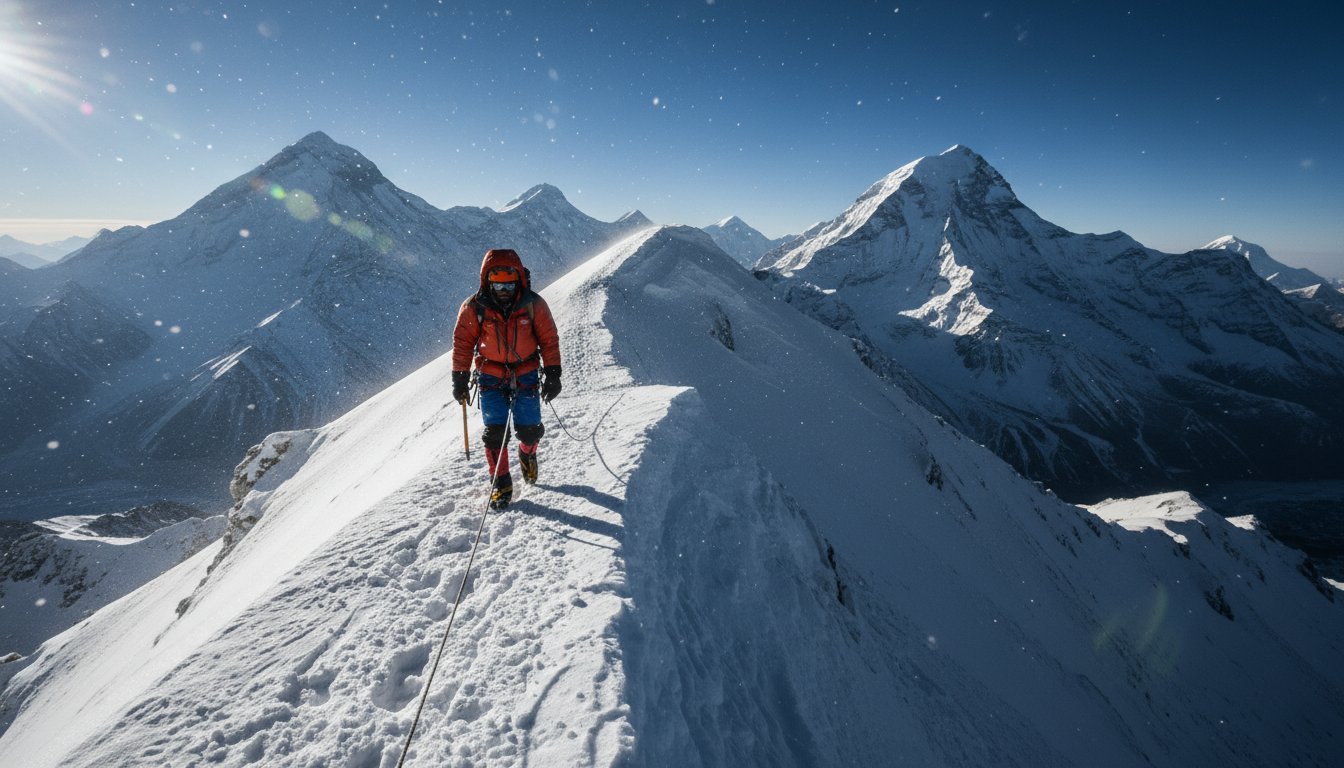
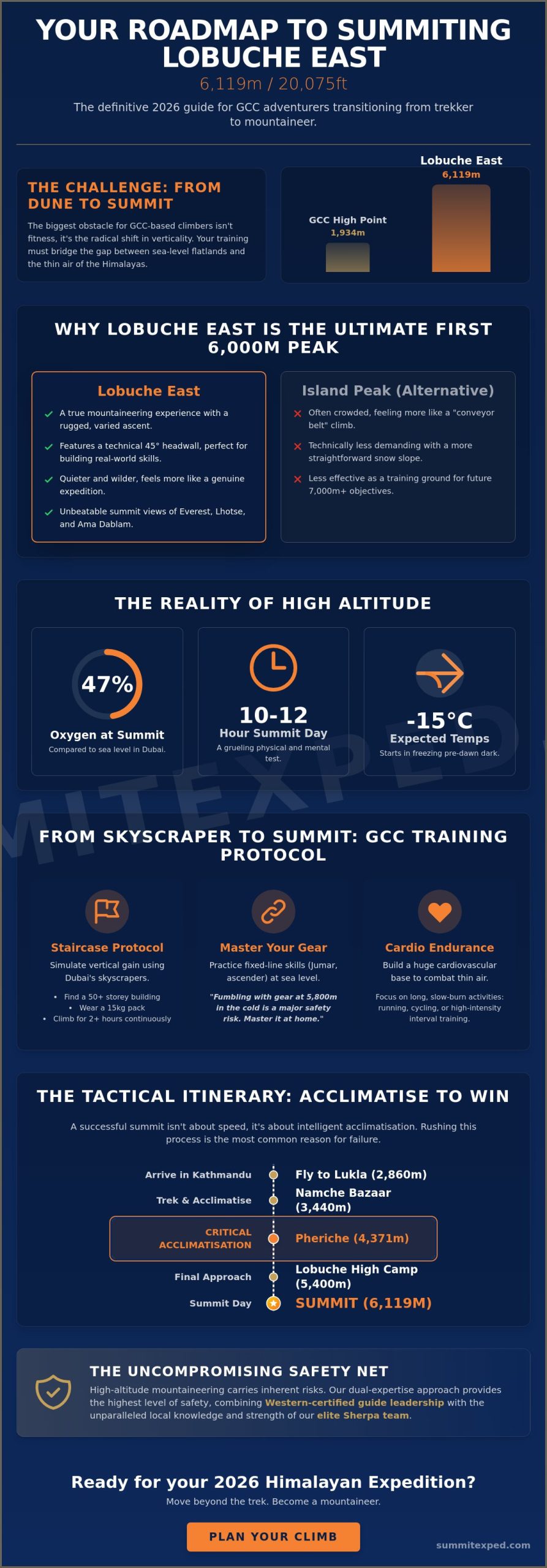
What if the biggest obstacle to your first Himalayan summit isn’t the thin air, but the flat horizon of the Arabian Peninsula? Most adventurers in Dubai and the wider GCC feel a restless boredom with standard trekking routes, yet the lack of local peaks above 1,934m (6,345ft) makes the transition to climb lobuche east feel like a massive leap into the unknown. It’s natural to worry about the technical headwall when your primary training ground is a gym or a desert dune.
This guide serves as your definitive roadmap for the 2026 season, providing the exact technical and physical steps needed to move from trekker to mountaineer. I’ll share the subtle insights I’ve gained from years of leading expeditions, helping you master fixed-line skills and acclimatisation strategies tailored for those living at sea level. We’ll explore the gear requirements, the reality of the 45 degree summit ridge, and how to experience the Khumbu Valley far beyond the reach of the standard tourist trails. By the time you reach the 6,119m (20,075ft) summit, you’ll have the confidence to manage the mountain safely and successfully.
Key Takeaways
- Learn why this 6,119m (20,075ft) summit is the ultimate bridge between trekking and technical mountaineering, requiring more than just a high level of hiking fitness.
- Discover how to utilise Dubai’s skyscrapers and the flat landscapes of Abu Dhabi or Doha to build a specific vertical-gain training programme at sea level.
- Master the tactical itinerary required to climb Lobuche East, focusing on the essential acclimatisation days in Pheriche that often make or break a summit bid.
- Streamline your 2026 planning with direct logistics for GCC residents, from choosing the best flight routes to navigating Nepal’s latest visa requirements.
- Understand the reality of high-altitude risk and how the combination of Western-certified guides and Sherpa expertise creates a necessary safety net.
Why Lobuche East is the Ultimate First 6,000m (19,685ft) Peak
Lobuche East sits at 6,119m (20,075ft) right in the heart of the Khumbu region. It’s more than just a high-altitude hike. For many of my climbers coming from the UAE or the wider Middle East, it represents the first real transition from trekking to genuine mountaineering. While it’s often grouped with other “trekking peaks,” this label can be misleading for the unprepared. To get a better sense of the mountain’s geography and history, you can check this Lobuche Peak overview. Unlike the standard path to Everest Base Camp, to climb lobuche east requires you to manage fixed ropes, crampons, and ice axes on steep, exposed terrain.
To better understand the physical demands and the stunning environment of this expedition, watch this helpful video:
The summit view is arguably the best vantage point in the entire Himalaya. You aren’t just looking at the peaks from a distance; you’re standing among the giants. Everest, Lhotse, and the sharp, iconic needle of Ama Dablam feel close enough to touch. It’s a significant psychological shift for any adventurer. You move from being an observer on a dusty trail to an active participant on a vertical mountain face. This isn’t just about reaching a specific height. It’s about learning how to move with confidence on a technical surface while your lungs scream for air.
Lobuche East vs. Island Peak: Which should you choose?
Island Peak is often the “go-to” for first-timers, but Lobuche offers a far more rugged and varied experience. The 45-degree granite slab and the final snowy headwall provide technical challenges that Island Peak’s straightforward snow slope often lacks. In my experience leading teams through the Khumbu, Lobuche also feels less like a conveyor belt. It’s wilder, quieter, and feels more like a true expedition. This makes it the perfect training ground if you’re eyeing a 7,000m (22,966ft) peak in the future. The skills you sharpen here on the fixed lines are exactly what you’ll need for bigger, more remote objectives.
The Reality of 6,119 Metres (20,075 Feet)
At this height, every single breath counts. The air contains roughly 47% of the oxygen you find at sea level in Dubai. The final 200m (656ft) is where the real work begins when you climb lobuche east. Your body feels heavy and your mind will likely want to quit. You should expect a grueling 10-12 hour summit day. It’s a long shift that starts in the freezing dark well before dawn. Setting realistic expectations is vital for success. You’ll be tired, it’ll be cold, and the “thin air” is a physical weight you can’t ignore until you finally step back into high camp and let the achievement sink in.
Technical Skills and Physical Preparation in the GCC
Training for a 6,119m (20,075ft) peak while living at sea level in the Middle East requires a shift in perspective. You don’t need a mountain in your backyard to build the engine required to climb lobuche east, but you do need consistency. The secret to success in the Himalayas lies in vertical gain and mental grit. Dubai’s skyscrapers are your greatest asset for this. Finding a 50-storey building and climbing the stairs with a 15kg pack for two hours mimics the slow, grinding pace of the Khumbu Valley. This ‘Staircase Protocol’ builds the specific leg strength and cardiovascular endurance that a flat run on the Corniche simply cannot replicate.
Technical proficiency is just as vital as your heart rate. You’ll be using fixed lines on the final headwall of the mountain. If you’re fumbling with your Jumar at 5,800m (19,028ft) in -15°C temperatures, you’re creating a safety risk for yourself and your team. It is essential to familiarise yourself with the Nepal Mountaineering Association Regulations regarding equipment standards and permit requirements before you depart. Mastering these skills in a low-stress environment allows you to perform them instinctively when oxygen is scarce.
Simulating Altitude in the Desert
Hypoxic chambers in specialised Dubai gyms offer a controlled environment to test your heart rate under oxygen-deprived conditions. While these sessions don’t replace the 21 days of natural acclimatisation needed on the trail, they do strengthen your respiratory muscles. Combine this with 40km weighted pack marches along the Al Qudra cycling path. The heat and monotony of the desert landscape are perfect for mental conditioning. You’ll need that same internal focus when you’re six hours into your summit push on Lobuche East. Interestingly, training in the 35°C heat of Doha or Muscat increases blood plasma volume, which can actually aid your cardiovascular efficiency once you transition to the cold.
Learning the Ropes
Don’t wait until you’re at High Camp to touch a Jumar (fixed-rope ascender) for the first time. The UAE has several indoor climbing gyms and outdoor crags in Ras Al Khaimah where you can practice basic knot tying and rope management. A subtle insight from my own expeditions: practice every technical move while wearing your thickest summit gloves. Manipulating a carabiner or a Jumar becomes significantly harder when your dexterity is limited by down-filled mittens. If you can manage your gear in your living room, you’ll be far more confident on the ice. If you’re looking for more specific drills to prepare, you can find my training breakdowns on my YouTube channel.
The Journey to the Summit: A Tactical Itinerary
The trek through the Khumbu Valley is more than just a scenic approach; it’s the foundation of your success. We don’t rush the journey to Namche Bazaar because your body requires time to adapt to the thinning air. Rushing here is a common mistake that often ends an expedition before it truly begins. By the time we reach Pheriche at 4,371m (14,340ft), we implement strategic rest days. These aren’t days of idleness. We use them for active recovery, short hikes to higher elevations, and meticulous gear checks. Moving to Lobuche village at 4,940m (16,207ft) marks the transition from trekking to mountaineering. It’s where the air feels noticeably thinner and every movement becomes more deliberate.
Managing your energy at High Camp, situated at 5,400m (17,716ft), is critical for a successful climb lobuche east. You’ll spend the afternoon hydrating and resting in a tent pitched on rocky platforms. Summit night starts early, usually around 1:00 AM. The push begins with a steady trek to the crampon point where the terrain shifts from rock to ice. This is the moment to focus. The cold is biting, but the rhythm of your movement will keep you warm as we move toward the technical sections.
Navigating the ‘Slab’ and the Headwall
The ‘Slab’ is a section of smooth, angled rock that requires precise foot placement. Trust your boots and maintain a centered balance, avoiding the urge to lean too far into the mountain. Once you reach the 45-50 degree snow headwall, your breathing must match your steps. One breath, one step. It’s a rhythmic dance that keeps your heart rate stable. Use your jumar effectively, sliding it up the fixed line and locking it before each move. Don’t be fooled by the false summit. The true peak of your climb lobuche east journey requires traversing a narrow, exposed ridge that offers some of the most breathtaking views in the Himalaya.
Acclimatisation: The Secret to a Strong Summit
We include a visit to Everest Base Camp at 5,364m (17,598ft) as a key part of our cycle. This “climb high, sleep low” strategy is non-negotiable for safety. We monitor your blood oxygen levels (SpO2) and resting heart rate daily using a pulse oximeter. Seeing a drop in SpO2 below 75 percent or a resting heart rate 20 beats above your baseline tells us we need to adjust the pace. This data-driven approach ensures you aren’t just surviving the altitude, but actually thriving in it. For a deeper dive into these protocols, read our guide on High Altitude Acclimatization: A Guide for Dubai & Middle East Adventurers (2026). We advocate for a pole pole pace, even in Nepal, to ensure every climber reaches the top with enough energy to descend safely.
Logistics and Gear: Planning from Dubai, Doha, or Kuwait
Flying from the GCC to Kathmandu is remarkably efficient, with several major carriers serving the route daily. If you are based in Dubai, FlyDubai flights FZ573 and FZ575 are the most popular choices for climbers, offering direct access to Tribhuvan International Airport. Those travelling from Doha will find Qatar Airways flight QR644 to be a consistent staple for Himalayan expeditions. Air Arabia also provides a cost-effective alternative from Sharjah for climbers looking to manage their budget without sacrificing reliability. By 2026, Nepal’s on-arrival visa system remains the primary entry method for most GCC residents and expats; expect to pay approximately 50 USD for a 30-day visa. Ensure your passport has at least six months of validity from your arrival date to avoid any last-minute hurdles at immigration.
Managing the transition from a Middle Eastern diet to Nepali trail food is a critical factor that many overlook. I have seen incredibly fit athletes sidelined by simple gut issues that could have been prevented. Start a high-quality probiotic course 14 days before you depart to prepare your digestive system. Once you are on the trek, the staple diet of dal bhat provides the essential carbohydrates needed for the 6119m (20,075ft) ascent, but the sudden increase in lentil consumption can be heavy. Stick to cooked foods, avoid raw salads in the tea houses, and use a reliable water purification system to stay hydrated without risk.
The 2026 Gear Checklist for Lobuche
Precision in your equipment choice is vital when you climb lobuche east. The summit push typically begins at 2:00 AM, when temperatures can plummet to -15°C (5°F) or lower. You need a technical layering system that balances warmth with breathability.
- Essential layers: Invest in high-quality merino wool base layers and a heavy-duty ‘Big Down’ jacket rated for at least -20°C.
- Boots: B3-rated double boots, such as the La Sportiva G2 Evo or Scarpa Phantom 6000, are non-negotiable. Single leather boots do not provide enough insulation for the static periods spent on fixed lines above 5800m (19,028ft).
- Local Tip: You can source your training kit at Adventure HQ or Decathlon in Dubai, but save your technical purchases for Kathmandu. Specialized shops like Shona’s Alpine offer expert fitting for 6000m (19,685ft) boots that you simply cannot find in most malls.
Timing Your Expedition
The 2026 climbing windows fall between April to May and October to November. For climbers living in the Middle East, the “Summer Slump” is your biggest challenge. When temperatures in Kuwait or Riyadh reach 48°C (118°F) in July, maintaining training intensity is difficult. I recommend shifting your focus to indoor high-intensity interval training or weighted pack walks in climate-controlled environments like Mall of the Emirates. This consistency during the peak heat ensures you arrive at the trailhead with the necessary cardiovascular base. For a deeper look at regional prep, check out Himalayan Mountaineering: A Guide for Explorers in Dubai & the Middle East.
Book a consultation for your 2026 Lobuche expedition today.
Safety, Risk, and the Summit Expeditions Difference
When you set out to climb Lobuche East, you must accept one truth immediately: the mountain always has the final word. No matter how much you’ve trained in the heat of the UAE or how expensive your boots are, nature doesn’t care about your schedule. Success in the Himalayas isn’t just about reaching 6119m (20,075ft). It’s about returning to base camp with your team in one piece. We mitigate these risks by pairing Western-certified lead guides with high-altitude Sherpas who have stood on this summit dozens of times. This dual layer of expertise ensures that technical safety is never compromised by cultural or linguistic barriers.
Most accidents happen on the way down. I’ve seen it often; the summit push drains your physical and mental reserves, and once the adrenaline fades, complacency sets in. Gravity is a powerful force when you’re exhausted. We focus on active descent techniques, ensuring you stay sharp and clipped in until the terrain levels out. Our 2026 expeditions maintain small team ratios, usually four climbers to one lead guide, so that no individual’s fatigue goes unnoticed. This bespoke approach allows us to manage the specific needs of climbers travelling from the GCC, who often face a steeper acclimatisation curve than those living at higher latitudes.
Managing Altitude Sickness (AMS)
Altitude is the great equaliser. Acute Mountain Sickness starts small, perhaps a dull headache or a lack of appetite, but it can escalate into HAPE or HACE rapidly if you ignore the signs. We follow a strict climb high, sleep low protocol. This means we might trek to a high point during the day but always drop back down to a lower elevation to sleep, giving your blood chemistry time to adapt. Every Summit Expeditions team carries pulse oximeters to monitor oxygen saturation, medical-grade oxygen cylinders for emergencies, and Gamo bags to simulate lower altitudes if a rapid descent isn’t immediately possible.
Why Experience Matters
Moving from the sea-level humidity of Dubai or Riyadh to the thin, dry air of the Khumbu is a massive physiological shock. You need a leader who understands this specific transition. I’ve spent years bridging that gap, helping climbers prepare their lungs and minds for the reality of high-altitude life. It’s not just about the gear; it’s about knowing when to push and when to listen to your body’s subtle warnings. Experience tells us that a slow, steady pace beats a fast, erratic one every time.
Take the Step from Trekker to Mountaineer
I’ve stood on many summits, and I can tell you that the transition from trekking to technical climbing is where the real magic happens. Lobuche East sits at 6119m (20,075ft), offering that perfect entry into the world of crampons and fixed lines without being overwhelming. To succeed, you need more than just fitness; you need a team that understands the specific logistics of travelling from the GCC. Our 2026 expedition is led by Omani mountaineer Nadhir Al Harthy, a leader who knows these peaks as well as he knows the desert. We’ve maintained a 100% safety record on technical Himalayan peaks because we don’t cut corners on acclimatisation or gear. If you’re ready to climb lobuche east, we’ve already handled the flight connections from Dubai and Doha, the permits, and the high-altitude safety protocols. It’s about moving beyond the ordinary and testing what you’re truly capable of in a high-stakes environment. I’ll see you at the sharp end.
Join our 2026 Lobuche East Expedition – Enquire Now
Frequently Asked Questions
Is climbing Lobuche East dangerous for beginners?
Lobuche East presents objective hazards like crevasses and steep headwalls that require specific technical skills. It’s classified as a Grade PD+ (Peu Difficile+) on the Alpine Grading System, meaning it’s a step above a standard trek. While it’s an entry-level peak, the final 400m (1,312ft) involves fixed ropes on 45 degree snow and ice. Beginners should ensure they have a 1:2 guide-to-client ratio to manage these risks safely.
How much does a Lobuche East expedition cost from Dubai?
Total costs depend on your support level, but 2024 industry data shows full-service expeditions range from $3,000 to $5,500. This doesn’t include your return flights from DXB to Kathmandu, which typically cost between 1,800 AED and 3,500 AED. You also need to factor in the $250 climbing permit fee required by the Nepal Mountaineering Association and about $500 for personal gear rentals if you don’t own your own kit.
Do I need previous ice climbing experience for Lobuche East?
You don’t need to be an expert ice climber, but you must be comfortable using crampons, an ice axe, and a Jumar on fixed lines. To safely climb Lobuche East, most reputable teams include a pre-climb training day at 5,200m (17,060ft) to practice these essential skills. If you’ve never walked in crampons, I recommend completing at least 10 hours of technical practice or a basic winter skills course before you fly out.
What is the success rate for Lobuche East summits?
Success rates generally hover around 65% across most commercial expeditions in the Khumbu region. This figure often drops during seasons with high wind speeds or heavy snowfall. Most failed attempts occur at the “False Summit” because climbers underestimate the final technical push to the true East peak at 6,119m (20,075ft). Proper acclimatisation in the valley is the single biggest factor in reaching the top.
Can I climb Lobuche East if I have already done Kilimanjaro?
Kilimanjaro provides excellent high-altitude experience, but Lobuche East requires a significant step up in technical ability. While Kili is a long walk at 5,895m (19,341ft), Lobuche involves technical rope work and much steeper terrain. If you handled the altitude on Kili well, you have a solid foundation, but you’ll need to focus on building your upper body strength to handle the vertical sections on the headwall.
What happens if I get altitude sickness on the mountain?
Safety is the priority, so we follow a strict descent protocol if symptoms of Acute Mountain Sickness progress. If your blood oxygen saturation drops below 70% or you show signs of HAPE, you’ll descend immediately to Pheriche at 4,371m (14,340ft). This village houses a dedicated Himalayan Rescue Association clinic. Our guides carry bottled oxygen and Gamow bags for emergency stabilisation during the descent if the weather prevents a helicopter evacuation.
How do I manage my training in the Dubai heat?
Training in the UAE requires shifting to indoor environments or early morning sessions to avoid 40°C temperatures. Use the stairs at Media One Hotel or the inclines at Mushrif Park for weighted pack walks before 7:00 AM. I spent 4 months training in air-conditioned gyms using the StairMaster for 90-minute blocks while wearing a 15kg pack. This builds the specific vertical endurance needed for the 6,119m (20,075ft) summit push.
What is the best month to climb Lobuche East in 2026?
April and October are the gold standard months for stable weather and clear views in the Himalayas. In April 2026, you’ll enjoy the blooming rhododendrons and warmer daytime temperatures in the lower valley. October offers the crispest air and the highest chance of dry rock on the lower sections of the climb. Avoid the monsoon window from June to August when visibility drops and rockfall risk increases by nearly 40%.