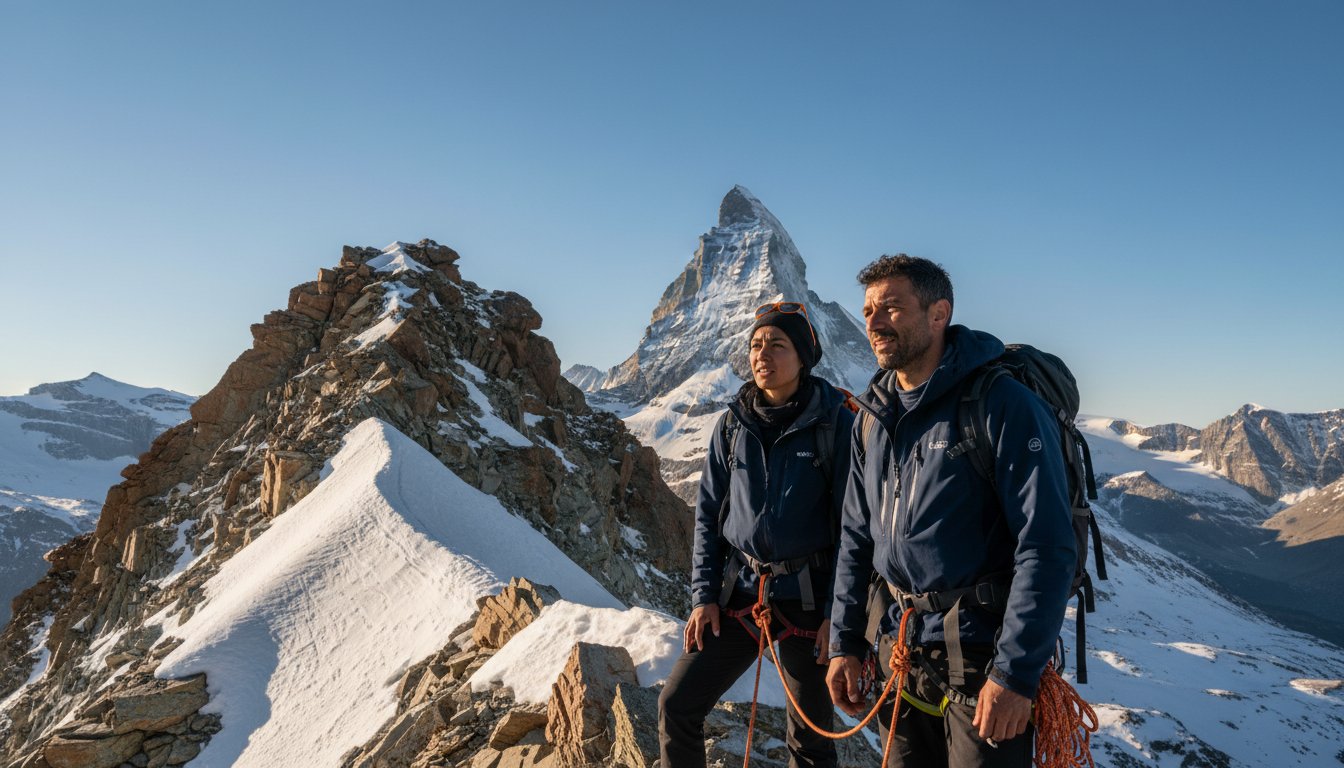
The jagged silhouette of the Matterhorn is perhaps the most recognisable peak on the planet, yet nearly 60% of climbers who attempt the Hornli Ridge each season fail to reach the 4478m (14,692ft) summit. Most of these setbacks aren’t due to a lack of fitness, but a lack of preparation for the relentless, technical scrambling that defines this mountain. I know how daunting that jump feels when you’re looking out over the Dubai skyline, wondering how to trade sand dunes for vertical granite. You’ve likely conquered the great trekking peaks and now you’re hungry for a real alpine challenge, but the logistics of training in a desert environment can feel like a mountain in itself.
This guide provides everything you need to know about The Matterhorn from a professional expedition leader’s perspective, specifically tailored for adventurers based in the Middle East. I’m going to share the exact training roadmap you can follow right here in the GCC to build the technical confidence you’ll need for the 2026 season. We’ll dive into the specific gear requirements, the reality of moving on a short rope, and how to manage the transition from trekking to technical alpinism without the guesswork.
Key Takeaways
- Understand why the Matterhorn at 4478m (14,692ft) is a “climber’s mountain” that requires genuine rock scrambling skills rather than just high-altitude trekking fitness.
- Compare the technical demands of the Swiss Hörnli Ridge against the Italian Lion Ridge to choose the route that best fits your current capability.
- Learn how to use the Hajar Mountains as a high-stakes training ground, prioritising technical movement over simple gym-based cardio.
- Get everything you need to know about The Matterhorn logistics, including the “Rule of the Mountain” regarding local guides and the essential July-to-September climbing window.
- Map out your journey from the Middle East to Zermatt, ensuring a logical progression in your climbing career to maximise your chances of a safe summit.
Beyond the Postcard: What Makes the Matterhorn a True Technical Challenge?
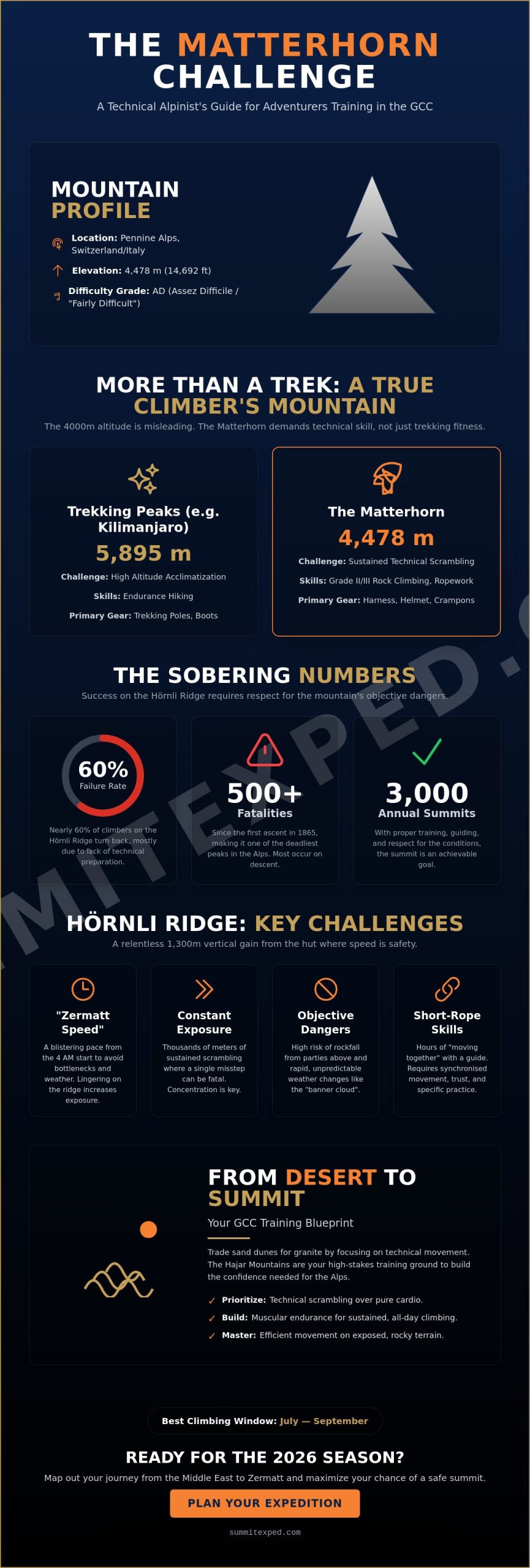
Most people recognise the jagged, pyramid profile from a chocolate bar or a postcard. Standing at the foot of The Matterhorn at 4478m (14,692ft) is a very different experience. It isn’t a “walk-up” peak. While many GCC adventurers start their high-altitude journey on the trekking paths of Kilimanjaro, this Swiss icon requires a completely different toolkit. If you want everything you need to know about The Matterhorn, you have to start with the technical reality. It’s a climber’s mountain, defined by Grade II and III rock scrambling rather than a simple trail. You’ll be using your hands as much as your feet from the moment you leave the hut.
To get a real sense of the exposure and the physical demands you’ll face on the Hörnli Ridge, watch this perspective from a professional guide:
The 4000m Misconception
Don’t let the altitude numbers fool you. At 4478m (14,692ft), it’s significantly lower than the 5895m (19,341ft) of Kilimanjaro, yet it’s exponentially more difficult. The AD (Assez Difficile) rating means “fairly difficult.” For a climber, this translates to thousands of metres of sustained exposure where a single slip can be fatal. You’ll spend hours “moving together” on a short rope with your guide. This is a skill most trekkers haven’t practiced; it requires synchronised movement and absolute trust. If you can’t move efficiently on technical terrain while breathing thin air, the mountain will turn you back long before the summit. You can see how I prepare for these technical movements on my YouTube channel.
A Brief History of the “Jewel of the Alps”
The history of this peak is written in both triumph and tragedy. The 1865 first ascent ended with four men falling to their deaths because of a frayed rope and a lack of experience in the group. This event changed Zermatt forever, turning it into the global hub for alpine guiding it is today. While 3,000 people reach the top annually, the reality is sobering. Over 500 people have lost their lives on these slopes since that first climb. Most accidents happen during the descent when fatigue sets in and concentration slips. It’s a reminder that the summit is only the halfway point.
The 1300m (4,265ft) vertical gain from the Hörnli Hut is a relentless test of sustained concentration. You’re dealing with objective dangers you can’t always control. Rockfall is common, especially when other parties are climbing above you. The weather in the Valais Alps can shift from blue skies to a localised “banner cloud” storm in minutes. You need to be fast. If you aren’t at the Solvay Hut, the emergency shelter, within a specific timeframe, your guide will likely call the climb. Speed is safety here; lingering on the ridge increases your exposure to both weather and rockfall.
The Four Faces: Navigating the Routes and Technical Difficulty
Choosing your line on the Matterhorn is the first real test of your expedition. It isn’t just about which village you prefer for dinner; it dictates your entire training block. Most adventurers focus on the Hörnli and the Lion ridges, which are the two most viable paths for first-timers. Your choice between them will define your gear list and the specific type of muscular endurance you need to build. Everything you need to know about The Matterhorn starts with understanding that this mountain doesn’t offer an easy way up, only different styles of challenge.
The Hörnli Ridge (The Swiss Route)
The Hörnli is the classic line. You’ll start from Zermatt and spend the night at the Hörnlihütte, situated at 3260m (10,696ft). The atmosphere here is electric but tense. When the doors open at 4:00 AM, the “Zermatt Speed” begins. This isn’t a leisurely hike. Local guides set a blistering pace to avoid bottlenecks on the upper sections. If you can’t maintain this rhythm, you risk being turned around before the sun is even up.
The biggest hurdle on the Swiss side is actually the “Lower Face.” In the pre-dawn darkness, it’s a confusing maze of shattered rock and faint trails. I’ve seen many competent climbers lose the route here, wasting precious hours before they’ve even reached the technical sections. You need to be efficient on Grade II and III rock while moving together on a short rope.
The Lion Ridge (The Italian Route)
Starting from Breuil-Cervinia, the Lion Ridge is often described as a more “honest” climb. It’s more technical from the outset and physically demanding. You’ll stay at the Carrel Hut, perched at 3830m (12,566ft). This is significantly higher and colder than the Swiss hut, meaning your acclimatisation must be spot on before you arrive. The rock quality here is generally better, but the exposure is immediate and constant.
- Fixed Chains: The Italian side relies heavily on thick fixed chains. These require immense upper body strength, especially when descending.
- The Crux Points: Both routes have their filters. On the Hörnli, the Moseley Slabs require precise footwork. On both sides, the “Shoulder” at approximately 4000m (13,123ft) is where fatigue sets in just as the technicality increases.
- Fixed Ropes: Use them for efficiency, but don’t let them dictate your safety. Relying solely on pulling yourself up ropes will flash your forearms out within hours.
The technical difficulty isn’t just about the grade of the rock. It’s about the sustained nature of the movement at altitude. If you are unsure which ridge suits your current technical level, I often share deeper insights into route selection and preparation at caroline-leon.com to help you make an informed decision. Everything you need to know about The Matterhorn involves respecting these technical nuances before you set foot on the glacier.
Training in the Desert: Preparing from Dubai and the GCC
Preparing for a 4478m (14,692ft) peak while living at sea level in the desert sounds counterintuitive. It isn’t. The Hajar Mountains, spanning the UAE and Oman, offer some of the most technical limestone scrambling outside of Europe. When clients ask for everything you need to know about The Matterhorn, I tell them the secret isn’t just cardio; it’s specific movement. You need to be comfortable on your feet for 10 to 12 hours, often on exposed terrain where a stumble isn’t an option.
I often tell my team that 10 hours of sustained scrambling at Jebel Jais is worth more than 30 hours on a treadmill. The Matterhorn is a movement puzzle. You must learn how to move your body over rock when your lungs are burning and your legs feel like lead. Training in the 35°C (95°F) heat of a Dubai autumn forces your heart rate into higher zones with less effort. This builds a physiological resilience that translates directly to the thin air of the Swiss Alps, helping you manage your output when oxygen is scarce.
Dubai’s indoor climbing gyms, like Mountain Extreme or Rock Republic, are your secret weapon for building grip strength and footwork precision. Don’t just climb in rock shoes; spend time on the easier walls in your approach shoes or even your mountain boots. This builds the specific calf endurance required for the Hörnli Ridge. You’ll want to focus on down-climbing as much as ascending, as the descent from the Matterhorn is where most accidents occur due to fatigue.
Technical Scrambling at Jebel Misht and Jebel Akhdar
Oman offers world-class training grounds that closely mimic the AD (Assez Difficile) rock grade of the Matterhorn. The 1,000m (3,280ft) East Face of Jebel Misht or the ridges of Jebel Akhdar are perfect for long days in “Big Boots.” You shouldn’t train in lightweight trainers if you plan to summit in mountaineering boots; the weight and stiffness change your balance entirely. Technical endurance is the ability to down-climb safely after 6 hours of ascent.
The 6-Month GCC Training Roadmap
Success on the mountain requires a structured approach. This roadmap covers everything you need to know about The Matterhorn preparation from a desert base.
- Months 1-2: Build your Zone 2 aerobic base. Run or fast-walk the Jumeirah beach track or Mushrif Park trails in the humidity to increase blood plasma volume.
- Months 3-4: Transition to vertical gain. Spend your weekends at Wadi Shawka or the Stairway to Heaven in Ras Al Khaimah, aiming for 1500m (4,921ft) of elevation gain in a single session.
- Months 5-6: Focus on technical rock and acclimatisation. Plan a trip to Mt Kenya at 5199m (17,057ft) to practice moving on technical rock at altitude before heading to Zermatt.
If you want to discuss your specific training plan or gear requirements, you can find more resources at caroline-leon.com. Consistency in the heat will make the cool alpine air feel like a performance enhancer when you finally tie into the rope.
Logistics and the “Rule of the Mountain”: Huts, Guides, and Timing
Success on this peak isn’t just about fitness; it’s about understanding the rigid logistics that govern the Swiss Alps. If you’re looking for everything you need to know about The Matterhorn, you have to start with the calendar. The climbing season is remarkably tight, typically running from early July to mid-September. Outside this window, the rock is often too icy or the avalanche risk too high for a standard ascent. Even within the season, a single summer storm can shut the mountain down for days.
Zermatt itself adds a layer of complexity. It’s a car-free village, so you’ll leave your vehicle in Täsch and take the shuttle train. This “tax” on your time and budget is just the beginning. Most climbers stay at the Hörnlihütte, situated at 3,260m (10,696ft). Life here is governed by the 3:30 AM “alpine start.” It’s a choreographed rush where guides and clients move in unison to beat the afternoon storms. If you aren’t at the Solvay Hut by a certain time, your guide will likely turn you around. The mountain has no room for ego when the weather turns.
The Guide-to-Client Ratio
On the Matterhorn, the safety standard is strictly one guide per client. This 1:1 ratio ensures your guide can manage your rope and movement constantly on the exposed ridges. Don’t settle for anything less than a UIAGM or IFMGA certified professional. Most Zermatt guides require a “test climb” first, usually on the Breithorn at 4,164m (13,661ft). This isn’t a cash grab; it’s a vital assessment to ensure you have the movement skills required for the Hörnli Ridge. When gathering everything you need to know about The Matterhorn, the most critical lesson is that the mountain doesn’t care about your CV; it only cares about your performance on the day.
Essential Gear for the Alpine Rock
The transition from the 40°C heat of a Dubai summer to the -10°C chill of the summit ridge is a shock to the system. You’ll need a technical layering system that balances warmth with breathability. Your boots are the most critical piece of kit. You need a B2 or B3 rated mountaineering boot that can take a semi-automatic crampon while remaining stiff enough for precise footwork on rock. Heavy, insulated Everest-style boots are a mistake here; they lack the “feel” needed for technical scrambling.
Keep your pack weight under 8kg (17.6lbs). Every extra gram feels like a kilogram when you’re pulling through the fixed ropes at 4,000m (13,123ft). Focus on a “light and fast” philosophy because speed equals safety in the mountains. If you’re moving slowly, you’re exposed to objective hazards like rockfall for longer. Pack only the essentials: water, high-calorie snacks, a headlamp, and your shell layers.
Ready to start your journey? You can book a consultation with me to discuss your specific training plan and gear requirements.
Your Path to the Summit: Planning Your Matterhorn Expedition from the Middle East
Transitioning from trekking to technical mountaineering is a massive shift. I’ve seen many climbers from the GCC excel on Kilimanjaro 5895m (19,341ft) or Elbrus 5642m (18,510ft), but the Matterhorn requires a completely different toolkit. It’s less about the lungs and more about the hands and head. If you’re looking for everything you need to know about The Matterhorn, start with your progression. You shouldn’t make this your first major peak. Build your foundation on non-technical high-altitude mountains first so that when you hit the Hörnli Ridge, you’re only worrying about the rock, not your breathing.
Logistically, the journey from the Middle East is straightforward. Most climbers fly from DXB or DOH directly into Zurich or Geneva. From there, the Swiss Rail system is your best friend. You’ll take the train to Visp and then change for the mountain cogway to Zermatt. Remember, Zermatt is car-free. You’ll arrive in a village where the only sounds are electric taxis and the church bells; it immediately sets the tone for the focus required ahead. I recommend arriving at least four days before your summit window to adjust to the mountain rhythm.
The real challenge isn’t just the physical climb; it’s the exposure. Spending six to eight hours on a narrow ridge with 1000m (3,280ft) drops on either side creates a specific type of psychological pressure. You need to be comfortable moving fast while short-roped on Grade II and III terrain. Before you leave, check your insurance policy twice. Most standard travel insurance won’t cover technical climbing with ropes and crampons above 3000m (9,842ft). You’ll need a specialist provider like the Austrian Alpine Club or a dedicated high-altitude policy that covers search and rescue.
The “Matterhorn of the Himalayas”
Success in Switzerland often opens doors to more iconic peaks. The Matterhorn is the perfect training ground for Ama Dablam 6812m (22,349ft) in Nepal. While the Matterhorn focuses on “alpine style,” which means moving fast from a hut to the summit and back, Ama Dablam requires an “expedition style” approach with multiple camps and fixed lines. Mastering the technical movement in the Alps gives you the confidence to tackle these Himalayan giants. For a closer look at the specific gear you’ll need for these technical transitions, check out Caroline Leon’s YouTube channel for honest breakdowns based on field experience.
Next Steps for GCC Adventurers
Don’t wait until you get to Zermatt to start climbing. Join us for a Summit Expeditions prep weekend in the Hajar Mountains. We use the rugged terrain of the UAE and Oman to practice scrambling and movement on loose rock. Proper High Altitude Acclimatisation is also vital before your summit push. Spend at least three days climbing 3000m (9,842ft) peaks like the Breithorn before attempting the big one. Everything you need to know about The Matterhorn boils down to this: it’s a dream that demands discipline. The mountain doesn’t care about your desire; it only cares about your preparation.
Your Path to the 4478m Summit
Standing at the base of the Matterhorn and looking up at that 4478m (14,692ft) pyramid, you’ll realize it’s far more than a famous silhouette. It’s a relentless test of focus, technical skill, and cardiovascular endurance. We’ve covered everything you need to know about The Matterhorn, from the AD grade scramble of the Hörnli Ridge to the vital importance of alpine logistics. Don’t make the common mistake of thinking treadmill sessions are enough. You need time on real rock. Our technical training camps in the Hajar Mountains are designed specifically for GCC adventurers, mimicking the sustained, rhythmic movement required for the Swiss Alps.
Led by Omani mountaineer Nadhir Al Harthy, our team brings a safety-first approach that respects the mountain’s volatile conditions. We don’t just guide; we partner with you to ensure your 2026 expedition is built on a foundation of grit and meticulous preparation. Our protocols are tailored for those coming from the Middle East, ensuring you’re ready for the thin air and steep drops. The ridge is waiting, and with the right experts by your side, that summit is a goal you can actually achieve.
Start your journey to the Matterhorn with expert guidance from Summit Expeditions
Common Questions for GCC Adventurers
How hard is it to climb the Matterhorn for a beginner?
The Matterhorn is an extremely demanding peak and is not a suitable objective for a total beginner. You’ll face 1,200m (3,937ft) of vertical gain on the Hörnli Ridge, much of which involves sustained scrambling over sheer 1,000m (3,280ft) drops. This guide covers everything you need to know about The Matterhorn, including the reality that you’ll need the stamina to move continuously for 10 hours at high altitude without losing focus.
Do I need previous climbing experience to attempt the Matterhorn?
Yes, you must have solid experience with Grade 2 or 3 scrambling and basic crampon technique on steep ice. I’ve seen incredibly fit marathon runners from Dubai fail because they lacked “mountain legs” and couldn’t move efficiently on technical rock in heavy boots. You should ideally have at least 3 or 4 other 4,000m (13,123ft) Alpine peaks in your logbook before you even look at the Matterhorn.
What is the best time of year to climb the Matterhorn from Dubai?
The climbing season is very short, typically running from July to mid-September. This window aligns perfectly with the peak summer heat in the GCC, offering a refreshing escape into the high Alps. However, the mountain dictates the schedule; if a summer storm drops 10cm (4 inches) of snow, the rock becomes too slick to climb safely, and we often have to wait 2 or 3 days for the sun to clear the route.
How much does a Matterhorn expedition cost from the GCC?
A standard 6-day mountaineering programme with a 1:1 guide ratio for the summit attempt typically costs between 5,000 and 7,000 Swiss Francs according to 2024 Zermatt Alpine Centre data. This doesn’t include your flights from Doha or Dubai. You’ll also need to budget roughly 150 Swiss Francs per night for the Hörnli Hut, which includes your dinner and a very early breakfast before the climb starts.
Is the Matterhorn harder than Mount Kilimanjaro?
The Matterhorn is significantly more technical and physically dangerous than Kilimanjaro. While Kili is a high-altitude trek where you’re mostly walking, the Matterhorn is a technical rock climb that requires you to use your hands for hours on end. On Kili, you’re walking to 5,895m (19,341ft); on the Matterhorn, you’re navigating exposed ridges at 4,478m (14,692ft) where a single misplaced step has much higher consequences.
What happens if the weather turns bad during the climb?
We turn around immediately if the weather shifts, as the upper ridges become a lightning rod during Alpine storms. Statistics from the Zermatt rescue services show that most accidents occur when climbers push through deteriorating conditions rather than retreating. If you’re above the Solvay Hut at 4,003m (13,133ft) when the clouds roll in, the descent becomes twice as slow and significantly more hazardous.
How do I get from Dubai or Doha to Zermatt?
Fly directly into Zurich or Geneva airports, then take the SBB train directly to Zermatt. Emirates and Qatar Airways offer daily flights that arrive in Switzerland by midday, making the transition seamless. The train journey from the airport takes about 3.5 hours through incredible scenery. Remember that Zermatt is car-free, so you’ll finish the final leg of the journey on a small electric shuttle or by walking to your hotel.
Can I climb the Matterhorn without a guide?
You can, but 60 percent of unguided parties fail to reach the summit because they lose the route. The Hörnli Ridge isn’t a marked trail; it’s a complex maze of ledges and hidden gullies. Local guides know every foot-hold and can keep you on the safest line. Climbing without one requires elite-level navigation skills and the ability to move very fast while roped together on exposed, technical terrain.