The cheapest quote you find online for the roof of Africa is often the most expensive mistake you can make. Having led numerous teams to the 5,895m (19,341ft) summit, I’ve seen firsthand how “budget” operators cut corners on safety and porter welfare. If you’re researching the cost to climb kilimanjaro from Dubai or Doha, the price disparity is staggering. You’re likely feeling overwhelmed by the $4,000 gap between low-cost outfits and international luxury brands. I understand that frustration.
Your hard-earned dirhams should go toward a successful summit, not hidden fees or exploitative practices. This guide provides a transparent 2026 budget that covers everything from the mandatory $800 park fees to your Emirates or Qatar Airways flights. I’ll share a clear, line-item breakdown to ensure your money supports ethical standards while getting you to the top safely. From technical gear lists to organising flight logistics from DXB, we’ll move step by step through the numbers to plan your expedition without the surprises.
Key Takeaways
- Identify why cut-price operators are a safety “red flag” and how to choose a tier that balances professional mountain support with your personal budget.
- Access a full, transparent breakdown of the 2026 cost to climb kilimanjaro, including mandatory KINAPA park fees and fair wages for the porters who make your journey possible.
- Simplify your logistics with expert advice on booking flights from DXB, AUH, or DOH and sourcing the right technical gear within the Middle East.
- Learn why choosing a longer route is a smarter investment for your success rate, ensuring you reach the 5,895m (19,341ft) summit safely without the heartbreak of an early descent.
- Discover what is truly included in a professional expedition package to avoid hidden surprises and ensure your trek adheres to ethical, KPAP-approved standards.
The Price Spectrum: Why Kilimanjaro Costs Vary So Much
When you start planning your trek from Dubai, the first thing that hits you is the massive price gap. You’ll see offers ranging from $1,500 to over $7,000. It’s confusing. In my experience leading teams to the roof of Africa, the cost to climb kilimanjaro reflects the thin line between a safe, ethical expedition and a dangerous gamble. High-altitude trekking isn’t the place to hunt for a bargain. You’re paying for the infrastructure that keeps you alive when the air gets thin.
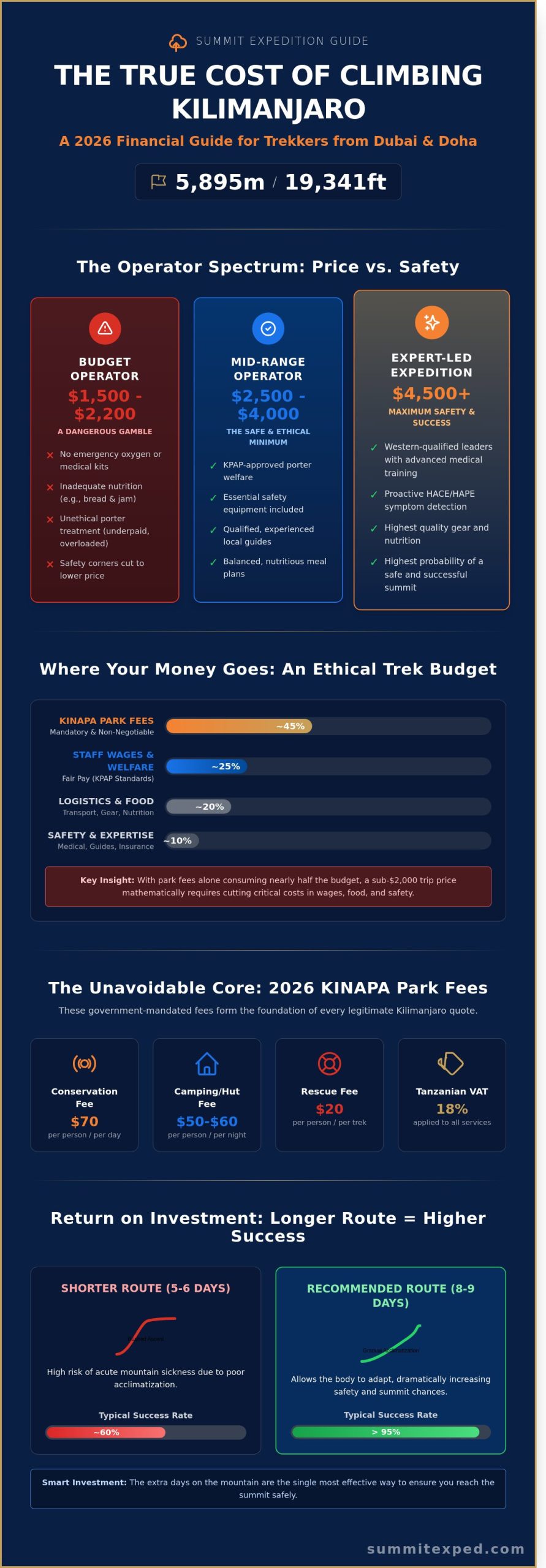
Operators generally fall into three brackets. Budget outfits charge between $1,500 and $2,200. Mid-range companies sit between $2,500 and $4,000. Expert-led or luxury expeditions start at $4,500 and go up from there. If you find a quote for $1,500, it’s a massive red flag. Fixed park fees for Mount Kilimanjaro consume nearly $1,000 of that budget for a standard seven-day route. This leaves the operator with almost nothing to pay staff, maintain gear, or buy quality food.
To better understand how these costs break down on the ground, watch this helpful video:
The Danger of Budget Operators
Cheap treks often cut corners where it hurts most. I’ve seen budget groups on the mountain without a single bottle of emergency oxygen or a working pulse oximeter. Their nutrition often consists of white bread and jam. This provides a quick sugar spike followed by a total energy crash, which is a recipe for failure when you’re pushing your body at 4,000m (13,123ft). There’s also a dark side to these low prices. Operators often underpay porters or force them to carry excessive weight to save money. When your crew is cold, hungry, and exhausted, they can’t look after you properly in an emergency. Ethical treatment isn’t just a moral choice; it’s a safety requirement.
Why Expert Leadership Justifies the Premium
The real value of a premium expedition lies in the decision-making at 5,895m (19,341ft). A Western-qualified leader brings a layer of clinical oversight that local-only crews sometimes lack due to different training standards. We’re trained to spot the subtle, early signs of High-Altitude Cerebral Oedema (HACE) before they become fatal. It’s about having someone who can say “no” when your ego wants to keep going but your lungs are failing. You can see how we manage these high-stakes environments on Caroline Leon’s YouTube channel. Investing in expert leadership means you’re paying for the experience to get you home safely, not just to the top. This is the most critical factor in your cost to climb kilimanjaro calculation for 2026.
Fixed Costs: The Unavoidable Expenses in 2026
When you’re looking at the total cost to climb kilimanjaro, it’s easy to get lost in the spreadsheets. Some numbers simply aren’t up for debate. These are the fixed costs set by the Tanzanian government and the ethical standards we uphold to ensure the mountain remains a sustainable workplace. I’ve seen climbers try to haggle on these points, but cutting corners here usually means compromising on safety or the fair treatment of the crew. In 2026, you can expect these base expenses to form the foundation of every legitimate quote.
Mandatory National Park Fees
The Kilimanjaro National Park (KINAPA) fees are the largest non-negotiable expense. These include conservation fees at roughly $70 per day, camping or hut fees at $50 to $60 per night, and a mandatory rescue fee of $20 per trek. The Tanzanian government also applies an 18% VAT to all park services, which often catches budget-conscious climbers by surprise. While a shorter 5-day trek might look cheaper on paper, I always recommend the 8-day or 9-day routes. Spending more on daily fees is a direct investment in your safety. Longer itineraries allow your body to adapt to the thinning air above 3000m (9,842ft), which is the most effective way to prevent altitude sickness and reach the 5895m (19,341ft) summit successfully.
Staff Wages and Tipping Culture
We follow the strict guidelines set by the Kilimanjaro Porters Assistance Project (KPAP). In 2026, the daily wage for a porter starts at 20,000 TZS, while guides and cooks earn significantly more based on their expertise. Beyond the base wage, tipping is a deep-rooted tradition and a vital part of the local economy. You should budget between $250 and $350 for tips. A transparent operator will always provide a clear tipping breakdown before you fly. This ensures your crew is treated with the respect they deserve for carrying your gear and keeping you safe in the wilderness.
Logistics and Equipment Maintenance
The logistics of a high-altitude expedition extend far beyond the trail. Your fee covers transfers from Kilimanjaro International Airport (JRO) and at least two nights in a reliable hotel in Moshi or Arusha. We also factor in the “hidden” cost of gear. Using high-quality, four-season tents like the Mountain Hardwear Trango series requires constant maintenance. Replacing zips, waterproofing flies, and renewing poles after heavy alpine seasons ensures your home at 4000m (13,123ft) remains a sanctuary. If you want to see how we manage these details on the ground, you can explore my approach to expedition leadership.
The Middle East Factor: Flights, Gear, and Training
Living in the Gulf offers a distinct advantage when calculating the total cost to climb kilimanjaro. You’re roughly five hours away from Tanzania, which significantly reduces travel fatigue compared to climbers arriving from Europe or the US. However, preparing for a frozen summit while living at sea level in a desert climate requires specific logistical planning and a dedicated budget for specialized training.
Flights and Travel Logistics
Airlines like Qatar Airways, Ethiopian Airlines, and FlyDubai provide the most reliable connections to Kilimanjaro International Airport (JRO). If you’re flying from Dubai (DXB) or Abu Dhabi (AUH), you’ll likely pay between $600 and $900 for a return ticket. I’ve found that booking at least four months in advance is the sweet spot for securing these rates. Beyond the flight, remember to set aside $50 to $100 for your visa, depending on your nationality. Most GCC residents can obtain a visa on arrival, but it’s vital to check the latest U.S. State Department Travel Advisory for Tanzania to stay updated on current entry requirements and health protocols. Don’t overlook specialized travel insurance. Standard policies often exclude trekking above 3,000m, so you must ensure your coverage extends to 6,000m (19,685ft) to account for emergency evacuation.
Of course, for those accustomed to the ultimate in travel flexibility for business or other adventures, options like a private jet charter london offer a different level of logistical control. For this specific journey to the roof of Africa, however, commercial carriers remain the most practical choice.
Gear Sourcing in Dubai and the GCC
Sourcing technical mountaineering gear in the Middle East has become much easier with retailers like Adventure HQ and Decathlon stocking high-altitude essentials. A full technical kit, including four-season boots and moisture-wicking layers, can cost upwards of $1,500. If this is a one-off adventure, I always suggest the “Buy vs. Rent” strategy. Buy your boots and base layers to ensure a perfect fit and hygiene. Rent your heavy down jacket and -15°C sleeping bag in Moshi for a fraction of the price. This approach can bring your initial gear cost to climb kilimanjaro down to approximately $500.
High-Altitude Training in the Desert
Preparing your lungs for 5,895m (19,341ft) while living at sea level is your biggest challenge. I recommend a structured six-month fitness programme that combines cardiovascular endurance with weighted pack walks. Use the local landscape to your advantage. Jebel Hafeet in Al Ain and the rugged trails of Wadi Showka or Jebel Shams in Oman offer “free” vertical gain training. For those with a higher budget, altitude centre sessions in Dubai or Abu Dhabi are invaluable. These facilities simulate low-oxygen environments, helping your body produce more red blood cells before you depart. Expect to pay around $30 for a single session or $250 for a block of ten. You can find more of my specific training routines at caroline-leon.com to help you prepare effectively.
Calculating the ROI: Success Rates vs. Daily Cost
When you look at the cost to climb Kilimanjaro, it’s easy to get fixated on the bottom line. However, the cheapest itinerary often becomes the most expensive mistake you’ll ever make. I’ve seen far too many climbers choose a 5-day “budget” trek only to find themselves turning around at 4,000m (13,123ft) because their bodies simply couldn’t cope. A 5-day trek is effectively the most expensive ‘failure’ you can buy. You pay 80% of the price but give yourself less than a 50% chance of standing on the roof of Africa.
The correlation between price and success is simple: time equals safety. By investing in a longer route, you’re paying for the extra days required for your physiology to adapt. High-quality expeditions also factor in the price of life-saving equipment. In 2026, a professional outfit should never step onto the mountain without automated external defibrillators (AEDs) and comprehensive mountain-specific medical kits. These tools, along with pulse oximeters used twice daily, are what separate a lucky summit from a managed expedition.
Nutrition is the other silent factor in your ROI. At high altitude, your body burns through 3,500 to 4,000 calories a day just to maintain basic functions. If your operator cuts costs on food quality, your engine will stall. We prioritise nutrient-dense, fresh produce that remains palatable even when altitude-induced nausea kicks in. Quality fuel is the only way to ensure you have the energy for the final 1,200m (3,937ft) push to Uhuru Peak.
Route Choice and Acclimatisation
Acclimatisation is the process of adjusting to decreased oxygen at 3,000m (9,843ft) and above. Routes like the Lemosho and Northern Circuit offer 8 or 9-day schedules, resulting in success rates exceeding 90%. Conversely, the Marangu and Machame “short” routes have much lower success rates because they force an ascent profile that ignores basic mountain medicine. Spending more on a longer route isn’t a luxury; it’s a strategic investment in your own success.
The ‘Subtle Insights’ of a Professional Leader
Success often hides in the details that budget operators ignore. For our 2026 expeditions, we’ve upgraded to double-walled tents. These are essential for preventing internal condensation from freezing and dripping on your sleeping bag at night. We also insist on private toilet tents. Maintaining high standards of hygiene and personal comfort isn’t about being pampered; it’s about preventing the gastrointestinal issues that end 15% of all Kilimanjaro attempts. You can check out caroline-leon.com for more on the mindset and preparation needed for a successful summit.
Ready to invest in a trek that actually gets you to the top? View our high-success 2026 itineraries here.
Booking Your 2026 Expedition with Summit Expeditions
Choosing a partner for your trek is the most critical decision you’ll make before leaving Dubai. When you look at the total cost to climb kilimanjaro, you’re paying for more than just a tent and a guide. You’re paying for a safety net that spans two continents. Our 2026 expedition packages include all Tanzanian National Park fees, emergency oxygen, high-quality mountain meals, and 4-star hotel stays in Arusha. We exclude international flights and personal insurance, but we provide a transparent breakdown so there are no surprises when you land.
Ethics sit at the heart of how I run these trips. We are fully compliant with the Kilimanjaro Porters Assistance Project (KPAP). This means we guarantee fair wages, proper clothing, and three nutritious meals a day for the crew. Many operators cut corners here to lower their prices, but I refuse to compromise on the dignity of our Tanzanian mountain family. Supporting the local community is a core part of the journey, not an optional extra.
The Summit Expeditions Difference
Our Dubai-based team offers a level of preparation you won’t find with generic booking platforms. We keep our group sizes small, usually capped at 12 climbers, to ensure personalised safety management. I’ve seen far too many people arrive at 3,000m (9,842ft) only to realise their boots don’t fit or their layers are insufficient. We hold in-person gear checks in Dubai to catch these issues before you fly. We also host monthly training webinars for our Middle East clients, focusing on everything from physical conditioning to the mental shifts needed for high-altitude success. For those serious about maximizing their summit chances, our comprehensive training for kilimanjaro programme for Dubai and Middle East climbers provides the specific preparation needed to overcome the challenges of living at sea level while preparing for a 5,895m summit.
Next Steps for Your Journey
Securing your spot for the 2026 season is straightforward. We require a $500 deposit to lock in your dates, with the balance due 60 days before departure. Our 2026 calendar focuses on the primary dry seasons, specifically the January to March window and the June to October window. These months offer the most stable weather for reaching the summit at 5,895m (19,341ft). Understanding the best time to climb kilimanjaro for Dubai adventurers is crucial for maximising your chances of success while aligning with UAE public holidays.
- Flexible Booking: We offer easy rescheduling if your work commitments in the UAE change.
- Bespoke Consultations: You can book a one-on-one session at our Dubai office to discuss your fitness levels.
- Expert Guidance: Every expedition is led by guides who understand the specific needs of climbers travelling from sea-level environments.
If you’re ready to commit to this challenge, reach out to us at caroline-leon.com. We can walk you through the itinerary, discuss the cost to climb kilimanjaro in detail, and help you start your training plan today. The mountain is waiting, and we’re here to make sure you’re ready for it.
Start Your 2026 Ascent
Your journey to the 5895m (19,341ft) summit begins with a clear-eyed look at the numbers. We’ve broken down why the 2026 cost to climb kilimanjaro reflects more than just a permit; it’s an investment in safety, ethics, and your own success. Don’t cut corners on your acclimatisation. Our 8-day routes currently hold a 95% summit success rate because they give your body the time it needs to adapt. I’ve learned through years of leading expeditions that the cheapest option often carries the highest hidden price in safety risks and poor support.
Beyond the gear and flights from Dubai, ensure your provider follows strict KPAP standards for porter welfare. It’s the only way to climb with integrity. At Summit Expeditions, we take care of the complex logistics so you can focus entirely on the mountain. I’ll be there to guide you through every stage of preparation, from choosing the right boots to mastering your mindset. Let’s get you ready for the trek of a lifetime. Plan your 2026 Kilimanjaro Summit with Summit Expeditions today. The roof of Africa is waiting for you.
Frequently Asked Questions
Is it cheaper to book a Kilimanjaro climb locally in Tanzania?
Booking locally in Tanzania can save you $500 to $800, but it requires careful vetting. Low cost operators often cut corners on safety equipment and porter wages. I’ve seen teams struggle because their budget local booking didn’t include enough oxygen or high quality food. For 2026, expect to pay at least $2,500 for a reputable local operator who prioritises safety and fair treatment of their mountain crew.
How much should I budget for tips on Kilimanjaro in 2026?
You should budget between $250 and $350 per climber for tips in 2026. This isn’t just a bonus; it’s a vital part of the mountain economy. We follow KPAP guidelines to ensure every porter, cook, and guide receives a fair share. I recommend bringing US Dollars printed after 2021 in small denominations. This ensures your hard working crew can easily exchange or use the cash in Arusha.
What is the total cost including flights from Dubai?
The total cost to climb Kilimanjaro for a Dubai resident usually ranges between $4,800 and $6,200 for a high quality expedition. You’ll spend roughly $850 on a return flight with FlyDubai or Emirates. The trek itself costs around $3,200, while insurance, visas, and gear rentals add another $750. I always tell my Dubai teams to keep an extra $300 in their pocket for celebratory dinners after the climb.
Do I need to buy all my gear, or can I rent it in Arusha?
You can rent about 70% of your kit in Arusha, including heavy items like down jackets and -15°C (5°F) sleeping bags. Rental costs for a full kit package usually hover around $200 for the week. However, don’t rent your boots. You need to buy your own pair and walk at least 60km in them before arriving. Ill fitting rental boots are the quickest way to end your summit dreams.
Is travel insurance for Kilimanjaro expensive for UAE residents?
Travel insurance is quite affordable for UAE residents, typically costing between $120 and $180 for a comprehensive policy. The key is ensuring it covers trekking up to 6,000m (19,685ft). Many standard policies stop at 3,000m (9,842ft), which is useless once you pass Barranco Camp at 3,900m (12,795ft). I use providers that specifically mention mountaineering and search and rescue to avoid any expensive surprises during an emergency.
Why do some routes cost significantly more than others?
Route prices vary because of the number of days spent on the mountain and the size of the support crew. A 9-day Northern Circuit costs roughly $1,200 more than a 6-day Marangu trek. This covers extra park fees of $100 per day and more food for the team. While it’s pricier, the extra time for acclimatisation at 4,000m (13,123ft) increases your summit success rate by nearly 35%.
Can I climb Kilimanjaro on a budget of under $2,000?
Attempting the climb on a budget under $2,000 is extremely difficult, as the fixed cost to climb Kilimanjaro includes roughly $950 in park fees alone. When an operator offers a price below $2,000, they usually underpay porters or provide substandard emergency equipment. I’ve found that spending $2,800 or more ensures you have the medical support and professional guides needed for a safe 5,895m (19,341ft) summit attempt.
What happens if I need to be evacuated, and how much does it cost?
If you need a helicopter evacuation, it can cost between $2,500 and $5,000 without the right coverage. We require all our climbers to register for the AMREF Flying Doctors service for $25. This covers the flight costs if you’re injured or suffer from severe altitude sickness above 3,000m (9,842ft). Most evacuations happen because of pulmonary oedema, so having this $25 insurance is the smartest investment you’ll make.
Is it difficult to book a Kilimanjaro climb from Dubai?
The process is more straightforward than many expect, but it requires careful planning around operator selection, route choice, and timing. Our detailed guide to how to book your Kilimanjaro climb for 2026 as a Dubai-based climber walks you through every step, from choosing the right route to managing the logistics of flying from the Middle East to Kilimanjaro International Airport.