The biggest mistake most Middle East based climbers make isn’t a lack of fitness; it’s underestimating how a 50 degree temperature swing impacts their performance. You’ve likely felt the frustration of trying to find high-altitude training grounds in a landscape of sand and skyscrapers. Preparing to climb mount elbrus from the GCC presents unique hurdles, from securing a Russian visa in Dubai or Doha to finding technical gear that actually works at 5642m (18,510ft). It’s a massive leap from the humidity of the Gulf to the biting winds of the Caucasus.
I understand that transition because I’ve lived it. This guide bridges the gap, offering the exact logistical framework and technical training plan I’ve used to help desert dwellers successfully stand on Europe’s highest point. We’ll break down the 2026 visa protocols, specific acclimatisation strategies for those living at sea level, and the precise gear list you’ll need to survive the transition from the heat to the ice. Whether you’re a weekend hiker or an aspiring mountaineer, this is your roadmap to a successful summit.
Key Takeaways
- Understand the critical differences between the infrastructure-heavy South Route and the wild North Route to choose the path that best suits your technical goals.
- Learn how to effectively train for a climb mount elbrus while living at sea level by building “mountain legs” using specific stair-climbing routines in the GCC.
- Master the layering system and technical gear requirements needed to handle the brutal transition from Dubai’s humidity to the -20°C conditions at 5642m (18,510ft).
- Streamline your expedition logistics with updated 2026 advice on flight connections from the Middle East and the latest Russian visa requirements for expats.
- Gain field-tested insights into the unique physiological challenges of ascending Europe’s highest peak and how to manage acclimatisation effectively.
What is Mount Elbrus? Europe’s Highest Peak Explained for GCC Adventurers
Mount Elbrus is a massive, dormant volcano that dominates the horizon of the Caucasus Mountains in Southern Russia. Standing at 5642m (18,510ft) above sea level, it’s officially the highest point in Europe. This status makes it one of the prestigious Seven Summits, the highest peaks on each of the seven continents. For those of us living in the urban sprawl of Dubai or Doha, the contrast is staggering. You trade the shimmering glass of the Burj Khalifa for a rugged, glaciated wilderness. The Baksan Valley offers a level of isolation that feels worlds apart from the 24-hour bustle of the GCC. It’s a place where the air is thin, the silence is heavy, and the terrain is unforgiving.
If you’ve already stood on the roof of Africa, you’ll find that to climb mount elbrus is the logical next step in your mountaineering journey. Kilimanjaro is primarily a test of lung capacity and mental grit on dusty trails. Elbrus raises the stakes. It introduces you to the world of glaciated mountaineering. You’ll move from trekking boots to double boots, and from walking poles to ice axes. It’s the perfect training ground for anyone looking to transition from high-altitude hiking to genuine alpine climbing in 2026. For those with ambitions beyond a single peak, Elbrus is also a foundational step in climbing the seven summits — a journey that is more achievable for GCC-based adventurers than most people realise.
The Geography of the Caucasus Range
The Caucasus Range acts as a dramatic physical border between Europe and Asia. Elbrus itself is unique because of its distinct twin-peak structure. The West Summit reaches 5642m (18,510ft), while the East Summit sits slightly lower at 5621m (18,442ft). While both are impressive, the West Summit is the primary objective for international expeditions because it holds the title of the highest point on the continent. The mountain is covered in 22 different glaciers, which feed the rivers that flow through the surrounding valleys. When you climb mount elbrus, you’re navigating a landscape shaped by ancient volcanic activity and shifting ice.
Why Elbrus is a “Trekking Peak” with a Twist
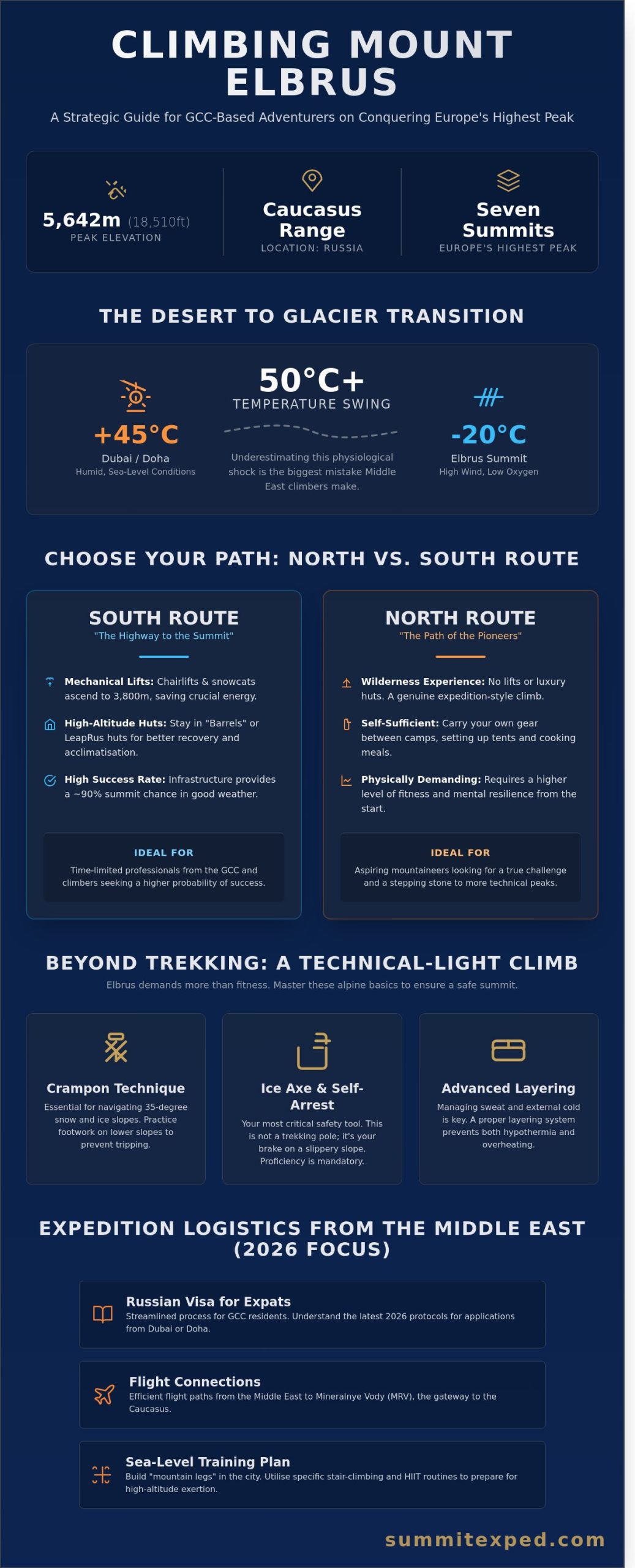
In mountaineering circles, Elbrus is often called a trekking peak. This label can be dangerous if you don’t respect the mountain. It isn’t a standard hike; it’s a non-technical mountaineering expedition. You won’t need to scale vertical rock walls, but you must be comfortable using crampons and performing a self-arrest with an ice axe on 35-degree snow slopes. The weather in the Caucasus is notoriously fickle, with storms blowing in from the Black Sea in less than 30 minutes. You need to be prepared for sub-zero temperatures and high winds, even in the peak summer months.
- Preparation tip: Don’t wait until you’re on the glacier to learn how to walk in crampons. Practice your footwork on lower slopes to avoid catching a point on your trousers.
- Lesson learned: The physical toll of the summit day on Elbrus is often higher than Kilimanjaro due to the steeper gradient and colder conditions.
- Common mistake: Underestimating the “technical-light” nature of the climb and failing to train for the specific muscle groups used in snow travel.
Elbrus is a technical-light mountain that demands basic alpine proficiency without requiring the advanced rope work found on more vertical peaks.
North vs. South: Comparing the Best Routes to Climb Mount Elbrus
Choosing between the north and south sides of Elbrus isn’t just about difficulty; it’s about the kind of story you want to tell. Most people who climb mount elbrus choose the south side because it offers a safety net of infrastructure. The north side is for those who want to feel the weight of the mountain on their shoulders. For my Dubai-based clients, this decision usually comes down to how much time they can take off work and whether they’re using this peak as a stepping stone for something bigger.
The South Route: Convenience and Capability
The South Route is the mountain’s “highway,” but don’t let that fool you into thinking it’s easy. It’s popular because it’s efficient. You’ll stay in the “Barrels” or more modern high-altitude huts like LeapRus, situated at roughly 3,800m (12,467ft). These provide a solid roof, beds, and often a chef, which means your body recovers faster between acclimatisation hikes. The biggest advantage is the chairlift system. By using the lifts to reach 3,800m (12,467ft), you save your legs for the final 1,842m (6,043ft) push to the summit. For a professional living in the DIFC with only 9 days of annual leave, this route offers a 90% success rate when the weather holds. It’s about maximising your chances in a tight window.
The North Route: The Path of the Pioneers
The North Route is a different beast entirely. There are no lifts, no snowcats, and no luxury huts. You carry your own gear, often including tents and stoves, between camps. You’ll move from the base camp at 2,500m (8,202ft) to the high camp at 3,800m (12,467ft) with a 15-20kg pack. It’s physically draining but incredibly rewarding for those seeking a “pure” experience. I often recommend the North to climbers training for technical peaks like Aconcagua or Denali. It builds the mental resilience you can’t get when a snowcat drops you off at 4,700m (15,420ft). You earn every single metre on foot. If you’re unsure which path matches your current fitness level, I’ve shared more about my own training blocks on my personal site.
A few field-tested tips for your choice:
- South Side: Bring earplugs. The huts are noisy, and sleep is your best tool for acclimatisation.
- North Side: Don’t skimp on your boots. You’ll be doing significantly more load-carrying on rougher terrain than the South.
- Success Rates: The South side generally sees higher success because the physical toll of the approach is lower.
Ultimately, the South side is about the summit; the North side is about the journey. If you’re coming from the sea-level humidity of the UAE, the South’s infrastructure helps mitigate the shock to your system. However, if you want to test your absolute limits in a wilderness that feels untouched, the North is waiting.
Training for 5642m (18,510ft) in the Desert: Preparing for Elbrus from Dubai and Doha
Training for a glacier while living in a desert requires a specific kind of madness and a lot of discipline. When you prepare to climb mount elbrus from the GCC, your biggest hurdle isn’t just the lack of incline; it’s the physiological gap between sea level and 5642m (18,510ft). You’re training your body to perform on a summit day that often lasts 12 to 15 hours in temperatures that can plummet to -30°C. Doing this while it’s 40°C outside in Dubai or Doha takes more than just physical fitness. It takes a shift in mindset.
The goal is to build “mountain legs” without having a mountain. You need to focus on vertical gain and aerobic capacity. Endurance, not speed, is the currency of the Caucasus. If you can’t move comfortably for eight hours straight at sea level, you’ll struggle when the oxygen levels drop by nearly 50 percent on the upper slopes of Elbrus.
The Dubai Staircase Strategy
In a flat landscape, stairs are your best friend. I spent months in the stairwells of JLT and towers near the Burj Khalifa to prepare my legs for the relentless ascent. Don’t just walk them; use a weighted vest. Start with 5kg and increase the load by 2kg every fortnight until you’re comfortably carrying 15kg. This mimics the weight of your pack and builds the eccentric strength required for the long descent. For more detailed protocols, I’ve shared specific Caroline Leon’s training insights on building functional strength that actually translates to high-altitude success.
Cardio and Respiratory Conditioning
Forget HIIT for a moment. Your priority is Zone 2 training. These are long, slow sessions where you can still hold a conversation. This builds mitochondrial density and teaches your body to burn fat efficiently, which is vital for the 15 hour push to the peak. While some climbers in the Middle East use altitude masks or hypoxic tents to simulate thin air, they’re no substitute for raw cardiovascular volume. Masks can strengthen your respiratory muscles, but they don’t mimic the blood chemistry changes of real altitude. Focus on the basics: long weekend hikes in the Hajar Mountains or six-hour sessions on a treadmill at a 10% incline. To successfully climb mount elbrus, your heart needs to be a slow-revving, unstoppable engine.
- Visualisation: While training in the desert heat, practice “mental cold.” Visualise the wind off the Black Sea and the bite of the snow. It builds the mental resilience needed for the Saddle.
- Consistency: Aim for four days of weighted incline work and one day of long-duration active recovery.
- The Descent: Don’t ignore the down. Use the stairs to go down as well as up to condition your knees for the 2000m (6,561ft) drop after the summit.
Gear, Weather, and Technical Skills: Realities of the Caucasus Range
Leaving the 40°C humidity of Dubai for the frozen slopes of the Caucasus is a massive shock to the system. You will go from sweating in Terminal 3 to facing -20°C winds on the summit ridge. This transition is not just about being uncomfortable; it is about survival. When you climb mount elbrus, your gear acts as your life support system. I have seen many climbers underestimate the “Elbrus Factor,” which is the mountain’s habit of brewing violent storms out of nowhere. We do not just hope for good weather. We use professional forecasting and strategic “summit windows” to ensure you are moving when the mountain is at its most cooperative.
Essential Gear for the Summit
You cannot compromise on your summit down jacket or your boots. I have watched people try to use standard hiking boots, only to turn back with early-stage frostbite because they ignored the need for 8000m-rated double boots. The snow and the metal of your crampons will pull the heat right out of your soles. For eyewear, Category 4 lenses are non-negotiable. The snow reflects up to 80% of UV rays. Without proper protection, snow blindness can set in within an hour. GCC residents can find high-quality kit at specialized shops in Dubai, or you can source it through us. For a deep dive into my personal kit list, check out Caroline Leon’s gear breakdown on YouTube.
Managing the “Elbrus Factor”: Weather and Wind
The weather in the Caucasus is notoriously fickle. A clear morning can transform into a dangerous whiteout in less than 20 minutes. This is why our safety protocols are so rigid. We maintain a 1:3 guide-to-client ratio, which is significantly better than the industry average. This ensures that if one person needs to descend, the rest of the team can safely continue their push.
Technical skills are taught on the mountain during our acclimatisation rotation to the Pastukhov Rocks at 4700m (15,420ft). You do not need to be a pro climber before you arrive, but you must be ready to learn. We will spend hours practicing:
- Crampon work: Learning to walk without tripping on your own feet.
- Ice axe self-arrest: The reflex move that stops a slide on steep ice.
- Rope travel: How to move as a synchronized unit on the upper glaciers.
These skills turn a dangerous trek into a managed adventure. Every drill we do at 4700m (15,420ft) is designed to make the final summit push feel like second nature.
Ready to master the skills needed for the summit? Book your spot on our 2026 Elbrus expedition.
Organising Your Elbrus Expedition: Logistics from the Middle East
Getting from the desert heat to the glaciated slopes of the Caucasus takes more than just a plane ticket. It requires a logistical bridge. Most of my climbers fly from Dubai (DXB) or Doha (DOH) via Istanbul (IST) to reach Mineralnye Vody (MRV). In 2026, this remains the most efficient route, with total travel times usually ranging between 9 and 12 hours. It’s a long day of travel, but it’s the gateway to the high mountains.
I’ve found that booking with a Middle East-based operator like Summit Expeditions provides a layer of cultural alignment you won’t find with European or Russian-only outfits. We understand the specific needs of climbers coming from the GCC, from dietary requirements to the physical transition from sea level to 5642m (18,510ft). Our Oman-led expertise combines local regional knowledge with global safety protocols, ensuring you aren’t just a number on a permit list. When you decide to climb mount elbrus with us, we manage the friction of international logistics so you can focus on your training.
Visa and Travel Requirements
Navigating Russian bureaucracy is often the most daunting part of the prep. You’ll need a Russian Tourist Visa, which requires a formal Letter of Invitation (LOI). We issue these to our team members 60 days before departure. Once you arrive in the Baksan Valley, registration with local authorities is mandatory within 7 working days. We handle this process on the ground to avoid any legal hiccups. If you’re transiting through Istanbul, I recommend a layover of at least 4 hours. Tight connections are the primary reason gear bags fail to arrive at MRV on time. Our 2026 safety protocols include daily briefings on regional travel advisories, ensuring our route from the airport to the mountain remains secure and efficient.
Your Summit Journey Starts Here
Our 12-day itinerary is designed for success, not speed. We spend 4 dedicated days on acclimatisation hikes, reaching heights of 4700m (15,420ft) before we even consider a summit bid. This “pole pole” approach, a habit I brought from my time on Kilimanjaro, is what gets people to the top safely. Standing on the roof of Europe at 5642m (18,510ft) is an emotional milestone that words rarely capture. It’s the culmination of months of grit and sweat in the Dubai gyms. If you’re ready to climb mount elbrus and stand where few others have, join our next expedition. You can find more details on our upcoming dates at caroline-leon.com. Let’s get you to the top.
From the Desert Heat to the Caucasus Snow
Standing on the summit of Europe at 5642m (18,510ft) requires more than just grit. It takes a calculated approach to training and logistics that starts long before you reach the Russian border. We’ve found that success for GCC-based climbers depends on bridging the gap between sea-level living and high-altitude reality. You’ll need to decide between the technical solitude of the North route or the established infrastructure of the South. Both paths demand respect and a dedicated 12-week physical preparation phase to handle the thin air.
At Summit Expeditions, we don’t believe in crowded groups. We maintain a strict 1:3 guide-to-climber ratio to ensure your safety and individual pacing are never compromised. Led by Nadhir Al Harthy, Oman’s premier high-altitude climber, our team provides the subtle insights that only come from years spent in the mountains. We’ve built tailored training programmes specifically for adventurers in Dubai and Doha to ensure you’re ready for the 2026 season. When you decide to climb mount elbrus, you’re choosing a journey that will change your perspective forever. For those looking to take their mountaineering to the next level, many of our Elbrus graduates go on to climb Aconcagua from Dubai, using the technical skills and high-altitude experience gained on Europe’s highest peak. Elbrus itself is a cornerstone of climbing the seven summits, and our GCC-focused approach gives Middle East adventurers a clear, practical pathway to completing the full list.
Book your Mount Elbrus expedition with Summit Expeditions today and let’s start getting you ready for the peak. The mountain is waiting, and we’re ready to help you reach it.
Frequently Asked Questions
How hard is it to climb Mount Elbrus compared to Kilimanjaro?
Elbrus is technically harder and more physically demanding than Kilimanjaro because it requires moving on snow and ice. While Kili is a high-altitude trek, a successful climb mount elbrus attempt involves using crampons on 35 degree slopes. You’ll face temperatures dropping to -20°C (-4°F) on summit night, which is significantly colder than the African plains. It’s a step up that requires much better cold-weather management.
Do I need previous mountaineering experience to climb Elbrus?
You don’t need a professional resume, but basic winter skills are essential for your safety. Most 2026 expeditions include a 2 day skills workshop on the lower slopes to teach you self-arrest and crampon techniques. I’ve seen many fit hikers struggle because they haven’t practiced moving in heavy plastic boots or managed their layers in high winds. Preparation in the gym is only half the battle.
What is the best time of year to climb Mount Elbrus?
The primary climbing season runs from June to August when the weather is most stable. During this 92 day window, the snow is usually firm and the daylight hours are longest. Avoid the shoulder months of May or September unless you’re an expert. Historical data shows that 40% of summit attempts in early May are turned back by sudden, violent storms that roll in without warning.
Is it safe to travel to the Caucasus region for climbing in 2026?
Safety depends on current geopolitical stability and following official travel advisories from the UAE Ministry of Foreign Affairs. Based on security data from 2024, the Baksan Valley remains a dedicated tourist zone with a constant security presence at the 3 main checkpoints. We monitor the 24 hour news cycles to ensure our 2026 routes remain well away from any restricted border zones near the 700km (435 mile) frontier.
How much does it cost to climb Mount Elbrus from Dubai?
A standard 10 day expedition from Dubai typically costs between 11,000 AED and 15,500 AED. This price includes your return flights from DXB to Mineralnye Vody, which usually cost about 2,200 AED on FlyDubai. You should also budget an extra 1,800 AED for specialised gear rentals and the mandatory 50 USD park entry permits required by the regional Russian authorities for all international climbers.
What happens if I get altitude sickness on the mountain?
We follow a strict descent protocol if you show symptoms of Acute Mountain Sickness at 4,000m (13,123ft) or higher. Our guides carry pulse oximeters to check your oxygen saturation levels every 6 hours. If your saturation drops below 75% or you develop a persistent headache, we immediately move you down to the base camp at 2,300m (7,545ft) for recovery. Safety always overrides the summit’s pull.
Can I use my Kilimanjaro gear for Elbrus, or do I need new equipment?
You can reuse about 60% of your Kilimanjaro kit, but you’ll definitely need specialised winter gear for Elbrus. Your soft-shell trekking boots won’t work on the ice; you need B2 or B3 rated mountaineering boots. To climb mount elbrus safely, you also need a 4-season down jacket rated for -30°C (-22°F) and Category 4 glacier goggles to prevent permanent snow blindness from the high-altitude glare.
How long is the summit day on Mount Elbrus?
Summit day is a grueling 12 to 15 hour push that starts at 3:00 am. You’ll gain approximately 1,000m (3,280ft) of vertical elevation from the Barrels Hut to the western peak at 5,642m (18,510ft). It’s a test of mental grit where most climbers burn over 4,500 calories before they even begin the long 4 hour descent back to the safety of the lower camps.