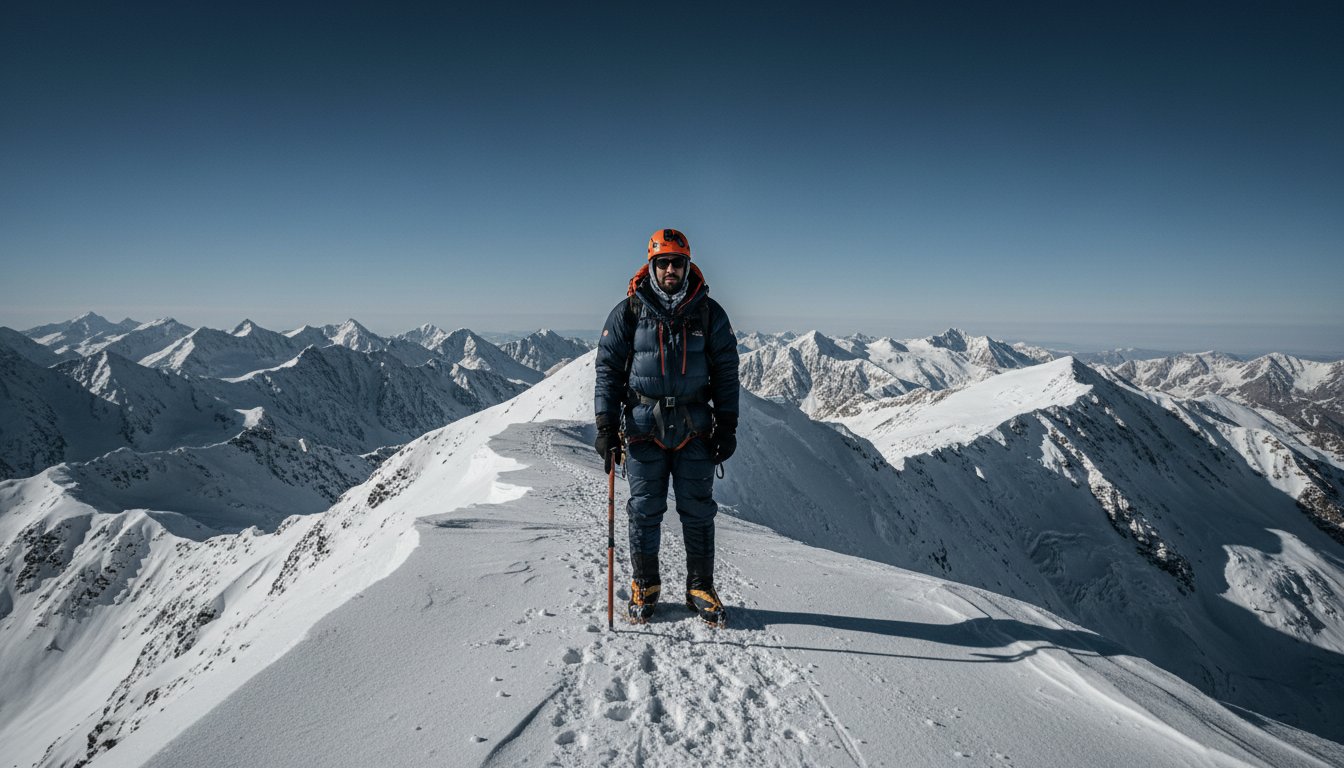
You don’t need a mountain in your backyard to stand on top of the world. Standing on the summit of Everest at 8848m (29,029ft) feels a world away from the heat of a Dubai summer, yet the gap is smaller than most people realise. Embarking on the journey of climbing the seven summits is a monumental challenge, particularly when your local training ground consists of flat desert roads or the internal stairs of a skyscraper. I understand the struggle of preparing for thin air while living at sea level and the headache of navigating complex flights from the GCC to the remote corners of Antarctica or South America.
This guide provides the exact roadmap you need to conquer the highest peak on every continent, offering practical advice tailored for climbers in our region. We’ll clarify the debate over the competing peak lists, outline a realistic training plan that works in a desert environment, and give you the confidence to manage the logistics of these life-changing expeditions. From managing altitude sickness to mastering your gear, here is how you bridge the gap between the dunes and the world’s highest points.
Key Takeaways
- Build a safe, logical progression by testing your body’s reaction to altitude on Kilimanjaro or Elbrus before committing to the extreme demands of Aconcagua at 6961m (22,838ft).
- Navigate the debate between the Bass and Messner lists to decide if your path to climbing the seven summits includes the technical rock of Carstensz Pyramid or the trekking route of Mount Kosciuszko.
- Learn how to transform the UAE’s desert terrain into a world-class training ground by utilising local landmarks like Jebel Jais and the ‘Stairway to Heaven’ to prepare for high-altitude life.
- Master the logistical advantages of using Dubai as a global expedition hub and gain “subtle insights” into gear choices that are often overlooked by even the most seasoned trekkers.
- Understand the critical importance of a safety-first mindset, focusing on meticulous planning and professional support to navigate the unique challenges of the world’s highest peaks.
What are the Seven Summits? Defining the Challenge
I’ve spent over 15 years on these peaks, and I can tell you that the journey is never just about the altitude. When we talk about What are the Seven Summits? we are describing a quest to stand on the highest point of each of the seven continents. It’s a massive undertaking that requires years of dedication and a huge amount of logistical coordination. For many, climbing the seven summits is the pinnacle of a mountaineering career. It’s a goal that forces you to adapt to everything from the humid jungles of Indonesia to the frozen, wind-swept expanse of Antarctica.
To better understand this concept, watch this helpful video:
The Bass vs. Messner Debate
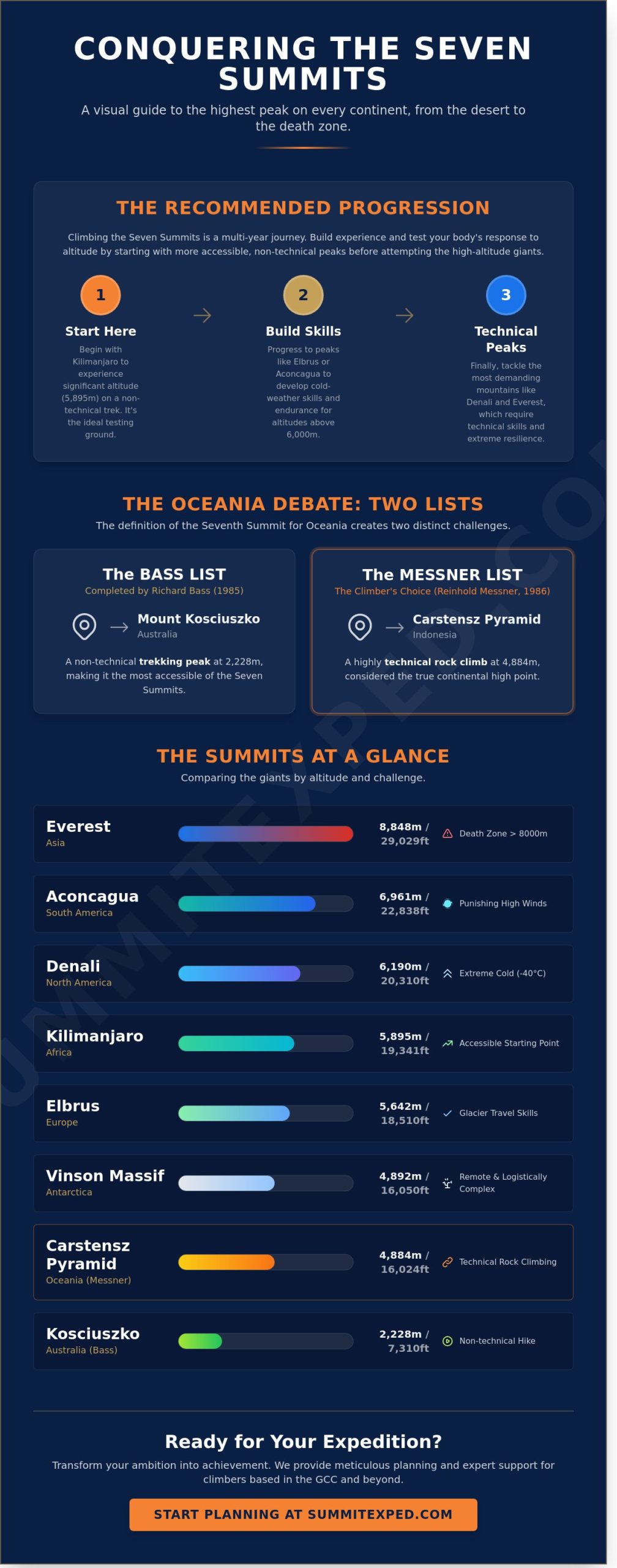
The list of peaks isn’t as straightforward as a map might suggest. On 30 April 1985, Richard Bass became the first person to finish the challenge. He used Mount Kosciuszko in Australia, which stands at 2228m (7,310ft), as the highest point for Oceania. Not long after, Reinhold Messner proposed a more difficult alternative. He finished his own list in December 1986, arguing that Puncak Jaya, or Carstensz Pyramid, at 4884m (16,024ft) should be the true continental summit because it sits on the same tectonic plate. Carstensz is a sharp limestone ridge that requires technical rock climbing skills and a 5.8 (Grade 15) difficulty rating. Kosciuszko is a pleasant hike. Because of this gap in technicality, the Messner list is now the gold standard for serious climbers. Many of us choose to climb both to cover all bases, a concept often called the “8th Summit” approach.
Why Pursue the Seven Summits?
People often ask me why I put myself through the cold and the thin air. The answer lies in the transformative power of the mountains. You aren’t just ticking boxes; you’re building a global community of peers and mentors. You learn the value of pole pole, the Swahili phrase for “slowly, slowly,” which we use constantly on Kilimanjaro. This mindset is essential for success on any massive goal. It’s about meticulous planning and respecting the local guides who make these expeditions possible. You find personal growth in the quiet moments at 5000m (16,404ft) when your lungs are burning but your spirit is soaring. If you want to see how I’ve navigated these challenges myself, you can find more on my personal site at caroline-leon.com. Every expedition is a lesson in resilience and authentic connection to the wild.
The Seven Peaks: A Quick Look at the Giants
Every mountain has its own temperament. When you’re climbing the seven summits, you aren’t just ticking off boxes; you’re learning to speak different languages of rock, ice, and thin air. The highest peaks of each of the world’s continents range from the humid forests of Indonesia to the frozen, wind-scoured plateaus of Antarctica. Mount Everest stands as the ultimate psychological and physical barrier at 8848m (29,029ft), but it’s not the only giant that demands respect. Aconcagua in Argentina reaches 6961m (22,838ft) and often surprises climbers with its punishing winds and high-altitude dust storms. If you’re looking for a starting point, Mount Kilimanjaro in Tanzania is widely considered the most accessible entry, offering a non-technical trek to 5895m (19,341ft).
The Technical Peaks: Denali and Everest
Denali is a beast. While its peak sits at 6190m (20,310ft), the low barometric pressure at its high northern latitude makes it feel much higher. You’ll be hauling 60kg (132lb) sleds across glaciers and managing extreme cold that can drop to -40°C. Everest requires a different kind of endurance. Beyond the technical hazards of the Khumbu Icefall, you’ll spend weeks acclimatising for the “Death Zone” above 8000m (26,247ft), where the body literally begins to die from lack of oxygen. Don’t underestimate the need for technical rope skills. Mastering the Jumar and learning to rappel safely on fixed lines are non-negotiable before you step foot on these two peaks.
The High Trekking Peaks: Kilimanjaro and Elbrus
Mount Elbrus in Russia is Europe’s highest point at 5642m (18,510ft). It’s a twin-coned glaciated volcano that requires crampons and ice axes but lacks the sheer verticality of the Himalayas. For those living in Dubai or Doha, Kilimanjaro is the perfect first step. It’s a direct flight away and requires no technical climbing, making it an ideal environment to see how your body reacts to altitude. Then there’s Vinson Massif. While it’s the lowest of the big summits at 4892m (16,050ft), the logistics are the real hurdle. Climbing in the Antarctic wilderness means you’re entirely dependent on a small window of summer weather and expensive private flights. If you’re ready to start your journey, you can see how I prepare for these environments at caroline-leon.com.
- Everest: High technicality and extreme altitude (8848m).
- Aconcagua: High physical demand and extreme winds (6961m).
- Denali: Self-sufficiency and extreme cold (6190m).
- Kilimanjaro: Accessible trekking and diverse ecosystems (5895m).
- Elbrus: Glaciated slopes and unpredictable weather (5642m).
- Vinson: Remote wilderness and complex logistics (4892m).
When climbing the seven summits, your success depends on choosing the right mountain for your current skill level. Don’t rush into Everest without first understanding how to manage your gear on Kilimanjaro or how to move on crampons on Elbrus. Experience is the only currency that matters at high altitude.
The Progression: Don’t Start with Everest
You don’t walk onto Everest without a resume. I’ve seen people try, and it rarely ends well. Climbing the seven summits is a game of patience and incremental skill acquisition. You need to understand how your body functions when oxygen is scarce before you commit to an 8,000m (26,247ft) peak. Think of it as a decade-long apprenticeship with the mountains. Each peak teaches a specific lesson that could save your life later on.
Building the Foundation
Kilimanjaro at 5,895m (19,341ft) is the perfect classroom. It’s where you learn the philosophy of pole pole, which means slowly, slowly in Swahili. This isn’t just a catchy phrase; it’s the biological requirement for successful acclimatisation. On Kili, you focus on hydration, pacing, and sleep hygiene without the distraction of technical gear. Many climbers also add Himalayan trekking peaks like Island Peak at 6,189m (20,305ft) to their early list. These peaks introduce you to basic crampon work and fixed lines in a controlled environment. You can find more details in this guide to climbing Mount Kilimanjaro.
Mastering the Technical Skills
Once you’ve handled the altitude of Africa, move to Mount Elbrus at 5,642m (18,510ft). Here, the focus shifts to glacier travel and unpredictable weather. You must master crevasse rescue and efficient ice axe self-arrest before you even consider the Alaskan range. Aconcagua, sitting at 6,961m (22,837ft), serves a different purpose. It’s a test of mental grit. In 2023, success rates on Aconcagua hovered around 30 percent; this is often because climbers underestimate the psychological toll of the 21 day itinerary. You’ll spend weeks in a high-altitude desert, moving heavy loads and dealing with relentless wind. It’s the closest you’ll get to the psychological grind of Everest without the technical complexity.
Denali at 6,190m (20,310ft) is arguably the hardest test before the Himalayas. You aren’t just climbing; you’re surviving. You’ll haul 60kg (132lbs) of gear across the Kahiltna Glacier and manage extreme cold that can drop below -40 degrees. This is where you prove you can look after yourself and your team in a truly hostile environment. Only after you’ve ticked these boxes should you look toward the Khumbu Icefall. Everest is the reward for the years of training you did on the smaller peaks while climbing the seven summits. It’s the culmination of your skills, not the place to start learning them.
Training for the Seven Summits in the Middle East
Living at sea level in cities like Dubai, Abu Dhabi, or Doha presents a unique set of hurdles when you’re climbing the seven summits. You start at 0m (0ft), far from the thin air of the peaks. However, the desert offers a secret weapon: the heat. Training in 40°C (104°F) or higher isn’t just about mental toughness. It actually improves your aerobic capacity. Scientific studies, including those from the University of Oregon, show that heat acclimation expands blood plasma volume. This helps your heart pump blood more efficiently, which is a massive advantage when you finally reach the cold, oxygen-depleted slopes of Aconcagua or Denali.
I often get asked about altitude masks and tents in the GCC. Masks are useful for strengthening your diaphragm, but they don’t change the oxygen percentage. They just make it harder to breathe. Altitude tents are a better investment for passive acclimatisation, though they can be hard to sleep in during a humid Dubai summer. Nothing beats time on your feet, so I focus on simulating the grind of a summit day right here in the desert.
Local Training Grounds in the UAE and Oman
Jebel Hafeet in Al Ain is a staple for my athletes. I recommend doing “stair repeats” on the service paths to rack up 1,000m (3,280ft) of vertical gain in a single session. For those preparing for the technical limestone of Carstensz Pyramid, the Hajar Mountains offer world-class scrambling. The “Stairway to Heaven” in Ras Al Khaimah is particularly good for building the head for heights you’ll need. Don’t forget Ski Dubai. It’s a small space, but it’s the only place in the region where you can test your heavy 8000m (26,247ft) boots and down gear to ensure nothing rubs or fails in the cold.
Cardio and Strength for the Desert Climber
The foundation of your programme must be Zone 2 training. This is low-intensity cardio where you can still speak in full sentences. It builds a massive aerobic base, allowing you to recover faster between big climbing days. You should also get comfortable with weighted pack walks. I’ve spent many mornings walking the Dubai Marina with a 20kg (44lbs) pack. It feels ridiculous at the time, but it’s the best way to conditioned your joints for the weight of a transition pack. You can find the specific training drills I use in the UAE on my YouTube channel to help structure your gym sessions.
Ready to see if your fitness is mountain-ready? Book a consultation with our expedition team to review your training plan.
Logistics and Preparation: The Summit Expeditions Approach
Success in climbing the seven summits isn’t won on the peak. It’s secured months earlier in the planning phase. Living in the GCC gives us a unique logistical edge. Dubai International Airport (DXB) serves as our primary gateway, offering direct connections that most Western climbers envy. We can reach Kathmandu for Everest or Mineralnye Vody for Elbrus with minimal layovers. This means we spend less time in transit and more time on the trail, arriving at base camp with more energy and less jet lag. A direct flight from DXB to Kilimanjaro takes roughly 5 hours and 30 minutes, allowing us to start our trek without the exhaustion of multiple connections.
I’ve learned that the most critical gear isn’t always the most expensive. Everyone remembers their ice axe, but few focus on their socks. A single damp seam can end a 6000m (19,685ft) expedition faster than a storm. I tell my climbers to pack three distinct layers of socks and to change them religiously. These subtle insights, the ones born from frostbite and long nights in a tent, are what keep you moving. We manage risk by looking at the small details that others overlook, ensuring our safety protocols are tailored for those transitioning from the humid heat of the Gulf to the sub-zero reality of high altitude.
Expedition Logistics from the GCC
We leverage our location to streamline the journey. Residents in the UAE and Oman benefit from simplified visa processes for many of these regions. My team handles the heavy lifting, from securing Russian permits for Elbrus to managing the complex paperwork required in Nepal. Having Caroline Leon as a local leader means you have someone who understands the cultural nuances of the Middle East while possessing the technical grit required for the world’s highest peaks. We bridge the gap between the desert and the glacier, providing a familiar support system in unfamiliar environments.
Mental Preparation and Mindset
Your CV and corporate success mean nothing at 5000m (16,404ft). The mountains are the ultimate leveller. I’ve seen the strongest athletes crumble because they couldn’t handle the “expedition blues,” that deep sense of isolation that hits during a week-long storm. You must prepare for the boredom as much as the exertion. When climbing the seven summits, remember that the peak is only the halfway mark. Our primary goal is always to return to our families in one piece. Safety isn’t a box to tick; it’s the entire foundation of why we climb. We focus on building the mental resilience to turn back when the mountain says no, which is the hardest skill to master.
Take Your First Step Toward the Peaks
Climbing the seven summits isn’t a project you finish in a single season; it’s a multi-year commitment that requires a deliberate, strategic progression. You’ve seen why starting with Mount Kilimanjaro at 5,895m (19,341ft) is the smartest entry point for adventurers based in the Middle East. It allows you to test your gear and your body’s response to altitude before moving toward the more technical demands of Denali or Everest.
At Summit Expeditions, we bridge the gap between the desert and the glaciers. Our team is led by Omani mountaineer Nadhir Al Harthy, who brings years of high-altitude experience and understands the specific training needs of GCC climbers. We combine this local insight with uncompromising safety protocols to manage the risks inherent in high-altitude environments. You don’t have to navigate the logistics alone. We provide the field-tested guidance required to transition from the heat of the Gulf to the world’s highest points successfully.
Start your Seven Summits journey with a Kilimanjaro expedition and let’s begin the work of getting you to the roof of Africa. The mountains are waiting, and I’ll see you on the trail.
Frequently Asked Questions
Which of the Seven Summits is the easiest for a beginner?
Mount Kilimanjaro in Tanzania is the most accessible peak for those starting their journey of climbing the seven summits. It stands at 5,895m (19,341ft) and is a non-technical trek, meaning you won’t need ropes or ice axes. Success rates on 8-day routes like Lemosho sit around 85%, making it a perfect entry point. It allows you to experience high-altitude camping and see how your body handles thin air without needing prior mountaineering skills.
How much does it cost to climb all Seven Summits?
Completing the full circuit typically costs between $170,000 and $200,000 USD based on 2024 industry averages. Vinson and Everest are the most expensive, with Vinson logistics alone costing roughly $50,000 due to the complex flights into Antarctica. These figures include permits, guides, and gear. I recommend spreading these costs over several years, which also helps you build the necessary skills between the more expensive expeditions.
Do I need technical climbing experience to start the Seven Summits?
You don’t need technical skills for every peak, but you’ll definitely need them for five out of the seven. While Kilimanjaro and Elbrus are high-altitude treks, mountains like Denali and Everest require proficiency in crevasse rescue and crampon work. I spent 12 months practicing rope work before my first technical ascent. It’s best to start with a basic mountaineering course to learn self-arrest techniques before you book a major expedition.
How long does it typically take to complete all seven peaks?
Most climbers take between 5 and 10 years to finish climbing the seven summits. While the world record is 117 days, a slower pace allows for better recovery and essential skill building. Taking 12 to 18 months between expeditions gives you enough time to train specifically for the unique terrain of the next peak. This approach also makes the significant financial commitment more manageable for most people working full-time.
Is it possible to train for Everest while living in Dubai?
Yes, you can train for Everest in Dubai by using the city’s unique infrastructure. I spent hundreds of hours carrying a 20kg pack up the stairs of 50-storey towers and training in altitude chambers that simulate 5,000m (16,404ft). While you lack natural mountains, the 40-degree heat provides excellent cardiovascular conditioning. Focus on stair climbing three times a week to build the specific leg strength needed for the Khumbu Icefall.
What is the hardest peak in the Seven Summits list?
Denali in Alaska is often considered the hardest peak because climbers must haul their own 60kg sleds in extreme cold. Unlike Everest, there are no porters to help with gear on Denali’s 6,190m (20,310ft) slopes. Statistics from the National Park Service show a historical summit success rate of only 50%. It demands a level of self-sufficiency and mental grit that sets it apart from the other six mountains.
Can I climb the Seven Summits if I have a full-time job in the Middle East?
Climbing these peaks with a full-time job is possible if you use public holidays and annual leave strategically. Most expeditions like Aconcagua or Elbrus fit into a 3-week window. I managed my climbs while living in the UAE by training at 4:00 am before heading to the office. The 30 days of annual leave typical in the region is usually sufficient for tackling one major peak every year.
What gear is essential for a first-time high-altitude climber?
A well-fitted 4-season sleeping bag rated to -20°C and broken-in mountaineering boots are the most critical items for your first climb. Don’t make the mistake of wearing brand new boots on day one; I suggest at least 50km of hiking in them beforehand. Invest in high-quality Category 4 sunglasses to prevent snow blindness, as UV radiation increases by 10% for every 1,000m (3,281ft) of elevation gain you achieve.