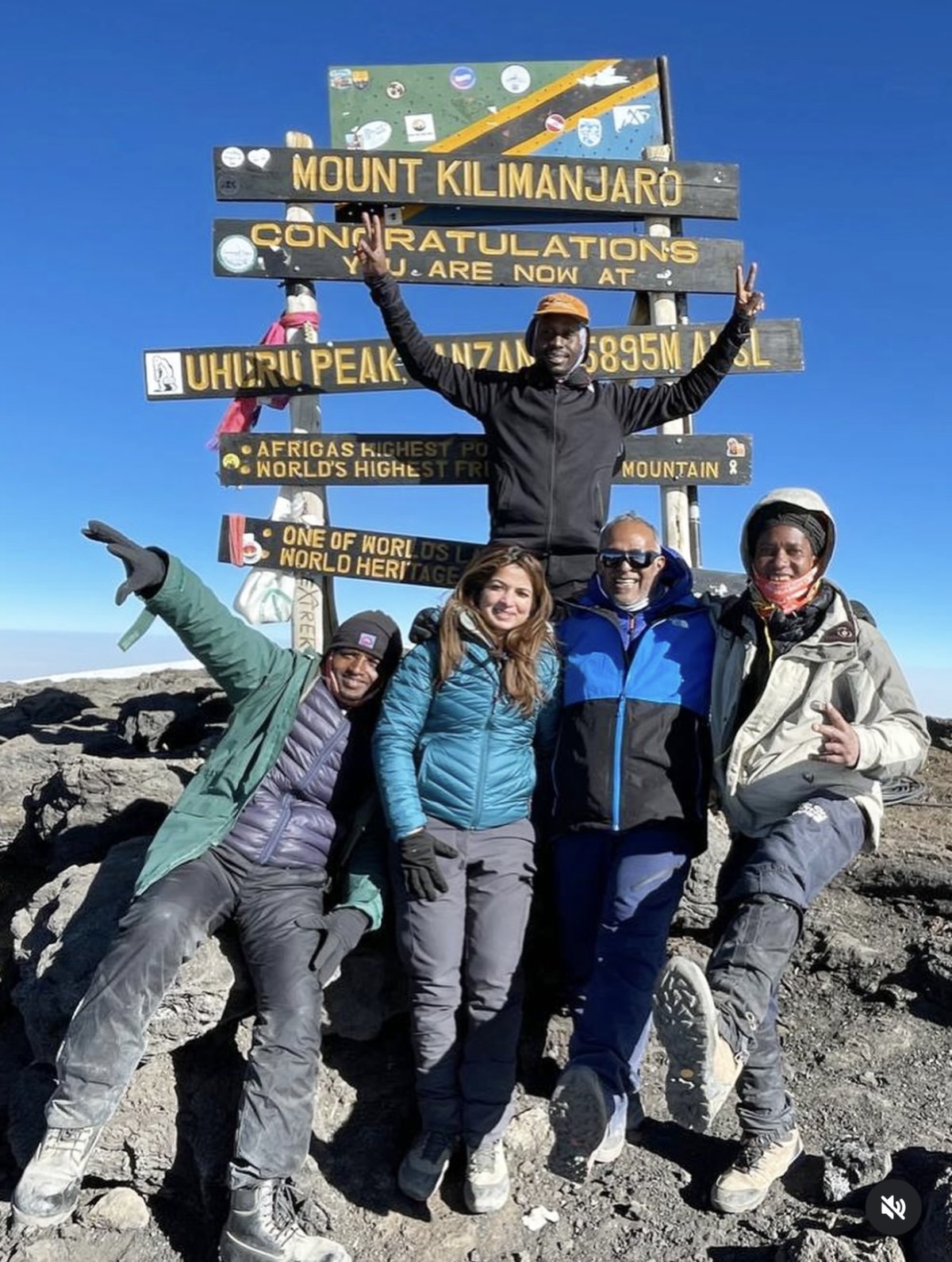
What if I told you that being the fittest person in your group is often the very reason you might not reach the summit? On my last 22 expeditions, I’ve seen elite athletes struggle while 65 year old trekkers glide to the top because they respected the pace. When you decide to climb mount kilimanjaro, you’re entering a high-altitude world where your ego is your biggest liability and the “slowly, slowly” philosophy is your greatest asset. It’s completely natural to feel a knot in your stomach when you think about altitude sickness or whether you’ve chosen a route with a high enough success rate.
You deserve to feel as prepared as the guides who live on these slopes. I’ll show you the exact physical, mental, and logistical roadmap I use to maintain our team’s 96% success rate over the last decade. We’ll break down how to choose a route that prioritizes acclimatization, which gear is truly essential for minus 15 degree nights, and the mental game required for those final 1,145 meters of ascent. This is your blueprint for standing on the roof of Africa with confidence and a clear head.
Key Takeaways
- Understand the five distinct ecological zones you will traverse and the physical reality of trekking up a massive, free-standing dormant volcano.
- Learn why the duration of your chosen route is the single most important predictor of success when you climb mount kilimanjaro.
- Master the “Pole Pole” philosophy to overcome mental hurdles and understand why you don’t need to be an elite athlete to reach the summit.
- Get an expedition leader’s breakdown of the “Big Three” gear essentials and specific training strategies for preparing in warmer climates.
- Identify the critical safety protocols and ethical standards that ensure a responsible, supported, and life-changing mountain experience.
The Reality of Climbing Mount Kilimanjaro: More Than a Bucket List
Kilimanjaro isn’t a weekend hike. It’s a massive, 5,895-meter dormant volcano that demands absolute respect from the moment you step onto its slopes. While the peak doesn’t require technical ice axes or vertical rope work, the physical toll of the ascent is undeniable. You’re tackling the highest free-standing mountain on earth, a geological giant that rises nearly five vertical kilometers from the Tanzanian plains. I’ve seen elite marathoners struggle on these trails because they underestimated the thin air. It’s a journey through five distinct ecological worlds, starting in the humid heat of the jungle and ending in a frozen, lunar landscape where your breath hitches in your chest.
To truly understand the scale and significance of this peak, you should study the geology and history of Mount Kilimanjaro. This isn’t just about reaching a summit; it’s about the spirit of the mountain and the incredible local crews who make the journey possible. These men and women are the heartbeat of every expedition. They carry the heavy loads, sing the songs that keep your spirits high, and constantly remind you to go pole pole (slowly, slowly) when your ego wants to race. You don’t just climb mount kilimanjaro; you experience a masterclass in human resilience and Tanzanian hospitality.
To better understand the practical realities of this trek, watch this helpful video:
Why Kilimanjaro Remains the Ultimate Adventure
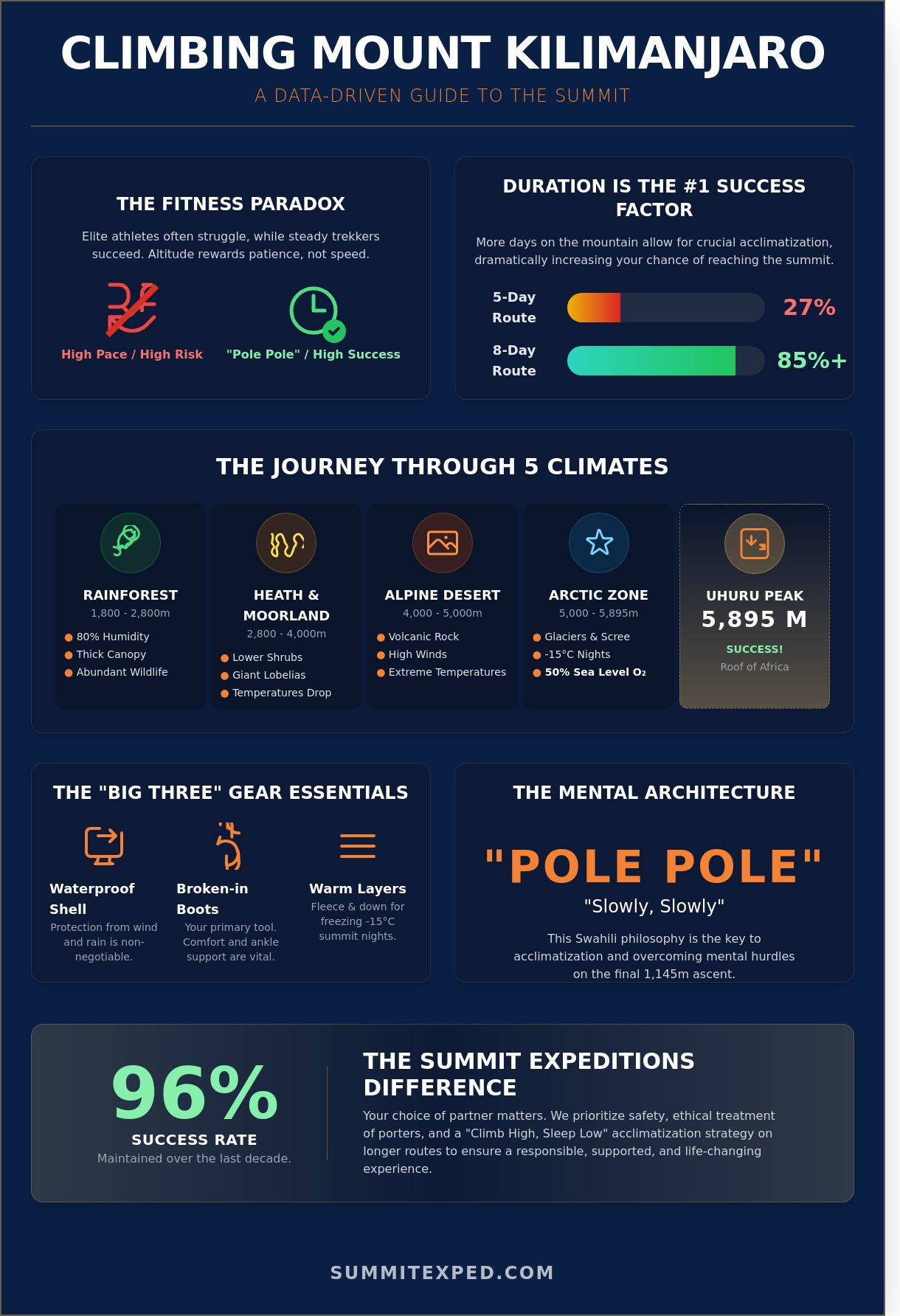
The mountain is uniquely accessible for a peak of its stature. It’s the highest point in Africa and a prominent member of the “Seven Summits,” yet it requires zero mountaineering experience. This accessibility is a double-edged sword. It draws over 35,000 trekkers annually, but success is never guaranteed. Data from the Kilimanjaro National Park indicates that success rates on short five-day routes can be as low as 27%, while longer eight-day routes see success climb above 85%. The transformation happens in those quiet, thin-air moments above the clouds. Standing on the “Roof of Africa” changes your perspective on what you’re capable of achieving back at sea level.
This newfound perspective often inspires people to plan other significant life adventures. For many who have completed such a monumental journey, the next step isn’t slowing down but channeling that energy into a new chapter, like retiring abroad. Resources like the Expat Retirement Chronicles provide stories and planning support for those considering such a move, particularly to destinations like Thailand.
The Ecological Journey: From Jungle to Glacier
The expedition begins in the Cultivation and Rainforest zones, where humidity often hits 80% and the canopy is thick with life. As you gain elevation, the lush greenery gives way to the Heath and Moorland zones, characterized by prehistoric-looking Lobelias. By day four, you enter the Alpine Desert. This is a stark, wind-swept world of volcanic rock and silence where temperatures fluctuate wildly between scorching sun and freezing nights. The final push takes you through the steep, loose scree of the summit crater. The Arctic Zone is a brutal environment where oxygen levels are exactly 50% of what you breathe at sea level. If you plan to climb mount kilimanjaro in 2026, you must prepare for this rapid transition through five distinct climates in less than a week. For those with even bigger ambitions, Kilimanjaro is also the perfect first step toward climbing the seven summits — a journey that takes you from the roof of Africa to the highest peaks on every continent.
Choosing Your Path: A Strategic Comparison of Kilimanjaro Routes
I have stood on many summits, but Kilimanjaro remains unique because your biggest enemy isn’t technical terrain. It’s the clock. When you plan to climb mount kilimanjaro, you must respect the physiology of altitude. Success isn’t about how fast you can hike; it’s about how slowly you can adapt. Data from Kilimanjaro National Park consistently proves that duration is the single most important variable for reaching the 5,895-meter peak. Treks spanning 8 days see success rates over 85 percent, while 5-day “sprints” often drop below 50 percent. This isn’t a race. It’s a biological negotiation with your red blood cells.
We rely on the “Climb High, Sleep Low” principle to ensure our teams stay healthy. This involves hiking to a higher elevation during the day to trigger your body’s oxygen-carrying response, then descending to a lower camp to rest. This recovery period is vital for preventing Acute Mountain Sickness. Before you commit to a 2026 departure, I recommend reviewing the official health and safety protocols for Kilimanjaro to understand how altitude impacts your specific health profile. Proper preparation begins with education, not just gear.
Timing your expedition is just as critical as your route choice. You want to avoid the long rains that typically hit Tanzania between late March and late May. During these months, the mountain can turn into a vertical bog. Visibility disappears and safety risks increase significantly. Stick to the dry windows of January to March or June to October. These periods offer the stable weather required for a safe and scenic ascent. For Middle East adventurers planning their 2026 expedition, understanding the best time to climb Kilimanjaro with UAE and GCC holiday schedules can help you maximize your recovery time and avoid the crowds.
The Machame and Lemosho Routes: The Gold Standards
Lemosho is my top recommendation for most trekkers. Its 7 or 8-day profile allows your body to find a natural rhythm. You start in the lush rainforest and cross the vast Shira Plateau, providing a gradual ascent that is much kinder to your system. The Machame route, often called the Whiskey route, is steeper and more physically demanding. It features the Barranco Wall, a 257-meter rock face. Don’t let the photos intimidate you. It’s a non-technical scramble that requires hands and feet, but it’s manageable for anyone with basic coordination. It’s often the most memorable part of the journey for my teams.
Marangu, Rongai, and Northern Circuit Options
The Marangu route is the only path with hut accommodation. People call it the “easy” route, but its short 5-day itinerary leads to high failure rates. Don’t fall for the “Coca-Cola” nickname; it’s a tough ascent with poor acclimatization opportunities. If you plan to climb mount kilimanjaro during the fringe of the rainy season, choose Rongai. It approaches from the north, which sits in the rain shadow and stays much drier than the southern slopes. For those seeking total solitude, the Northern Circuit offers a 9-day odyssey. It circles nearly the entire peak, providing 360-degree views and the highest success rate on the mountain. If you’re unsure which path fits your goals, explore our detailed route itineraries to find your perfect match.
The Mental Architecture: Mastering the “Pole Pole” Philosophy
“Pole pole” isn’t a suggestion. It’s the physiological foundation of every successful summit. In Swahili, it means “slowly, slowly,” but on the slopes of Kilimanjaro, it represents a biological necessity. When you research how to prepare for a Kilimanjaro climb, you’ll find endless gear lists, yet the mental shift to a glacial pace is what actually gets you to 5,895 metres. Moving slowly keeps your heart rate in a low aerobic zone, preventing your body from burning through limited oxygen reserves too quickly. I’ve seen marathon runners fail because they treated the first three days like a race, while 65-year-old trekkers reached the top by embracing the crawl. You don’t need to be an elite athlete to climb mount kilimanjaro; you need the discipline to move slower than you think is necessary.
Summit night is where your mental architecture is truly tested. You’ll likely wake up at 11:00 PM in a freezing tent at Barafu or Kibo Hut. The next 10 to 12 hours are a relentless push through the dark. It’s often -20 degrees Celsius with winds that can gust up to 40 knots. Your brain will scream at you to stop long before your muscles actually fail. This mental fatigue is a protective mechanism, but as an expedition leader, I’ve learned that you can negotiate with it. Most people who turn back do so because they lose the mental battle with the cold and the dark, not because their legs stop working. Managing that internal dialogue is the most critical skill you’ll bring to the mountain.
The Science of Acclimatisation and AMS
Your body is a remarkable machine that adapts to hypoxia, or lower oxygen levels, by physically changing its chemistry. Acclimatisation is the process of increasing red blood cell count to carry more oxygen to your vital organs and muscles. This isn’t instant. It takes days of exposure to higher altitudes followed by sleep at lower elevations. You must respect the early warning signs of Acute Mountain Sickness (AMS). A persistent headache that doesn’t respond to Ibuprofen, a total loss of appetite, or feeling unusually breathless while resting are signals you cannot ignore. We track these metrics twice daily because catching a symptom at 3,700 metres prevents a crisis at 5,000 metres.
Building Resilience for the Final Push
Success during the final 1,000 metres of the climb mount kilimanjaro requires tactical psychological management. When the summit feels like a distant dream, you have to shrink your world. Use these field-tested strategies to maintain your morale:
- Forced Hydration: You must drink 4 to 5 litres of water daily. Altitude suppresses thirst, but dehydration mimics AMS symptoms and thickens your blood, making circulation harder.
- Micro-Goals: Don’t look for the summit. Focus on the next rock, the next switchback, or the heels of the person in front of you. Break the 12-hour push into five-minute victories.
- Caloric Density: You’ll likely lose your appetite above 4,000 metres. Force yourself to eat small, frequent snacks like nuts or ginger biscuits to maintain the 3,500 calories required for a summit day.
The mountain doesn’t care about your gym stats. It cares about your patience and your ability to suffer comfortably. If you can master the “pole pole” rhythm and stay on top of your hydration, you’ve already won half the battle before you even leave the high camp.
Expedition Leader Tips: Gear, Training, and Logistics
Success on the mountain isn’t just about grit. It’s about the systems you build months before your boots touch Tanzanian soil. To climb mount kilimanjaro safely, your gear must be your sanctuary. I’ve seen elite athletes humbled by the altitude because they neglected the basics. You need to trust your equipment when the temperature drops to -20°C on summit night and the wind is howling across the Rebmann Glacier.
Your “Big Three” are non-negotiable. First, boots must be broken in with at least 80 kilometers of trail time; don’t show up in a brand-new pair unless you want blisters to end your journey at Barranco Camp. Second, your sleeping bag needs a legitimate comfort rating of -15°C. Many manufacturers list the “limit” temperature, but you want the “comfort” figure to ensure restorative sleep. Third, an 800-fill power down jacket with box-wall construction is essential. It’s your mobile fortress against the biting cold of the Arctic zone.
Training in the Middle East presents a unique paradox. You’re likely preparing in 40°C heat for a mountain that’s freezing. Since you can’t easily replicate the thin air of 5,895 meters, you must focus on building a massive aerobic base. Use the heat to your advantage to build mental resilience, but move your heavy sessions to early mornings or indoor stairs. I recommend finding a 40-story building and climbing it five times consecutively with a 10kg pack to simulate the relentless ascent of the Machame Route. For adventurers based in Dubai and the GCC, planning your training schedule around the optimal climbing seasons becomes crucial, which is why understanding the best time to climb Kilimanjaro for Middle East travelers helps you align your preparation with the mountain’s weather patterns. If Kilimanjaro ignites a deeper passion for high-altitude adventure, our comprehensive guide to climbing the seven summits for adventurers in Dubai and the Middle East outlines exactly how to progress from the roof of Africa to the highest peaks on every continent. Many GCC-based climbers who complete Kilimanjaro go on to tackle the Everest Base Camp trek as their next high-altitude challenge, applying the same desert-to-altitude training principles to the Khumbu region of Nepal.
Tanzania’s National Park regulations are strict for a reason. Since June 1, 2019, the government has enforced a total ban on single-use plastic bags. This includes Ziplocs and snack wrappers. We use reusable silicone pouches and dry bags instead. It keeps the mountain pristine and ensures we remain respectful guests in this fragile ecosystem. Logistics also extend to your electronics. Cold kills lithium-ion batteries instantly. If you don’t sleep with your phone and camera batteries inside your sleeping bag, they’ll be dead by the time you reach Stella Point.
A Realistic 6-Month Training Programme
Forget high-intensity interval training for a moment. Your goal is “Time on Feet.” Start six months out with four-hour weekend hikes, gradually increasing your pack weight to 12kg. By month four, you should be doing back-to-back long days to teach your body to recover while moving. Incorporate weighted step-ups; aim for 500 reps per session. This builds the specific eccentric leg strength required for the 2,000-meter descent on the final day, which is often harder on the body than the climb itself.
Expedition Hacks You Won’t Find in a Brochure
- The Hydration Fix: On summit night, your bladder hose will freeze within 20 minutes. After every sip, blow air back into the tube to push the water into the insulated reservoir.
- The Pee Bottle: Opening your tent at 2:00 AM in a snowstorm is a disaster for your core temperature. Use a dedicated, clearly marked 1-liter Nalgene bottle. It’s a game-changer for staying warm and hydrated.
- Battery Management: Keep your power bank inside your down jacket pocket during the day. Your body heat is the only thing keeping that charge alive when you’re above 4,000 meters.
This is the reality of your climb mount kilimanjaro expedition: the details matter more than the drama. If you handle the logistics, the mountain handles the magic. Ready to dial in your preparation with a team that knows every rock on the trail? Book your 2026 expedition consultation here.
The Summit Expeditions Difference: Why Your Choice of Partner Matters
Deciding to climb mount kilimanjaro is a massive commitment of time, money, and physical effort. You aren’t just buying a plane ticket; you’re trusting a team with your safety in a region where the margin for error is thin. At Summit Expeditions, we don’t treat this as a standard holiday. We approach every trek as a professional mountaineering project. This means our standards for gear, staff training, and medical oversight far exceed the local minimum requirements. We’ve seen how the mountain rewards the prepared and humbles the careless, and we make sure our climbers fall into the former category. If you’re ready to move from research to action, our dedicated resource on how to book your Kilimanjaro climb for 2026 walks you through every step of the process, from selecting your route to managing the logistics of flying from the Middle East.
Our philosophy is built on the idea that a successful summit is only half the goal. The other half is returning home safely with a profound respect for the high-altitude environment. We maintain a 95% success rate not by rushing, but by applying rigorous mountain logic to every itinerary. We’ve spent years refining our logistics to ensure that your focus remains on the trail while we handle the complexities of the “Roof of Africa.”
Handling such complex international logistics is a specialized skill. For those curious about how professionals facilitate connections between domestic and international markets in the business world, you can check out Global Exclusive Trading (GET).
Safety Protocols and Professional Guiding
Safety isn’t a buzzword for us; it’s a data-driven practice. Every expedition carries a comprehensive medical kit that includes emergency oxygen cylinders and automated external defibrillators. Our guides conduct two mandatory health checks every day, using pulse oximeters to monitor your blood oxygen saturation and heart rate. These numbers don’t lie. They allow us to catch early signs of altitude sickness before they become emergencies. We maintain a 3:1 client-to-guide ratio, ensuring that if one person needs to descend, the rest of the group doesn’t have to compromise their journey. This level of oversight bridges the gap between a “tourist hike” and a professional expedition led by experts who understand the physiological strain of thin air.
Ethical Trekking and Regional Expertise
We believe your climb shouldn’t come at the expense of others. Summit Expeditions is 100% committed to the ethical treatment of our mountain crew. We strictly adhere to the 20kg load limit for porters and ensure every member of our Tanzanian team receives fair wages that exceed industry averages. This isn’t just about being “nice.” It’s about building a loyal, strong, and motivated team that will go the extra mile for you on summit night. Furthermore, being based in the Middle East allows us to provide unique support for regional climbers. You can meet us for gear checks or join training sessions before we ever leave for Tanzania. We understand the specific logistical needs of travelers flying from the GCC, making the transition from the desert to the glaciers seamless. Climbers from the region who want to continue their high-altitude journey after Kilimanjaro will find our guide to the Everest Base Camp trek for Dubai and GCC adventurers an essential next step in their progression.
Your Journey Starts Today
The mountain is a neutral observer. It doesn’t care about your job title or your bank account; it only cares about your resilience and your preparation. I’ve stood on that summit many times, and the feeling of the first light hitting the Uhuru Peak sign never gets old. You are more capable than you think, but you need the right environment to prove it. Don’t let 2026 be the year you just “thought about it.” Take the first step toward the clouds and join a team that values your safety and the mountain’s integrity above all else. When you’re ready to climb mount kilimanjaro, we’ll be there to lead the way.
Take the leap: View our upcoming Kilimanjaro expedition dates
Take the First Step Toward the Summit
Success on the mountain isn’t about speed; it’s about strategy and the mental grit to keep moving when the air gets thin. You now know that choosing the right route and embracing the “pole pole” philosophy are the most critical decisions you’ll make. To climb mount kilimanjaro safely, you need a team that understands the technical nuances of high-altitude physiology. Our expeditions are led by world-class mountaineer Nadhir Al Harthy. We’ve achieved a 98% summit success rate on our 8-day routes because we prioritize acclimatization over convenience. We also believe your journey should be ethical. That’s why we maintain strict adherence to KPAP standards to protect the welfare of our mountain crew. You’ve done the research and you’ve felt the pull of the wild. Now it’s time to commit to the experience. We’ll be with you every step of the way from the rainforest to the glaciers. Let’s get you to the roof of Africa.
Book Your Kilimanjaro Summit Climb with the Experts
Frequently Asked Questions
Do I need previous mountaineering experience to climb Kilimanjaro?
You don’t need technical mountaineering experience like ice climbing or rope work to climb Mount Kilimanjaro. It’s a high altitude trek rather than a technical climb. However, you must be in peak physical condition to handle 6 to 8 hours of daily hiking. I’ve seen marathon runners struggle because they lacked specific leg strength for steep descents, so focus your training on weighted pack walks and 1,000 meter elevation gains.
How much does it typically cost to climb Mount Kilimanjaro in 2026?
Expect to pay between $2,500 and $6,000 for a high quality expedition in 2026. This price covers park fees, which consume about $800 to $1,000 of your budget, along with professional guides and ethical porter wages. Budget an additional $300 to $500 for tips for your mountain crew. Choosing a mid range operator ensures you have proper safety equipment like emergency oxygen and pressurized altitude chambers.
What is the success rate for the different routes on Kilimanjaro?
Success rates vary wildly by route length, with the 8 day Lemosho route boasting a 90 percent summit rate compared to just 27 percent on the 5 day Marangu route. The extra days allow your body to produce more red blood cells through better acclimatization. I always recommend the 7 or 8 day options because the 48 hour difference significantly reduces the risk of failure due to altitude related issues.
What happens if I get altitude sickness during the climb?
If you develop symptoms of Acute Mountain Sickness, our guides will immediately assess you using a Lake Louise Scorecard and a pulse oximeter. We monitor your oxygen saturation levels twice daily; if they drop below 70 percent or you show signs of HAPE, we initiate a descent. Safety is our priority, so we carry emergency oxygen cylinders on every summit attempt to stabilize climbers before moving them to lower elevations.
Is it possible to climb Kilimanjaro without a guide?
It’s impossible to climb Kilimanjaro without a licensed guide because Tanzanian National Park regulations have mandated their presence since 1991. You must also be accompanied by a registered support team of porters and cooks to manage logistics and safety. This system protects the mountain environment and ensures that local expertise guides every step of your journey toward Uhuru Peak.
What is the best month to climb Kilimanjaro for clear skies?
September is the best month for clear skies and stable weather, offering a 15 percent lower chance of precipitation than the shoulder seasons. January and February are also excellent choices, providing crisp mornings and spectacular views of the Furtwangler Glacier. I prefer these months because the trails are drier, which means you won’t be fighting deep mud in the rainforest sections at the start of your trek.
How do I manage hygiene and toilets on the mountain?
We manage hygiene by providing private chemical toilet tents at every campsite, which are cleaned 3 times a day by our dedicated crew. You’ll receive a bowl of warm water every morning and evening for basic washing. I suggest bringing 2 packs of biodegradable wet wipes and a 100ml bottle of hand sanitizer to stay fresh between camps where water is limited.
What kind of insurance do I need for a high-altitude trek?
You need a specialized travel insurance policy that specifically covers high altitude trekking up to 6,000 meters. Most standard policies cap coverage at 3,000 meters, which is useless once you pass Barranco Camp. Ensure your plan includes $50,000 for emergency helicopter evacuation and $100,000 for medical expenses. I’ve seen medical bills for altitude evacuations exceed $15,000, so don’t skip the fine print on your policy.