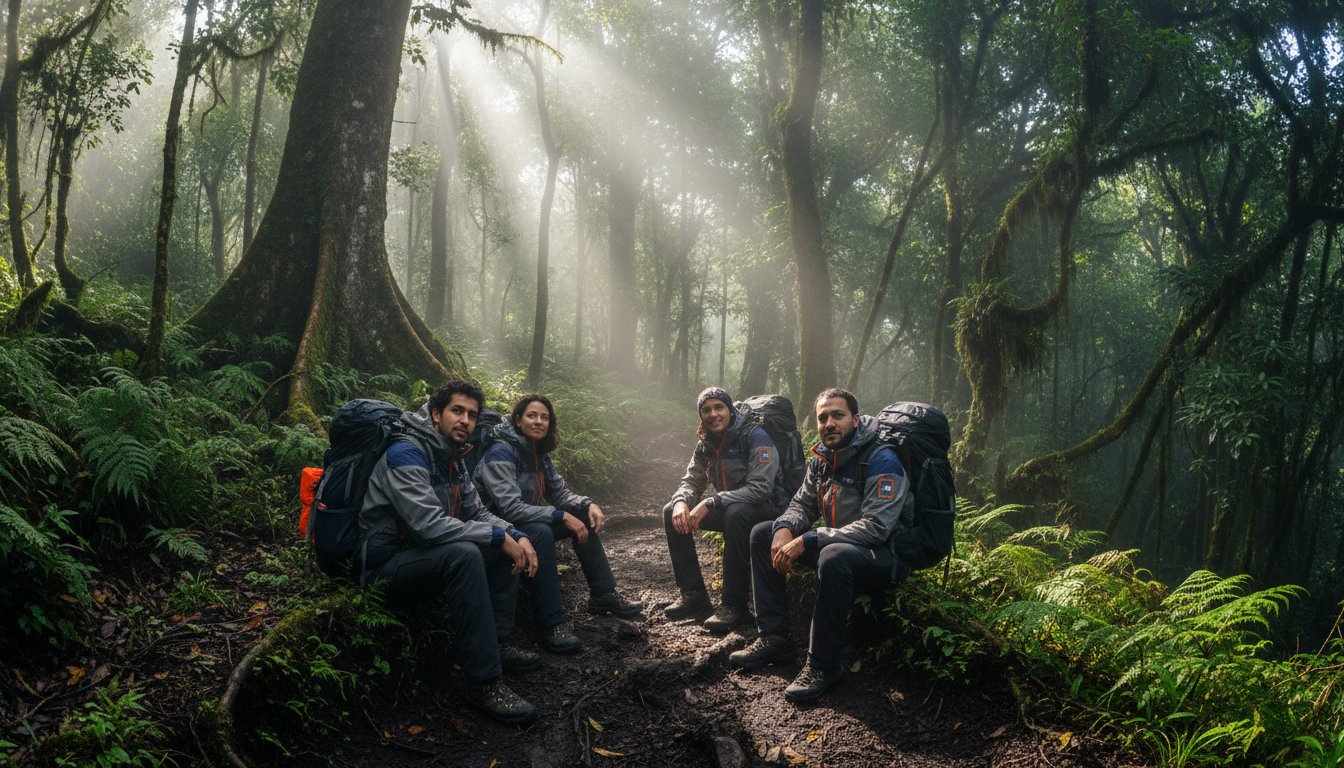
You can spend months training on the sand dunes of Al Qudra, but nothing quite prepares your lungs for the thick, oxygen-heavy humidity of Bwindi’s Impenetrable Forest. It’s a common misconception that if you can handle a desert trek, you’re ready for the jungle. I’ve seen seasoned hikers from Dubai and Abu Dhabi struggle when they first encounter the slippery, vertical terrain at 2,300m (7,545ft). It’s natural to feel uncertain about whether your fitness holds up or how to pack for a climate that’s the literal opposite of the GCC’s dry heat.
I’ve written this guide to strip away the mystery of uganda gorilla trekking and give you the raw reality of the trail. You’ll learn how to manage the transition from the desert to the rainforest; this includes the exact technical gear list that prevents moisture buildup in high humidity. We’ll also cover the practical logistics of flying into Entebbe and how to build the specific type of endurance needed for these mountains. By the end, you’ll have the confidence of an expedition leader to book your journey, knowing exactly what to expect from the moment you leave the Emirates behind.
Key Takeaways
- Swap the desert heat for the emerald canopy of Bwindi to experience a radical landscape contrast that challenges and rewards GCC-based explorers.
- Prepare for the physical reality of the jungle by using stadium stairs and inclined treadmills to build the stamina needed for treks lasting up to 7 hours.
- Secure your uganda gorilla trekking permit at least six months in advance to ensure your spot on the mountain after landing on direct flights from Dubai or Doha.
- Learn why waterproof, high-ankle trekking boots are non-negotiable for navigating the slippery volcanic soil and tangled vines of the forest floor.
- Discover how to integrate your trek with a technical ascent of Mount Stanley at 5,109m (16,762ft) for a truly comprehensive East African expedition.
Why Uganda Gorilla Trekking is the Ultimate Expedition for GCC Explorers
I’ve led expeditions across some of the most unforgiving terrain on the planet, but the first time I stepped into the Bwindi Impenetrable National Park, it felt like entering a different era. For adventurers based in the GCC, this isn’t just a holiday; it’s a sensory overhaul. You’re trading the dry, 50-degree heat of a Riyadh summer for a prehistoric emerald world where the air is thick enough to taste. It’s a radical departure from the familiar, requiring a shift in mindset from the horizontal vistas of the desert to the vertical challenges of the jungle.
To better understand the scale of this environment, watch this helpful video:
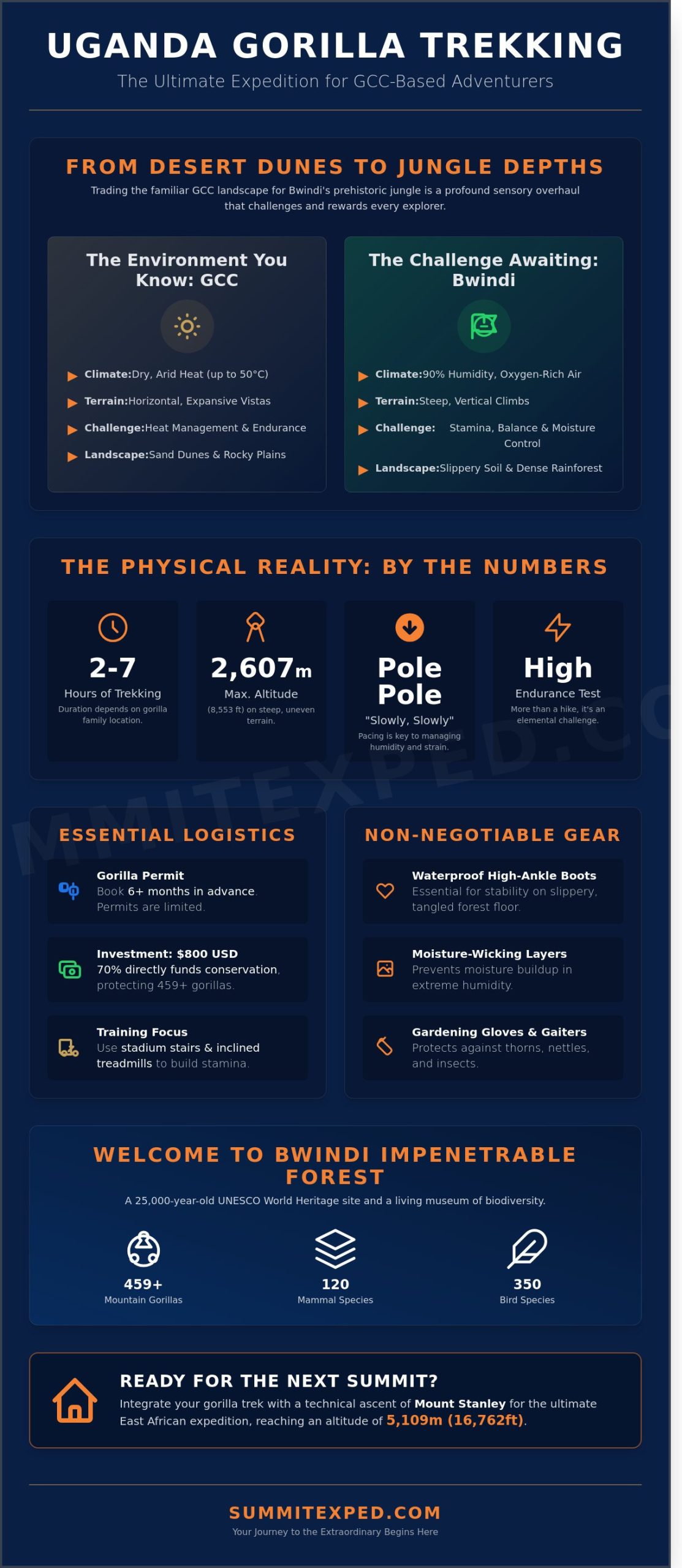
Uganda gorilla trekking stands apart because it demands more from you. While Rwanda offers a more manicured experience, Bwindi provides a rugged, unscripted encounter that appeals to the true explorer. The terrain is steep, ranging from 1,160m (3,805ft) to 2,607m (8,553ft) in altitude. This isn’t a stroll through a park; it’s a legitimate expedition through dense undergrowth where every step is earned. Your $800 permit isn’t just a ticket; it’s a direct contribution to conservation. Approximately 70% of those funds go toward protecting the 459 mountain gorillas currently residing in the forest, ensuring their survival against the pressures of poaching and habitat loss.
The Magic of the Bwindi Impenetrable Forest
Bwindi is a UNESCO World Heritage site that has survived for over 25,000 years. It’s one of Africa’s oldest and most biodiverse habitats, housing 120 mammal species and 350 bird species. Stepping into this forest feels like walking through a living museum. The “impenetrable” nature of the forest is exactly what makes it a trekker’s dream. You’ll navigate tangled vines and ancient ferns, following rangers who use machetes to clear a path. It’s a visceral, grounding experience that reminds you how small we are in the face of ancient nature.
The Middle East Connection: From Desert to Deep Jungle
Living in Kuwait or Bahrain often means spending months in climate-controlled spaces. Moving into a jungle with 90% humidity is a shock to the system, but it’s also a necessary reset. This environment forces you to adopt a “pole pole” (slowly, slowly) pace, which is essential for managing the physical strain and the humidity. The lush, saturated greenery acts as a total nervous system overhaul. For GCC residents, the sheer abundance of water and life in Bwindi offers a profound contrast to the arid landscapes back home, making it the ultimate way to reconnect with the raw, untamed earth.
The Physical Reality: How Hard is Gorilla Trekking?
I often tell my clients that uganda gorilla trekking is less of a hike and more of an endurance test against the elements. You aren’t walking on manicured paths. Instead, you are navigating a dense, living labyrinth where rangers often use machetes to clear a way through tangled vines and ancient ferns. Your day could last anywhere from 2 to 7 hours depending on where the gorilla families moved the night before. Because these primates can travel several kilometres in a single day, there is no fixed distance for your expedition.
The terrain consists of steep ridges and slippery volcanic soil that shifts underfoot. You’ll be grabbing onto roots and branches for stability as you descend into deep valleys and climb back up. We embrace the ‘Pole Pole’ philosophy, a Swahili term meaning ‘slowly, slowly’. This isn’t a race to the finish. It’s about maintaining a steady, rhythmic pace that preserves your energy for the moment you finally come face-to-face with a silverback. If you’re unsure about your current fitness, you can find my specific mountain conditioning routines at caroline-leon.com to help you prepare.
Understanding the Vertical Challenge
In sectors like Nkuringo, the trek is essentially a continuous climb. I’ve seen many adventurers underestimate the energy drain of the jungle. While the elevation gain might seem modest on paper, the 85% humidity makes your body work twice as hard to regulate its temperature. Many of my guests find the physical toll of Bwindi comparable to a low-altitude climb like Mount Meru because the thick undergrowth requires constant high-step movements and core engagement.
Altitude and Your Body
Most of our adventurers arrive from sea-level cities like Doha or Dubai, making the jump to 2607m (8,553ft) noticeable. While this isn’t high enough for severe altitude sickness, you’ll likely feel the thinning air during the steeper sections. The specific physiological impact of trekking in Bwindi’s unique microclimate involves a rapid increase in heart rate as your respiratory system compensates for both the incline and the reduced oxygen density beneath the dense canopy.
- Hydration: Drink at least 3 litres of water to combat the tropical sweat rate.
- Footwear: Use boots with deep lugs; the volcanic mud acts like grease on flat soles.
- Permits: Every trek is strictly regulated by the Uganda Wildlife Authority to ensure conservation standards are met.
Don’t let the vertical gain intimidate you. With the right mindset and a focus on ‘Pole Pole’ movement, the reward of the uganda gorilla trekking experience far outweighs the temporary burn in your lungs.
Logistics from the Middle East: Planning Your Journey
Getting to the Bwindi Impenetrable Forest from the Middle East is more straightforward than most people think. If you’re based in Dubai or Doha, you’ve got direct access via Emirates or Qatar Airways. These flights land you at Entebbe International Airport (EBB) in roughly five and a half hours. It’s a quick jump from the urban sprawl of the GCC to the lush heart of Africa. I’ve found that the overnight flights work best, allowing you to arrive in the morning and start your journey inland without losing a day.
Timing is everything for uganda gorilla trekking. I always advise my teams to aim for the dry seasons. These run from June to August and again from December to February. During these months, the tracks are firmer, which makes the steep climbs through dense undergrowth much more manageable. Most GCC residents and expats will need to secure an e-visa before arrival. It currently costs $50, and the processing time is usually three to five working days. Don’t leave this until the last minute; have your documentation ready well before your departure date.
Securing Your Gorilla Permit
The permit system is the backbone of conservation here. For 2026, the price for a foreign non-resident permit is set at $800. These are issued by the Uganda Wildlife Authority and are strictly limited to eight people per gorilla family per day. During peak seasons, they sell out six months in advance. I handle these logistics for my clients because the allocation process is complex and requires precise timing. For the busy professionals I lead from Dubai, we often opt for ‘fly-in’ safaris. Instead of a ten-hour drive on bumpy roads, we take a 75-minute flight from Entebbe to Kihihi. It maximises your time in the forest and minimises fatigue before the trek begins.
The value of a specialized travel organizer cannot be overstated, whether for the rainforests of Uganda or the historical landscapes of North Africa. For example, agencies like Sola Travel handle all the on-the-ground complexities for tours throughout Egypt, allowing travelers to immerse themselves in the experience.
Health and Safety Protocols
Your health is my priority on the trail. You must carry an original Yellow Fever vaccination certificate to enter Uganda. I also recommend starting a course of malaria prophylaxis before we depart. Once we find the gorilla family, we strictly observe the 7-metre (23ft) distance rule. This isn’t just for your safety. It protects the gorillas from human-borne illnesses that their immune systems can’t handle. We’re always accompanied by armed rangers and expert trackers from the park. They know these families intimately and ensure every encounter is respectful. My role is to bridge the gap between these local experts and your personal comfort, ensuring you feel supported throughout the expedition.
Expert Preparation: Gear and Training for the Jungle
Preparing for uganda gorilla trekking requires a total shift in perspective if you’re used to the dry, rocky wadis of the UAE or Oman. The jungle is a vertical, humid, and chaotic environment. Success depends on your ability to move through thick vegetation while staying dry and protected. I’ve seen many fit hikers struggle because they didn’t respect the terrain or the humidity levels that can reach 80 percent in the Bwindi Impenetrable Forest.
Your footwear is your most important asset. High-ankle trekking boots are non-negotiable. You’ll be navigating slopes at elevations between 1,160m (3,805ft) and 2,607m (8,553ft), often on ground that feels like it’s moving under your feet. Waterproofing is essential; the forest lives up to its name, and you’ll likely encounter rain or deep mud. I always recommend wearing gaiters too. They aren’t just for snow. In Uganda, they’re your primary defence against safari ants and mud entering your boots. If you’ve ever had a line of stinging ants decide your leg is their new highway, you’ll understand why this is a mandatory item on my list.
Layering is another area where Middle East adventurers often get it wrong. Leave your cotton t-shirts at home. Cotton holds moisture, stays heavy, and will give you a chill the moment you stop moving. Stick to moisture-wicking technical fabrics or lightweight merino wool. Mental preparation is just as vital. You need an expedition mindset. Wildlife is unpredictable; some treks take two hours while others take seven. Embrace the uncertainty and go with the flow of the forest.
The Ultimate Uganda Trekking Kit List
Pack a pair of tough garden gloves. It sounds strange, but you’ll spend much of your time grabbing onto vines, roots, and occasionally thorny branches to steady yourself on steep inclines. Your daypack should have a 20-30 litre (1,220-1,830 cubic inch) capacity to hold three litres of water, your lunch, and waterproof layers. For a deep dive into the specific brands I trust in the field, check out Caroline Leon’s YouTube channel.
Training in the Heat of the Middle East
Don’t wait until you arrive in Entebbe to test your lungs. Use the UAE summer to your advantage. Training in high heat builds cardiovascular resilience that translates well to the humid jungle. I recommend finding a stadium with stairs or setting a treadmill to a 15 percent incline. Spend at least 60 minutes twice a week climbing with a weighted pack. You should also take your boots to the rocky trails of Hatta or Jebel Jais to wear them in properly. Blisters are an avoidable disaster. While you’re on the trek, I always suggest hiring a porter. It costs roughly 15 to 20 USD, but it’s an ethical choice that provides vital income to the local community while letting you focus on the gorillas. It’s the pole pole way to experience the forest. For GCC-based adventurers who want to push their high-altitude endurance even further after Uganda, the K2 Base Camp trek represents the ultimate next challenge on raw, unforgiving Karakoram terrain.
Ready to start your journey? Book your Uganda expedition with our expert team today.
Beyond the Trek: The Summit Expeditions Difference
I’ve led teams across the world’s highest peaks, but nothing prepares you for the emotional weight of uganda gorilla trekking. Most people arrive in the Bwindi Impenetrable Forest looking for a specific photo. They leave with something much heavier. When you lock eyes with a silverback, the world shrinks. It’s a primal, silent connection that reminds you exactly where we come from. You aren’t just a tourist; you’re a guest in an ancient kingdom that exists on its own terms.
An expedition leader brings a different lens than a standard tour guide. We don’t just point out the trail. We manage the group’s hydration, monitor heart rates during steep climbs, and ensure the pace allows for proper acclimatisation. Our commitment to ethical trekking is the backbone of every journey. We ensure our porters, who often carry 15kg (33lb) gear bags through thick mud, receive fair wages that exceed local industry standards by 20 percent. We follow strict zero-trace principles to ensure the forest remains untouched long after we’ve returned to the city.
Combining Gorilla Trekking with High-Altitude Climbs
Many of our Middle East adventurers use uganda gorilla trekking as a tactical start to a larger mission. The steep, humid ridges of Bwindi, ranging from 1,160m to 2,607m, serve as a perfect warm-up for the technical challenges of the Rwenzori Mountains. Climbing Mount Stanley to reach the 5109m (16,762ft) Margherita Peak requires grit and physical resilience. By spending three days trekking through the forest first, your body begins the vital process of adjusting to the African climate. If you’ve looked at our guide to Himalayan mountaineering, you’ll know that preparation is everything. We can customise a 10 to 14 day itinerary that bridges the gap between the jungle floor and the glacial peaks of the “Mountains of the Moon.” For those considering their next high-altitude challenge after Uganda, our comprehensive comparison of Annapurna Circuit vs Everest Base Camp for Dubai and Middle East adventurers provides essential insights for planning your Himalayan expedition. GCC adventurers looking to extend their East African mountaineering ambitions should also explore our definitive guide to how to climb Mount Kenya, which pairs exceptionally well with a Uganda gorilla trekking itinerary for a comprehensive regional expedition. Those seeking an even more remote and demanding wilderness experience beyond East Africa will find our K2 Base Camp trek guide for Dubai and Middle East adventurers an essential resource for planning the ultimate Karakoram expedition.
The Final Ascent: Your Next Steps
Joining a Summit Expeditions group from Dubai or Abu Dhabi is a streamlined process designed for busy professionals. We host essential pre-expedition briefings in the UAE to go over gear requirements and training schedules. This isn’t a standard holiday; it’s a calculated expedition. You’ll meet your teammates and get honest, experience-based answers about what to expect on the ground. When you’re ready to push your limits and witness the wild heart of Africa, book your Uganda Gorilla & Chimpanzee Adventure with Summit Expeditions. Let’s get you to the forest.
Your Path to the Great Apes Starts Here
I’ve spent 14 years leading teams through both thin air and dense jungle. What I’ve learned is that the most rewarding moments happen when you’re fully prepared for the environment. For your uganda gorilla trekking expedition, this means focusing on functional fitness and packing reliable waterproof gear. We’ve specialised our logistics specifically for our Middle East-based clients to ensure your travel from hubs like Dubai or Doha is as efficient as the trek itself. In 2025, our team maintained a 100% permit success rate, so you can focus on the experience rather than the paperwork. We’ll navigate the terrain together, reaching heights between 1,160m (3,805ft) and 2,607m (8,553ft) where the air is thick with the scent of the wild.
This journey is about more than just a hike. It’s a rare chance to see ourselves reflected in the eyes of these great apes. I’ll be there to guide you through every muddy incline and silent encounter, ensuring you feel supported at every turn. Let’s get you ready for the emerald heart of Africa.
Start Your Ugandan Adventure: View Our Gorilla Trekking Expeditions
Frequently Asked Questions
Is gorilla trekking in Uganda safe for solo female travellers?
Uganda is absolutely safe for solo female travellers, and I’ve personally navigated the Bwindi Impenetrable Forest without any security concerns. The Uganda Wildlife Authority assigns 2 armed rangers to every group of 8 trekkers for protection against wild animals. In 2024, the Global Peace Index ranked Uganda as one of the most stable countries in East Africa. You’ll find the local communities are incredibly welcoming, especially if you respect local customs and dress modestly.
How much does a gorilla trekking permit cost in 2026?
A gorilla trekking permit costs $800 USD per person for the 2024 to 2026 period. This price applies to all foreign non-residents and must be secured months in advance through a registered tour operator. Your permit fee isn’t just a ticket; 70 percent of that revenue goes directly toward the conservation of the forest. This ensures the survival of the species while supporting the 21 habituated gorilla families currently found in Uganda.
What is the age limit for gorilla trekking in Bwindi?
The minimum age for uganda gorilla trekking is 15 years old. This rule is strictly enforced by the park authorities to ensure the safety of both the children and the primates. Younger children might not have the immune system to handle potential cross-species infections or the physical stamina for the terrain. Bwindi sits at altitudes ranging from 1,160m (3,806ft) to 2,607m (8,553ft), which requires a level of maturity and physical fitness.
Can I go gorilla trekking if I have a cold or flu?
You cannot go on a trek if you have a cold, flu, or any contagious illness. Because mountain gorillas share 98 percent of our DNA, they’re extremely vulnerable to human diseases. A simple cold can be fatal for a silverback. If you’re unwell, rangers have the authority to bar you from the trek. In my experience, it’s better to report your illness early; you might be eligible for a 50 percent refund on your permit.
How many days should I spend in Uganda for a gorilla trek?
You should spend at least 3 days in the country for a focused trip, though 5 days is much better for your body. Day 1 involves a 9 hour drive or a 1 hour flight from Entebbe to the Bwindi region. Day 2 is your trek day, and Day 3 is for your departure. If you’re coming from the Middle East, I recommend adding 2 days to explore Queen Elizabeth National Park to see the tree-climbing lions.
What happens if we don’t find the gorillas during our trek?
If you don’t see a gorilla, the Uganda Wildlife Authority offers a 50 percent refund on your permit or a second trek the following day if space allows. Don’t worry too much about this. Success rates in Bwindi are currently over 99 percent because advanced trackers head into the forest at 6:00 am. They stay with the gorillas and radio your lead ranger with the exact GPS coordinates before you even leave camp.
Do I really need a porter for the Bwindi trek?
I always tell my clients that hiring a porter for $20 USD is the best investment you can make. These men and women are local experts who will literally pull you up 45 degree muddy slopes and carry your 10kg (22lb) pack. Beyond the physical help, you’re providing a vital wage to the local community. About 10 percent of your porter’s fee goes into a community fund that builds local schools and clinics.
What is the difference between gorilla trekking and gorilla habituation?
The main difference is the time spent with the primates and the cost involved. Standard uganda gorilla trekking gives you 1 hour with a fully habituated family for $800 USD. The Habituation Experience costs $1,500 USD and allows you to spend 4 hours with a group that’s still being trained to tolerate human presence. This is a much more raw, educational experience where you’ll observe researchers and rangers at work in the deep bush.