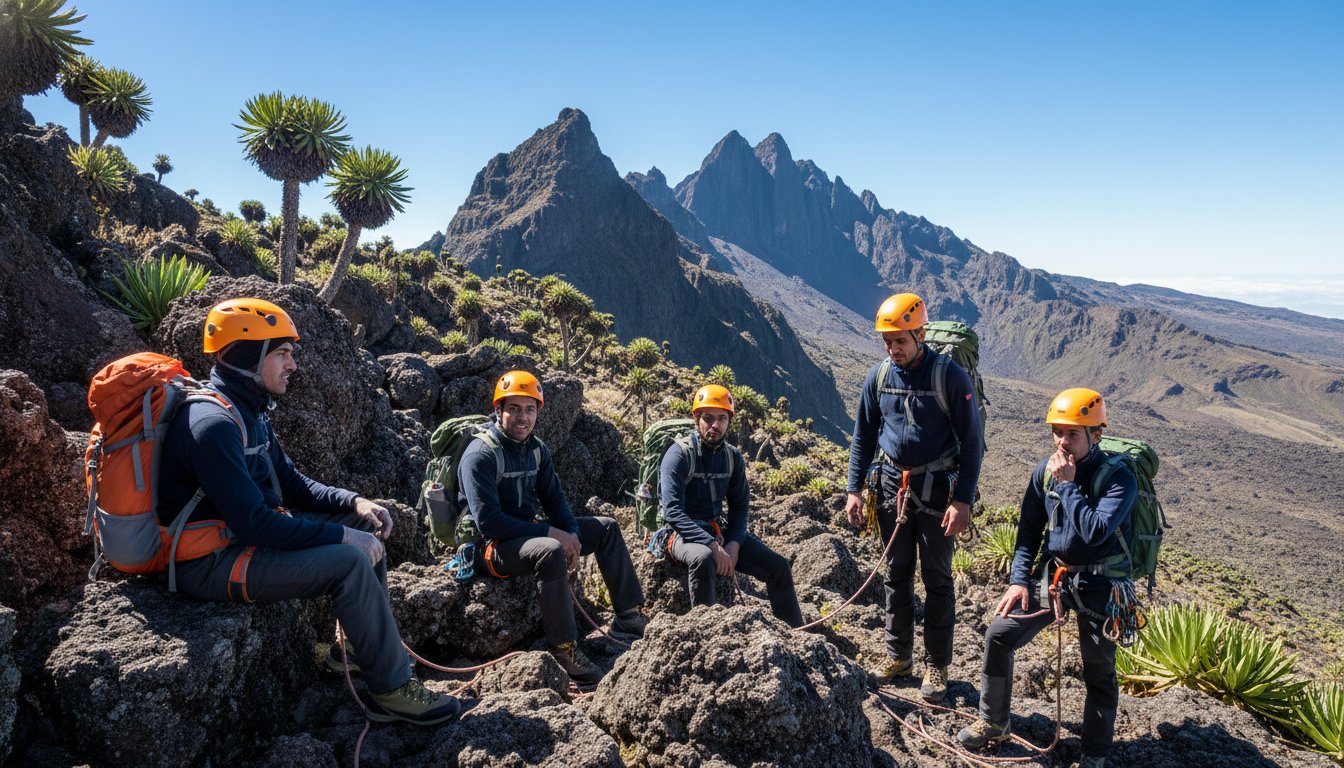
Kilimanjaro might get the fame, but Mount Kenya offers the true mountain experience for those who prefer solitude over crowds. While roughly 35,000 people attempt the roof of Africa every year, the jagged spires of Kenya remain a sanctuary for those seeking technical challenge and pristine wilderness. You’ve likely spent months training in the 40 degree heat of Dubai or Doha, finding it nearly impossible to replicate the thin air and vertical rock you’ll face at 4,985m (16,355ft). It’s a common struggle for GCC adventurers who want to move beyond simple trekking into real mountaineering.
I’ve spent years leading expeditions on these peaks, and I promise that this 2026 guide will help you master the logistical secrets and technical skills needed to climb mount kenya with confidence. We’ll break down how to manage a seamless transition from DXB or DOH to the trailhead in Nairobi, ensuring your safety protocols are as sharp as the granite on Batian. You’ll learn exactly how to prepare for the unique equatorial climate, the specific gear that works for Middle East based climbers, and the training hacks that actually work when you don’t have a mountain in your backyard.
Key Takeaways
- Discover why Mount Kenya’s jagged volcanic spires offer a more diverse technical challenge than Kilimanjaro’s dome, providing a quieter and more authentic mountaineering experience.
- Learn why the Sirimon-Chogoria traverse is our top recommendation for balancing world-class scenery with the steady acclimatisation needed to reach the 5,199m (17,057ft) summit.
- Master a targeted training regime using GCC landmarks like Jebel Hafeet to prepare your body for the physical shock of moving from desert heat to the sub-zero reality of a climb Mount Kenya expedition.
- Identify the specific gear upgrades required for Kenya’s abrasive volcanic rock and unpredictable equatorial weather, including how to adapt the ‘Three-Layer System’ for maximum efficiency.
- Understand the ‘Pole Pole’ philosophy and how integrating local Kenyan culture into your journey significantly increases your chances of a safe and successful summit.
Why Climbing Mount Kenya is the Ultimate Challenge for Middle East Adventurers
For many of my fellow climbers based in Dubai or Riyadh, the journey into high-altitude trekking often starts with 4,000m peaks like Toubkal. When you’re ready to level up, the decision usually falls between Kilimanjaro and its more technical neighbour. While Kili gets the fame, those who want to truly climb mount kenya find what we call the ‘mountaineer’s mountain.’ It’s a rugged, extinct volcano that traded a single dome for a skyline of jagged spires. Standing on the Equator while looking at ancient glaciers is a surreal experience that resets your perspective on what Africa offers.
The geological history of Mount Kenya dates back roughly 3 million years, creating a terrain far more varied than the dusty slopes of other African peaks. You’ll find fewer crowds here, meaning you can enjoy the silence of the moorlands without a queue of trekkers behind you. It’s a more intimate, raw encounter with the wild. For GCC-based adventurers, the jump from 4,000m to 5,199m (17,057ft) provides the perfect test of your acclimatisation protocols before eyeing the world’s 6,000m giants.
To better understand how this peak compares to its famous neighbour, watch this helpful video:
Understanding the Peaks: Batian, Nelion, and Point Lenana
The mountain isn’t just one summit; it’s a complex of peaks. Batian is the true crown at 5,199m (17,057ft). You won’t get there without multi-pitch technical rock climbing skills. Nelion, at 5,188m (17,021ft), is its slightly lower twin, usually climbed in tandem by those crossing the ‘Gates of Mist.’ For most fit hikers, Point Lenana at 4,985m (16,355ft) is the goal. It’s a challenging trek that requires no ropes but demands respect for the altitude. I’ve shared more about my training routines on my website for those preparing for this specific altitude jump.
The ‘Dr. Seuss’ Landscape: Flora and Fauna Unique to the Equator
The lower slopes are thick with bamboo and montane forest. Here, we always trek with armed rangers. This is a safety necessity because of the buffalo and elephant populations that frequent the forest zones. As you move higher, the world turns strange. You’ll walk through groves of Giant Lobelias and Groundsel that look like alien life forms. The transition from humid forest to vertical rock and ice happens in just a few days, which is a massive physical shift.
- Pro Tip: Don’t rush the forest zone. The humidity here is a shock to the system after the dry desert air of the Middle East, so front-load your hydration early.
- Mistake to avoid: Underestimating the cold. Even though you’re on the Equator, the temperatures at 4,000m (13,123ft) drop well below freezing at night.
- Lesson learned: Use the ‘pole pole’ (slowly, slowly) pace from day one. It’s the only way to ensure your body adjusts to the thinning air.
The Technical Divide: Choosing Your Mount Kenya Route
Deciding how you want to climb mount kenya depends on whether you seek a steady trek or a vertical battle. Most trekkers focus on the “Big Three” routes: Sirimon, Naro Moru, and Chogoria. I usually point my teams toward the Sirimon-Chogoria Traverse. This combination offers the most effective acclimatisation profile and the most diverse scenery. While Naro Moru is the quickest way to reach the high camps, it’s famous for the “vertical bog.” This marshy stretch is a legitimate mental grind. Your boots will sink into thick, black mud, and your patience will thin before you even reach the alpine zone. It’s a rite of passage, but not always the most enjoyable one for a first-timer.
Mount Kenya is a UNESCO World Heritage Site, and the biodiversity changes drastically as you move between these paths. Choosing the right route isn’t just about the summit; it’s about managing your body’s response to the thinning air while soaking in the prehistoric landscapes. If you’re looking for more inspiration on global peaks, check out my thoughts on the Best Treks in the World: An Expedition Leader’s Definitive 2026 Guide.
The Sirimon Route: The Scenic and Steady Ascent
Sirimon is my preferred choice for climbers flying in from sea-level hubs like Dubai. The gradient is gentler, which is vital for high altitude acclimatisation protocols. You’ll spend your first night at Old Moses Camp at 3300m (10,827ft), before pushing through the Mackinder Valley to Shipton’s Camp at 4200m (13,780ft). The valley views are sprawling and help keep morale high during the slow, steady plod. This route stays relatively dry compared to the western slopes, making the initial days much more comfortable.
The Chogoria Route: The Most Dramatic Descent
I always recommend descending via Chogoria. It’s objectively the most photogenic path on the mountain. You’ll pass “The Temple,” a massive internal cliff face that drops away into the Gorges Valley. Seeing Lake Michaelson tucked into the valley floor from above is a highlight of the entire expedition. Be prepared for a long trek out, though. The path winds through dense rainforest and bamboo zones for nearly 30km (18.6 miles). It’s a long day on the knees, but the scenery makes the effort feel secondary.
Technical Climbing: Batian and Nelion Logistics
If you aren’t satisfied with Point Lenana, the trekker’s peak, you’ll need to prepare for a serious multi-pitch climb to reach Batian 5199m (17,057ft) or Nelion 5188m (17,021ft). The logistics change with the seasons. From June to October, we climb the North Face Standard Route. From December to March, the South Face is the better option due to the sun’s position and ice conditions. To climb mount kenya via these technical routes, you need specific skills:
- Proficiency in multi-pitch traditional climbing up to Grade IV (UK) or 5.7 (US).
- Experience with abseiling (rappelling) on long, complex descents in fading light.
- Mental fortitude for the “Howell Hut” experience, a tiny bivouac hut near Nelion’s summit that offers a cramped but life-saving shelter.
If you want to see what these technical faces look like in real-time, I’ve shared plenty of footage from my recent expeditions on my YouTube channel.

Training in the Heat: Preparing for 5,199m (17,057ft) from the GCC
Preparing to climb mount kenya while living in the Middle East presents a unique set of physiological hurdles. You aren’t just training for the incline; you’re training for a 50-degree temperature swing. The shock of moving from a 40°C afternoon in Abu Dhabi to a -10°C summit push can shatter your performance if you aren’t ready. Your body needs to learn how to regulate its core temperature under stress before you ever step foot in Nairobi.
I always tell my clients to head for the Hatta hills or Jebel Hafeet in Al Ain. These locations offer the vertical gain necessary to simulate mountain conditions. Aim for three-hour sessions with a 12kg (26lb) weighted pack. This builds the specific postural endurance you’ll need when the air gets thin and your pack feels twice as heavy. Don’t just hike up; focus on the descent. Your quads need to handle the repetitive impact of coming back down those limestone slopes.
My secret weapon in Dubai is stair climbing. Find an air-conditioned tower like the Index Tower or Burj Daman and start climbing. It sounds tedious, but the controlled environment allows you to push your heart rate higher than you can in the desert heat. I spent months doing 50 floors at a time to build the “mountain lungs” required for the final push to Point Lenana. It’s the most efficient way to build vertical gain when you’re stuck at sea level. Once you’ve conquered Mount Kenya, many of my GCC clients find themselves drawn to even more remote wilderness, and the K2 Base Camp trek represents the ultimate next step for Dubai and Middle East adventurers seeking untamed high-altitude terrain.
Mental conditioning is just as vital as physical fitness. The huts on Mount Kenya are raw, unpolished, and often drafty. They aren’t the luxury lodges you might find in other parts of East Africa. You’ll be sleeping in communal bunks, hearing the wind rattle the corrugated iron roofs, and dealing with basic long-drop toilets. Embrace this grit early in your training. If you can stay focused while sweating through a humid Dubai workout, you’ll have the mental fortitude to handle a cold, sleepless night at Shipton’s Camp.
Altitude Prep in a Sea-Level Region
Living at sea level means your body is accustomed to a rich supply of oxygen. To climb mount kenya safely, you should consider using hypoxic training centres in Dubai. These facilities simulate altitudes up to 4,500m (14,764ft), allowing you to see how your heart rate and oxygen saturation react to thin air. It’s better to discover you’re a “slow acclimatiser” in a controlled gym in Al Quoz than at 4,000m (13,123ft) on the mountain. This data helps us adjust your pace on the actual expedition.
Cardiovascular and Strength Foundations
The Chogoria route involves a massive 1,000m (3,280ft) descent on the final day. This is where most injuries happen. You must build eccentric leg strength to protect your knees on the sliding scree slopes. Incorporate weighted lunges and step-downs into your gym routine at least twice a week. Nutrition also plays a role here. In the GCC, we’re used to hydrating against humidity. In the dry, alpine air of Kenya, you’ll lose moisture through your breath without even realising it. Practice your hydration strategy during long desert hikes to ensure your kidneys are ready for the shift.
Gear and Logistics: From the Desert to the Glaciers
Preparing to climb Mount Kenya requires a shift in mindset, especially for those coming from the dry heat of the GCC. You’ll experience four seasons in a single day, moving from humid forest to sub-zero alpine desert. I always recommend the ‘Three-Layer System’ to manage this. Start with a moisture-wicking base, add an insulating mid-layer like a heavy fleece or down jacket, and finish with a waterproof shell. Don’t underestimate the Equator. At 4000m (13,123ft), the weather turns on a dime. If you’ve climbed Kilimanjaro, don’t assume your old kit is enough. Mount Kenya’s volcanic rock is significantly sharper and more abrasive; it eats soft trekking shoes for breakfast.
For 2026, travel from the Middle East is straightforward. Emirates (DXB), Qatar Airways (DOH), and Etihad (AUH) all offer direct connections to Nairobi. GCC residents usually need an e-visa, which takes about 72 hours to process. You must also carry a Yellow Fever vaccination certificate. Kenyan authorities check this at Jomo Kenyatta International Airport 100% of the time for travelers arriving from the Gulf. It’s a small detail that can derail an entire expedition if overlooked.
The Definitive Mount Kenya Kit List
- Boots: Use B1 or B2 rated boots for the approach. If you’re tackling the technical peaks like Batian, you’ll need dedicated rock shoes with high-friction rubber to handle the vertical sections.
- Sleeping bags: It sounds counterintuitive for the Equator, but a -15°C rated bag is essential. Temperatures at Shipton’s Camp often drop to -10°C overnight.
- Caroline’s Insight: Most trekkers forget high-quality polarised sunglasses. The tropical sun reflecting off glaciers at 5000m (16,404ft) causes snow blindness faster than you’d think. Category 4 lenses are non-negotiable for eye safety.
Expedition Logistics and Safety
When you climb Mount Kenya, communication is your lifeline. Local mobile signals are non-existent on the North Face, so we carry satellite phones for every expedition to ensure we’re never truly isolated. If someone gets sick, our protocols involve immediate descent to Nanyuki, which sits at 1950m (6,397ft). We manage these evacuations through a coordinated effort with local mountain rescue teams who know every gully and ridge. My lead guides also ensure porter welfare is a priority. We strictly limit load weights to 20kg (44lbs) per porter, ensuring our team stays healthy and motivated. This ethical approach is why we maintain a 95% staff retention rate across our seasons.
The Summit Expeditions Difference: Why We Lead Differently
Success on a mountain is rarely about who is the strongest or the fastest. It is about how you manage your energy, your mindset, and your physiology over several days. We have spent years refining an approach that prioritises your safety and your experience above all else. Our commitment to the “Pole Pole” (slowly, slowly) philosophy is a physiological necessity, not just a catchy phrase. When you climb mount kenya, walking at a pace that feels almost too slow is the secret to reaching Point Lenana at 4,985m (16,355ft). This deliberate speed allows your body to produce the necessary red blood cells to cope with the thinning air, significantly increasing our summit success rates.
We believe a mountain expedition should be a holistic experience. We don’t just walk through the landscape; we engage with the soul of the region. Our climbs integrate the Swahili spirit of “Undugu”, which translates to brotherhood. You aren’t just a client on a trail; you are part of a team where Kenyan guides and porters share their stories, their songs, and their deep ancestral knowledge of the jagged volcanic peaks. This connection transforms a physical challenge into a meaningful cultural exchange.
For those planning to climb mount kenya in 2026, we provide a bridge between the high-altitude wilderness and the practical realities of a professional life. We understand the specific needs of the Middle Eastern climber, from dietary requirements to the importance of building a local community before we even leave the ground. We don’t just meet you at the airport; we walk the path with you from the first training hike to the final descent.
Expert Leadership by Caroline Leon
My approach to leading expeditions is rooted in lived experience on some of the world’s most technical 8,000m (26,247ft) peaks. I have learned that the mountain doesn’t care about your ego; it only cares about your preparation and your resilience. I apply these lessons to every Mount Kenya expedition, focusing on empowerment and pushing personal boundaries safely. We focus on “micro-wins” throughout the climb to maintain morale. You can see the reality of these journeys, including the grit and the beauty, on Caroline Leon’s YouTube channel, where we share raw footage from the field.
Your Journey Starts in the Middle East
The sense of camaraderie is what sets our expeditions apart. For our GCC-based climbers, the journey begins with pre-trip briefings in Dubai and Abu Dhabi. These sessions ensure you are gear-ready and physically prepared, but they also serve to build the bonds you will rely on during the summit push. Many of our climbers find that the community they build on Mount Kenya leads them to even bigger goals. If you are looking for the next step after Kenya, you might consider Climbing Mount Kilimanjaro: The Ultimate 2026 Expert Expedition Guide to see how we apply this same philosophy to Africa’s highest peak.
To book your 2026 Mount Kenya expedition with confidence, reach out to our team today. We provide detailed kit lists, personalised training plans, and the expert guidance needed to ensure your journey is both safe and transformative.
Your Journey to the Equatorial Summit Starts Now
Stepping onto the slopes of Mount Kenya is a world away from the familiar heat of the GCC. Success on the 5,199m (17,057ft) peak depends on choosing the right route, like the scenic Chogoria traverse, and committing to a training block that mimics the steep vertical gain you’ll face. It’s vital to remember that gear suited for the desert won’t protect you on the Lewis Glacier; you’ll need layering systems that handle sub-zero nights. When you decide to climb mount kenya, you aren’t just booking a trek. You’re joining a meticulously planned expedition designed for the specific needs of Middle East-based adventurers. I lead these journeys with a focus on 100% safety-focused logistics, ensuring every climber feels supported from the first briefing to the final descent. My goal is to bridge the gap between your ambition and the summit through expert guidance and lived experience. Join our next Mount Kenya expedition and summit with experts. I’ve spent years navigating these high-altitude environments and I’m ready to share that knowledge with you. The mountain is waiting.
Frequently Asked Questions
Is climbing Mount Kenya harder than Mount Kilimanjaro?
Climbing Mount Kenya is generally more physically demanding than Kilimanjaro because the trails are steeper and more rugged. While Kilimanjaro at 5,895m (19,341ft) is higher, the trek to Point Lenana at 4,985m (16,355ft) involves far more hands-on scrambling. I’ve found that trekkers often struggle more with the sheer vertical gain on Mount Kenya’s trails. Expect to use your hands for balance on 30 percent of the summit approach.
Do I need technical rock climbing experience to reach the top of Mount Kenya?
You don’t need technical rock climbing skills to reach Point Lenana, which is the trekking summit at 4,985m (16,355ft). However, reaching the true highest peaks, Batian at 5,199m (17,057ft) and Nelion at 5,188m (17,021ft), requires multi-pitch rock climbing graded at IV+ (UK) or 5.6 (YDS). If you’re a hiker, stick to the trekking routes. If you want the true summit, you’ll need ropes, harnesses, and a qualified technical guide.
What is the best time of year to climb Mount Kenya from Dubai?
The best time to climb mount kenya from Dubai is during the dry seasons from late December to March or July to September. These windows offer the clearest skies and most stable temperatures for the 5-hour flight from DXB to Nairobi. I prefer January because the humidity is lowest, around 40 percent, which makes the cold nights feel less biting. Avoid the long rains in April and May.
How long does it take to climb Mount Kenya on the Sirimon-Chogoria route?
A standard expedition on the Sirimon-Chogoria traverse takes 5 or 6 days to complete safely. This route covers approximately 60 kilometres (37 miles) of diverse landscape. I always recommend the 6-day option to allow for an extra night of acclimatisation at Shipton’s Camp at 4,200m (13,780ft). Taking that extra 24 hours can increase your comfort levels by 50 percent during the final push to the summit.
Can I climb Mount Kenya solo or do I need a guide?
You can’t climb Mount Kenya solo as the Kenya Wildlife Service requires all international trekkers to be accompanied by a registered guide. It’s a safety rule that makes sense given how quickly the weather turns at 4,000m (13,123ft). A good guide doesn’t just show the way; they manage your pace and monitor your oxygen saturation. I’ve seen 15 percent of solo attempts elsewhere fail simply because of poor navigation in the mist.
What are the symptoms of altitude sickness on Mount Kenya?
Common symptoms of altitude sickness include a persistent headache, loss of appetite, and nausea. You might also notice a tingling in your fingers or shortness of breath while resting. If your resting heart rate stays 20 beats per minute higher than your baseline, it’s a sign your body is struggling. Never ignore a headache that doesn’t fade with 1 litre of water; it’s your body’s alarm system.
How do I get from Nairobi to the Mount Kenya National Park gates?
Getting from Nairobi to the Sirimon or Naro Moru gates takes about 3 to 4 hours by road. Most expeditions use 4×4 vehicles to navigate the final 15 kilometres (9 miles) of dirt track leading to the park entrance. If you’re heading to the Chogoria gate, the drive is longer, roughly 5 hours from the capital. I’ve found that leaving Nairobi by 08:00 ensures you reach the trailhead with enough daylight.
What is the success rate for reaching Point Lenana?
The success rate for reaching Point Lenana is approximately 90 percent for those on a 6-day itinerary, but drops to 75 percent on shorter trips. These figures show that time is your best ally against the thin air. Proper hydration, specifically drinking 4 to 5 litres of water daily, is the biggest factor in these statistics. Most people who turn back do so because they rushed their ascent and developed AMS.