Most “top ten” lists you find online are written by people who have never actually slept in a tent at sub-zero temperatures or managed a team through a sudden alpine whiteout. You’re likely here because you want to find the best treks in the world, but you’re tired of generic advice that ignores the physical reality of high-altitude environments. It’s frustrating to see a 15-day expedition through the Himalayas compared to a weekend stroll in the woods without any mention of acclimatization protocols or technical gear requirements. You want to know if you’re truly ready for the thin air and the heavy pack.
I’ve spent over 2,500 days leading groups across technical terrain, and I’m going to show you exactly how to navigate these iconic routes with the mindset of a professional. My promise is simple: you’ll move beyond the glossy photos to understand the grit, the gear, and the physiological prep required for success. We’ll explore everything from the silent majesty of the Cordillera Blanca to the oxygen-thin ridges of Nepal, breaking down each trail by difficulty and the raw truth of what it takes to finish. This is your professional blueprint for a safe, transformative journey in 2026, grounded in the pole pole rhythm of the mountains.
Key Takeaways
- Identify how to define the best treks in the world for 2026 by balancing ecological majesty with the grit of a truly ethical, slow-paced expedition.
- Get an honest look at the physical realities of summiting Kilimanjaro and trekking to Everest Base Camp from a leader who has been on the ground.
- Evaluate raw, uncrowded alternatives like K2 Base Camp and the Annapurna Circuit to find the frontier that matches your specific endurance levels.
- Apply the “Three Pillars” of training-aerobic base, functional strength, and mental resilience-to ensure your body is ready for the actual demands of high-altitude terrain.
- Learn how to strategically build a mountain resume that allows you to progress safely from high-altitude trekking to technical mountaineering peaks.
Beyond the Postcard: What Truly Defines the Best Treks in the World?
The best treks in the world aren’t just about the summit photo or the bragging rights. They exist at the raw intersection of cultural immersion, physical grit, and ecological majesty. For 2026, we’re seeing a massive shift toward “slow adventure.” This means travelers are trading five-day sprints for twelve-day expeditions that allow the body to adapt and the mind to settle. It’s about ethical expeditioning where you aren’t just a visitor; you’re a temporary part of the mountain’s rhythm.
There’s a fundamental difference between a scenic hike and a high-altitude trek. A hike might leave your legs tired, but a trek at 4,000 meters changes how your body functions. Your lungs work 30% harder just to keep you moving at a snail’s pace. This physical tax is exactly what makes the experience transformative. You can find thousands of long-distance footpaths across the globe, but only a handful offer the visceral shift of a true high-altitude journey.
To better understand this concept, watch this helpful video:
I’ve spent years leading teams through thin air. I’ve learned that the hardest days on the trail, the ones where the wind is howling and your boots feel like lead, often yield the most profound rewards. You don’t find your limits on a sunny afternoon stroll. You find them when you’re forced to dig deep into your reserves of mental’s resilience. That’s the Caroline Leon perspective: the mountain doesn’t care about your ego, it only cares about your preparation and your respect for the path.
The Anatomy of a Legendary Trail
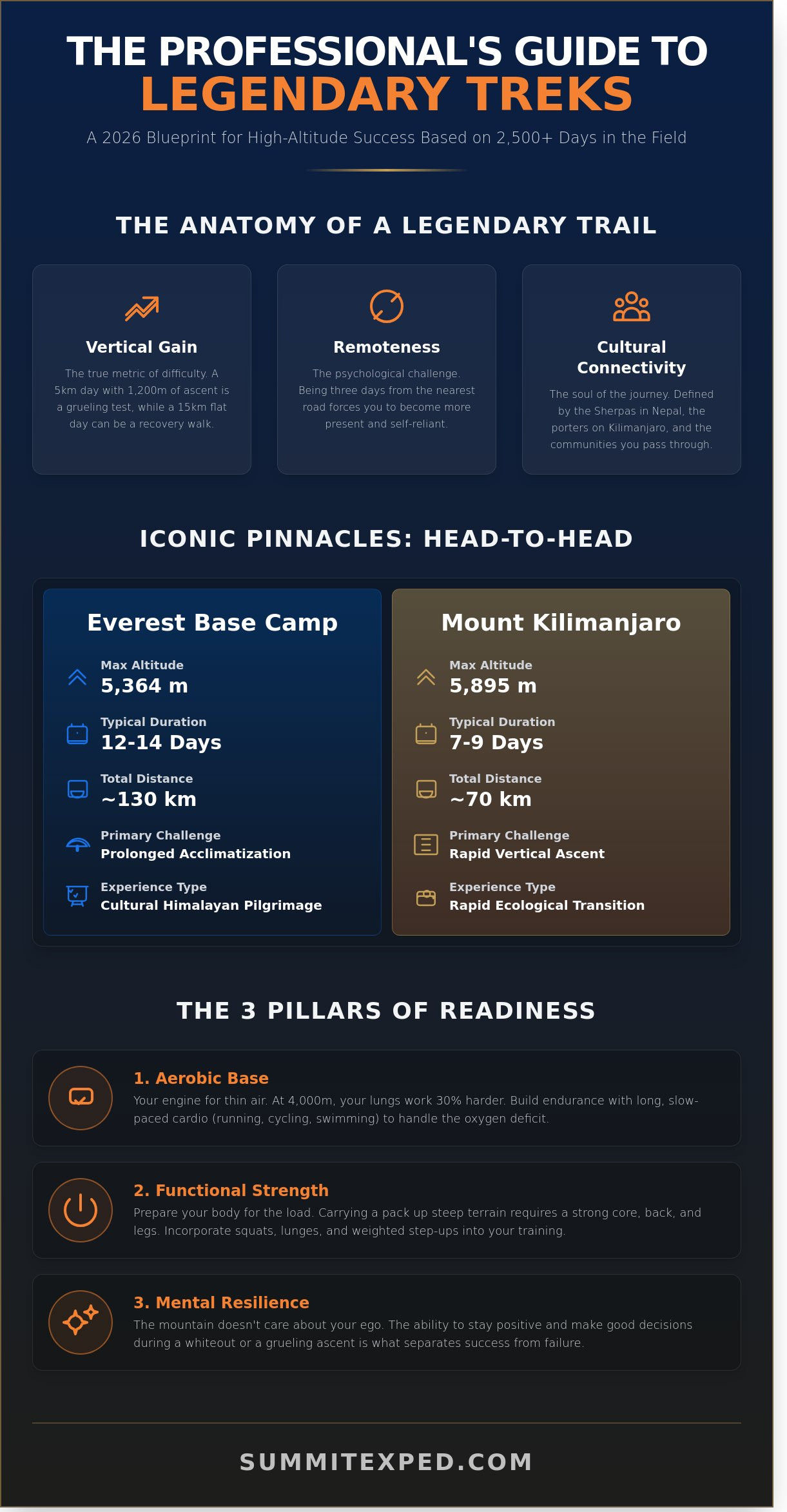
Vertical gain is the metric that actually determines difficulty, not total distance. A 15km day with 200 meters of gain is a recovery walk. A 5km day with 1,200 meters of gain is a grueling test of your cardiovascular system. Remoteness adds a psychological layer that’s hard to replicate. When you’re three days from the nearest road, your perspective shifts. You become more present. Cultural connectivity is the final piece. The best treks in the world are defined by the people you meet, from the Sherpas in Nepal to the porters on Kilimanjaro who carry the weight of the expedition with a smile.
High-Altitude Realities for 2026
The landscape of mountain tourism is changing rapidly. For 2026, many regions are implementing stricter permit systems to combat overcrowding and protect fragile ecosystems. Climate impacts are also visible; some glaciers have receded by as much as 20% in the last decade. Authentic trekking now means choosing routes that support local economies directly. This isn’t just about being a “tourist.” It’s about being a partner in conservation. Before you even pack your boots, you need a safety-first mindset. This involves understanding acclimatization schedules and recognizing that the mountain always has the final say. We don’t conquer peaks; we’re simply allowed to stand on them for a moment if we’ve done the work.
The Iconic Pinnacles: Everest Base Camp and Mount Kilimanjaro
For many adventurers, the journey into high-altitude trekking begins with a choice between two legendary giants. These routes consistently rank among the best treks in the world because they offer a manageable yet profound entry point into the thin air of the high mountains. While they share a certain prestige, the experience on the ground couldn’t be more different. One is a cultural pilgrimage through the heart of the Himalayas; the other is a rapid, vertical ascent through every climate zone on earth. Both demand respect, but they reward that respect with a perspective you simply can’t find at sea level.
Everest Base Camp: More Than Just a Destination
The 130 kilometer round trip to Everest Base Camp trek (EBC) is less about the 5,364 meter finish line and more about the rhythm of the Khumbu Valley. You’ll walk past ancient Mani stones and cross suspension bridges draped in prayer flags while the Dudh Kosi river roars below. I’ve seen many trekkers try to rush this process, but the two nights spent in Namche Bazaar at 3,440 meters are non-negotiable for safety. This is where your blood starts the hard work of producing more red cells to handle the thinning atmosphere. The true psychological reward isn’t actually at Base Camp itself, where the peak is often hidden by the massive Nuptse ridge, but from the 5,545 meter summit of Kala Patthar. Standing there at sunrise, watching the first light hit the highest point on the planet, changes how you view your own capabilities forever.
Kilimanjaro: A Journey Through Five Ecosystems
Mount Kilimanjaro stands at 5,895 meters, making it the highest free-standing mountain on the planet. The climb is a biological survey that starts in lush, humid rainforests and ends in an arctic stone scree. Selecting your path is the most critical decision you’ll make before leaving home. I always recommend the 8 day Lemosho route over the 6 day Machame route; those extra 48 hours for acclimatization can increase summit success rates by over 25 percent. You’ll move from the jungle through giant lobelias in the moorland, finally reaching the stark, lunar landscape of the high desert. Moving pole pole, or slowly, slowly, is the single most important factor for allowing your body to adapt to the decreasing oxygen levels on the way to Uhuru Peak. If you’re ready to test your grit on the roof of Africa, consider joining our expert-led teams for a safe, supported summit push.
When you compare these two, the logistics define the daily vibe. EBC relies on teahouse culture, where you’ll eat dal bhat and sleep in plywood-walled rooms. It’s social, dusty, and deeply connected to the Sherpa community. Kilimanjaro is a full-service camping expedition. Our crews handle the heavy lifting, setting up private mess tents and sleeping quarters each afternoon. Both are excellent “first steps” because they don’t require technical climbing skills, just a high level of physical fitness and a stubborn mental attitude. These trails aren’t just entries on a bucket list; they’re the training grounds where you’ll learn if the high-altitude life is for you. You can find more details on why these remain the world’s top treks through various global rankings, but the real proof is always in the dirt on your boots and the memories of the thin, cold air.
The Wilderness Frontier: K2 Base Camp and the Annapurna Circuit
The quest for the best treks in the world often leads travelers to the familiar trails of Everest, but the true wilderness frontier lies where the infrastructure ends. If you’re looking for a challenge that strips away the comforts of tea houses and replaces them with raw, high-altitude grit, you need to look toward the Karakoram and the deeper reaches of the Annapurna massif. These aren’t just hikes. They’re transformative journeys that bridge the gap between being a trekker and becoming an expeditionist.
K2 Base Camp & Concordia: The Throne Room of the Gods
Pakistan is a different beast entirely. You won’t find luxury lodges or heated dining rooms on the way to K2. Logistics here are complex. You’re required by law to have a licensed guide and a government-issued No Objection Certificate to enter the Central Karakoram National Park. Most teams spend 14 days navigating the 65-kilometer-long Baltoro Glacier. This is where the “Grit Factor” becomes a reality. Unlike the Khumbu Valley in Nepal, where trails are well-defined, the Baltoro is a shifting landscape of rock and moving ice. You’ll spend at least 7 nights sleeping directly on the glacier. It’s cold, it’s loud as the ice groans beneath you, and it’s physically exhausting.
The reward is Concordia. It’s the only place on Earth where you can stand at the intersection of two massive glaciers and see four of the world’s fourteen 8,000-meter peaks at once: K2, Broad Peak, Gasherbrum I, and Gasherbrum II. Many people fail this trek because they underestimate the terrain. Walking on loose scree and ice for eight hours a day requires a level of ankle stability and mental focus that most trail hikers aren’t used to. You’re not just walking; you’re managing your survival in a landscape that feels indifferent to your presence. If you’re based in the Middle East and want a detailed breakdown of logistics, permits, and training, our comprehensive K2 Base Camp trek guide for Dubai and Middle East adventurers covers everything you need to plan your 2026 expedition.
The Annapurna Circuit: A Cultural Odyssey
While K2 is about isolation, the Annapurna Circuit is about the incredible diversity of the human and natural landscape. It remains a bucket-list staple because it transitions from subtropical forests at 800 meters to the high alpine desert of the Mustang region. The physical climax is crossing the Thorong La Pass at 5,416 meters. It’s a grueling 1,000-meter ascent from Thorong Phedi that usually starts at 4:00 AM to avoid the afternoon winds. For the most current permit requirements and safety updates, always consult the Nepal Tourism Board before you fly into Kathmandu.
A common mistake is thinking the “new road” has ruined this trek. While 4×4 tracks have reached Manang, you can stay on authentic trails by following the NATT (Natural Annapurna Trekking Trails). These are marked with red and white blazes and keep you away from the dust and traffic. This circuit is the best training ground for high-altitude endurance. The gradual ascent allows your body to produce the extra red blood cells needed for 5,000-meter passes. You’ll learn the “pole pole” pace, a Swahili term we use to remind climbers that moving slowly is the only way to reach the top. By the time you drop into the Kali Gandaki Gorge, the deepest in the world, you’ve earned your stripes as a mountain traveler.
- K2 Tip: Bring high-quality, insulated sleeping pads with an R-value of 5.0 or higher. The ground cold will drain your energy faster than the climb.
- Annapurna Tip: Don’t skip the side trip to Tilicho Lake at 4,919 meters. It adds 3 days to your itinerary but offers some of the best acclimatization benefits on the planet.
- Mindset: Transitioning to an expeditionist means taking ownership of your gear. Don’t rely on your porter for your water or extra layers. Keep them on your back.
Preparing for the World’s Toughest Trails: A Professional Reality Check
You don’t just “go” on the best treks in the world; you prepare for them with the discipline of an athlete. I’ve seen too many hikers arrive at the base of the Himalayas with high-end gear but zero “mountain legs.” Physical conditioning isn’t about looking fit in a gym. It’s about surviving the 12th hour of a summit push when the oxygen is thin and your quads feel like they’re on fire. If you live in a flat landscape like Dubai, find a skyscraper with at least 50 floors and start climbing. Gravity is the only honest coach you’ll ever have, and stair-climbing is the closest simulation to the relentless vertical gain you’ll face in the wild.
Preparation relies on three pillars. Your aerobic base is the engine that keeps you moving for 8 hours a day. Functional strength protects your knees and ankles from the strain of a 12kg backpack. Mental resilience is the silent partner that takes over when the weather turns and the trail gets steep. Without all three, you’re just a tourist waiting for a rescue helicopter.
Gear is your life support system. Never skimp on footwear or your sleeping setup. I recommend putting at least 80km of trail time into your boots before you even check in for your flight. A poor sleeping mat can lead to a 30% drop in recovery efficiency because your body loses heat to the frozen ground. When the temperature hits -15°C at camp, a high R-value rating on your mattress is more important than the brand of your jacket.
Acclimatization is a science, not a suggestion. The “climb high, sleep low” rule is our golden standard. By ascending to a higher altitude and then descending to sleep, you trigger your body to produce more red blood cells. This physiological shift takes 24 to 48 hours to begin. Rushing this process leads to Acute Mountain Sickness, which ends roughly 15% of high-altitude expeditions before they even reach the midpoint.
The 6-Month Training Blueprint
In months 1 and 2, focus on building your aerobic engine. Spend 4 to 6 hours every week in Zone 2 heart rate training, which means low-intensity movement where you can still hold a conversation. During months 3 and 4, introduce your pack. Start with 5kg and gradually increase to 12kg while finding hills or stairs. In the final two months, hit peak volume with back-to-back long days. Always include a 14-day taper before your flight to ensure your muscle fibers are fully repaired and ready for the climb.
Mindset: The Invisible Gear
Dealing with discomfort is a skill you must practice. I use a method of “chunking” time. When I hit the “wall,” I don’t think about the summit; I focus on the next 15 minutes or the next 200 steps. You must also remain flexible. On a 2023 expedition to Aconcagua, we sat in tents for 4 days waiting for a wind window. The mountain always has the final say in your itinerary. The expedition mindset is the ability to find joy in the struggle, a trait shared by adventurers from high-altitude trekkers to those who take to the air with experiences like UK Skydiving or explore the cosmos at events with Immersive Experiences.
Ready to test your limits on the trail? Check out our detailed expedition prep guides to start your journey correctly.
Mapping Your Progression: From Trekker to Mountaineer
Your first summit is rarely just a finish line. It is a gateway. Over the last decade, I’ve seen hundreds of trekkers stand on the roof of Africa and realize their journey is only beginning. We call this building a mountain resume. It’s a deliberate process of stacking experiences, altitudes, and technical skills so you never find yourself in a situation your training can’t handle. You don’t just wake up and decide to climb an 8,000 meter peak. You earn it through a sequence of increasingly challenging environments.
If you’ve already explored some of the best treks in the world, you have the foundation. The transition from a trekker to a mountaineer happens when you move from walking paths to navigating terrain that requires tools. For instance, moving from the standard Everest Base Camp trek to Island Peak (6,189m) or Lobuche East (6,119m) introduces you to crampons, ice axes, and fixed ropes. These peaks are the perfect classroom. They offer a controlled environment to test your grit at high altitude without the extreme technicality of the Himalayas’ most dangerous faces.
This progression is the secret behind the Seven Summits pathway. High altitude trekking on routes like the Lemosho on Kilimanjaro prepares your respiratory system for the 6,961 meter thin air of Aconcagua. It teaches you the discipline of the “pole pole” pace, which is the only way to survive the 20 day expeditions required for Elbrus or Denali. At Summit Expeditions, we bridge this gap by treating every trek as a training ground. We want you to understand the “why” behind every acclimatization hike and gear choice. For Middle East-based adventurers ready to take the next step, our complete resource on climbing the seven summits provides a tailored roadmap from desert training to standing on the highest peak of every continent.
Choosing Your Next Horizon
Selecting from the list of the best treks in the world is about more than just scenery; it’s about strategic growth. If you loved the volcanic terrain of Kilimanjaro, your next target should be climb Mount Kenya (5,199m) or the rugged, wet complexity of Uganda’s Rwenzori Mountains. If you mastered the EBC trail, look toward Mera Peak (6,476m) or the legendary K2 Base Camp trek in Pakistan. This is where the role of your guide changes. You move from following a lead to learning the craft, understanding weather patterns, and managing your own gear efficiency.
The Summit Expeditions Difference
We don’t operate like a standard travel agency. Our guides are mountaineers first. They’ve spent years on technical faces and high altitude plateaus, meaning they prioritize safety protocols over summit photos. Based in the UAE, we understand the specific challenges of training in a desert climate for a frozen peak. We provide tailored 12 week training programs that transform weekend hikers into competent expedition members. We are your partners in this progression, ensuring you have the skills to match your ambition.
Take the Lead on Your 2026 Adventure
Selecting one of the best treks in the world is a commitment to your own growth. Whether you’re targeting the 5,895-meter summit of Kilimanjaro or the remote wilderness of K2, success is built on a foundation of 16 to 20 weeks of rigorous preparation. Our data shows that trekkers who utilize expert-led safety protocols see a significant increase in summit success. It’s about moving from a casual hiker to a prepared mountaineer through disciplined training and the right mentorship.
Founded by Omani mountaineer Nadhir Al Harthy, Summit Expeditions provides the technical expertise and specialized training advice necessary for Middle East-based adventurers to thrive in thin air. We don’t just guide you; we partner with you to ensure every gear choice and acclimatization step is handled with professional precision. The trail ahead is challenging, but the reward of standing on a global pinnacle is worth every drop of sweat. Start your expedition journey with Summit Expeditions and see the world from a new perspective. You’re ready for this.
Frequently Asked Questions
What is the single best trek in the world for a beginner?
Nepal’s Ghorepani Poon Hill trek is the premier choice for those seeking the best treks in the world without facing extreme technicality. It reaches a maximum altitude of 3,210 meters over a 5 day journey, offering massive views of Dhaulagiri and Annapurna. You will walk roughly 10 kilometers daily on established stone steps. It is manageable for anyone with basic fitness who can handle 600 meters of elevation gain in a single afternoon.
How much does it cost to do a world-class trek like EBC or Kilimanjaro?
You should budget between 2,500 and 5,000 USD for a high-quality 8 to 12 day expedition on Kilimanjaro or Everest Base Camp. This price includes a 1 to 3 ratio of guides to trekkers and covers permits, food, and ethical porter wages. Lower prices often signal compromised safety standards or poor staff treatment. Expect to spend an additional 800 USD on technical gear and 1,200 USD on international flights.
Do I need technical climbing experience for the K2 Base Camp trek?
You don’t need technical mountaineering skills like ice climbing or rope work for the K2 Base Camp trek. However, you must be comfortable walking on shifting glacial moraine for 8 hours a day. The trail crosses the Baltoro Glacier, where the terrain changes every season. It’s a strenuous 14 day journey reaching 5,150 meters, so your endurance needs to be 30 percent higher than for a standard Himalayan trek.
How do I prevent altitude sickness on high-altitude treks?
The most effective prevention is a slow ascent rate of no more than 300 to 500 meters of sleeping elevation per day once you pass 3,000 meters. Drink 4 liters of water daily to maintain hydration and follow the “climb high, sleep low” rule. We monitor blood oxygen levels twice daily with pulse oximeters. If your saturation drops below 70 percent, you must descend immediately to avoid serious pulmonary or cerebral edema.
What is the best time of year to go trekking in the Himalayas?
The two primary windows are the pre-monsoon season from March to May and the post-monsoon period from late September to November. Spring offers temperatures between 15 and 20 degrees Celsius at lower elevations and blooming rhododendrons. Autumn provides the clearest skies for photography with a 90 percent chance of unobstructed mountain views. Avoid the winter months of December and January when temperatures regularly drop below minus 20 Celsius.
Is it safe for solo female travelers to join these expeditions?
Yes, joining an organized expedition is safe for solo female travelers, as 40 percent of our trekking groups consist of women traveling alone. You’ll have the security of a professional team and the immediate camaraderie of a group. I always recommend choosing operators that employ female guides or have a clear code of conduct for staff. This ensures a respectful environment while you tackle the best treks in the world.
What kind of insurance do I need for high-altitude trekking over 5,000m?
You need a specialized policy that specifically covers trekking up to 6,000 meters including emergency helicopter evacuation. Standard travel insurance usually caps coverage at 2,500 meters. Look for providers like Global Rescue or World Nomads that offer high-altitude add-ons. Ensure your policy has a minimum of 100,000 USD for medical evacuation because a single private helicopter flight from the Khumbu region costs roughly 5,000 USD.
How do I choose between a local operator and an international expedition company?
Choose an operator based on their safety record and staff treatment rather than just their office location. International companies often provide better pre-trip logistics, while local operators keep 100 percent of the profit in the community. Ensure they pay porters at least 15 USD per day and provide proper mountain gear. Verify their success rate is above 85 percent and ask for the specific names of the guides leading your 2026 trip.