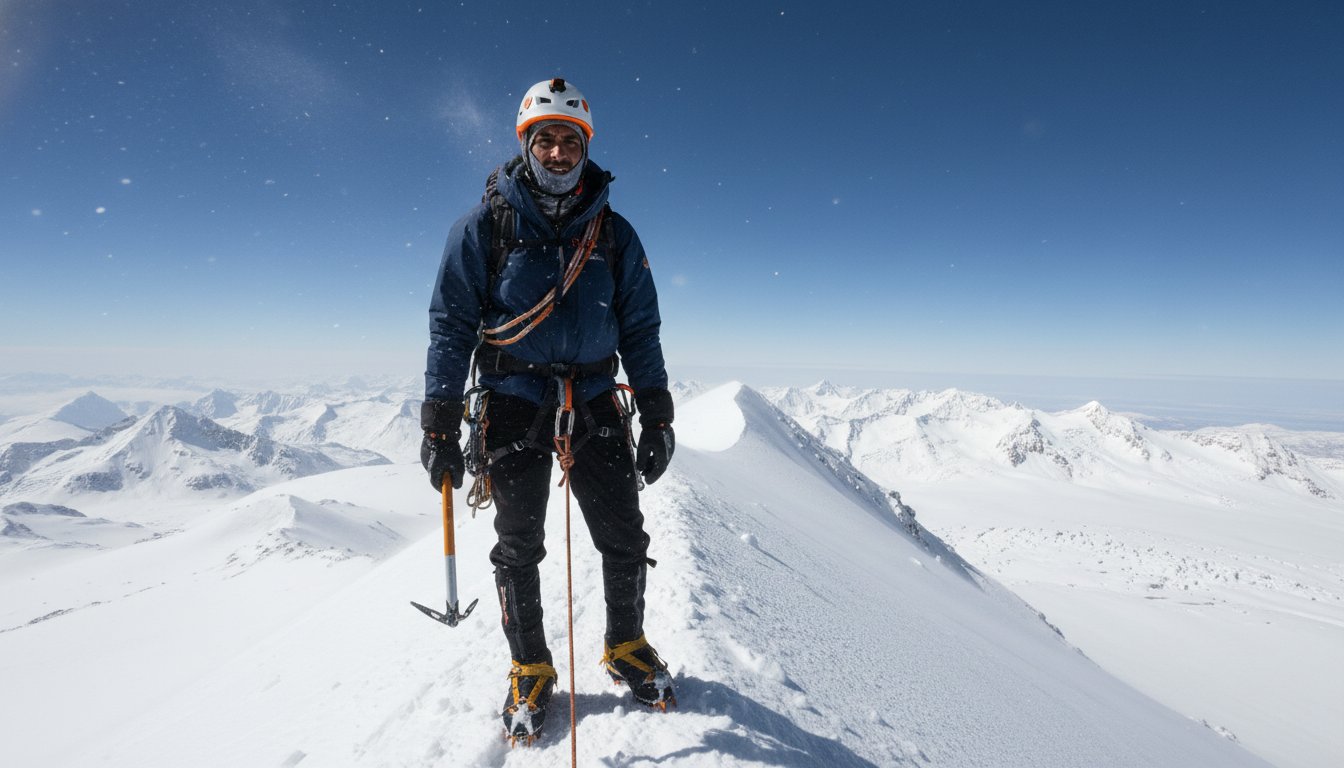
Last January, I sat with a climber in a Dubai café who was terrified that their lack of technical knowledge would lead to frostbite at 5895m (19,341ft). They had plenty of ambition but felt completely lost between hardshell ratings and crampon compatibility. It’s a common feeling when you’re preparing for your first big expedition from the GCC. You’re transitioning from 40°C desert heat to sub-zero alpine environments, and the sheer volume of technical jargon can make anyone feel out of depth.
I’ve spent years refining my own kit on the world’s highest peaks to ensure you don’t have to learn the hard way. This guide will cut through the noise to provide a field-tested mountaineering gear list beginner adventurers actually need, specifically curated for the 2026 season. You’ll learn exactly what’s worth a splurge, what you should rent from local providers, and how to build a layering system that keeps you safe and warm when the temperature drops at 5000m (16,404ft).
Key Takeaways
- Master the modular three-layer system used by professionals to manage body temperature and moisture while climbing above 5000m (16,404ft).
- Identify the “Big Three” technical tools and learn how to choose items for a mountaineering gear list beginner that integrate seamlessly with your harness and layers.
- Discover the specific legwear and handwear combinations that prevent frostbite, including why the “Cotton Kills” rule is non-negotiable in the mountains.
- Learn how to distinguish between standard lifestyle eyewear and Category 4 glacier glasses to safeguard your vision against high-altitude snow blindness.
- Gain local insights on sourcing specialist kit in the GCC and field-tested methods for breaking in rigid B2 or B3 boots while training in the desert.
The Foundation: Why Your Beginner Mountaineering Gear List Starts in Dubai
When you pack for a peak like Kilimanjaro or Elbrus while sitting in the 40-degree heat of Dubai, it’s easy to view kit as just a collection of warm clothes. This is the first mistake I see climbers make. Your mountaineering gear list beginner isn’t a wardrobe; it’s a modular survival system. Every item must work in harmony to regulate your core temperature as you move from the humid base to the frozen summit. In the mountains, your gear is your life support.
Many GCC climbers arrive at base camps around 4000m (13,123ft) over-packed with heavy, “lifestyle” outdoor brands that look the part but fail under pressure. They often under-invest in the two areas that actually end expeditions: feet and hands. I always tell my teams to save money on their trekking trousers or sun hats, but never compromise on boots or gloves. A 500-dirham pair of boots can easily ruin a 25,000-dirham expedition. High-quality mountaineering boots provide the rigid sole required for crampons and the thermal protection needed when the mercury hits -20°C.
The Three-Layer System for Extreme Temperature Swings
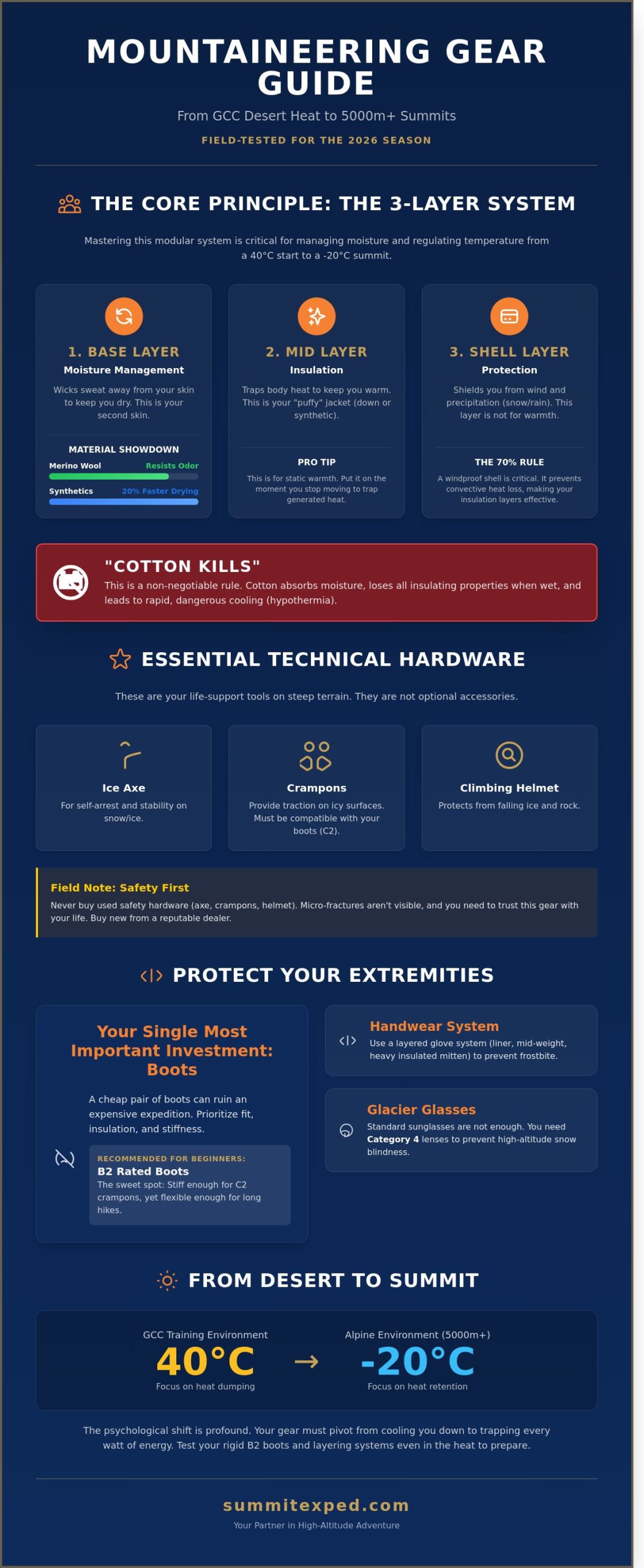
Success at 5000m (16,404ft) depends on moisture management. Your base layer should be merino wool or a high-performance synthetic. Merino is a personal favourite because it doesn’t hold odours during a seven-day trek, whereas synthetics dry 20% faster. The mid-layer, or the “puffy” down jacket, serves as static warmth. You’ll pull this out the second you stop moving to trap the heat your body just generated. Finally, the hardshell is your shield. It’s not there for warmth; its sole job is to block 60km/h winds and sideways snow from stripping away your microclimate.
Transitioning from Desert Hiking to High-Altitude Climbing
The psychological shift from desert hiking to mountaineering is profound. In the UAE, we hike to stay cool, seeking shade and breathable fabrics. At altitude, you must pivot to retaining every watt of energy. Your favourite desert kit will likely fail because it’s designed to dump heat, not trap it. I’ve seen experienced Jebel Jais hikers struggle because they didn’t respect how fast sweat turns to ice at 5500m (18,044ft). For a visual breakdown of how I organise my own kit for these conditions, check out Caroline Leon’s YouTube for field-tested advice.
- The 70% Rule: Roughly 70% of heat loss occurs through convection. If your outer shell isn’t windproof, your expensive down layers are useless.
- Avoid Cotton: It’s a death fabric in the mountains. Once it gets wet from sweat or snow, it stays wet, leading to rapid cooling.
- Tool, Not Fashion: Choose gear based on weight and function. Every extra 500g in your pack feels like 2kg on summit night.
Technical Hardware: Essential Tools for Your First Ascent
When you transition from trekking to true mountaineering, your kit shifts from simple comfort to life-support systems. The ‘Big Three’ of any mountaineering gear list beginner needs to focus on are your ice axe, crampons, and climbing helmet. These aren’t just accessories; they are the tools that keep you attached to the mountain when the gradient steepens. You’ll also need a technical backpack, typically between 35 and 45 litres (2,135 to 2,746 cubic inches). This size is the sweet spot for carrying your hardware, extra layers, and hydration without the bulk of a 70-litre expedition pack that might throw off your balance on technical terrain.
Choosing a harness requires a different mindset than gym climbing. Ensure yours has fully adjustable leg loops. You need to fit this over three or four bulky layers, including thermal leggings and thick hardshell trousers. If it’s too tight in the shop while you’re wearing jeans, it won’t work at 5000m (16,404ft). Look for a model with large gear loops that you can easily access while wearing thick gloves.
Field Note: I’ve seen too many people try to save money by buying used hardware online. Don’t do it. Micro-fractures in a dropped helmet or a stressed ice axe aren’t always visible to the naked eye. As a beginner, your life depends on the integrity of these materials. Buy your hardware new from a reputable dealer so you know its full history and can trust it when the weather turns.
Mountaineering Boots: The Single Most Important Investment
Your boots are your foundation. Beginners should look for B2 rated boots. These are stiff enough for C2 crampons but have enough flex for long approach marches. Avoid B1s for snowy peaks and leave the ultra-stiff B3s for vertical ice climbing. A common mistake I see in Dubai is people buying the same size as their daily trainers. You must size up at least one full size. Your feet swell at altitude, and you need space for thick wool socks. Perform the ‘kick test’ in the shop: kick a wall or the floor firmly. If your toes hit the front, you’ll lose your toenails on the first 1000m (3,280ft) descent.
Ice Axes and Crampons: Choosing Beginner-Friendly Tools
Selecting the right ice axe is a pivotal part of any mountaineering gear list beginner guide. For your first few peaks, choose a straight-shaft axe. Curved shafts are for steep ice, but a straight shaft is better for self-arrest and using as a walking support on moderate slopes. Pair this with C2 crampons. These use a ‘semi-automatic’ binding system with a heel lever and a plastic toe cradle. They are the goldilocks choice because they fit most B2 boots securely without the complexity of full-step-in systems. Always check the fit at home before you fly. If you want to see how I pack these essentials for a trip, check out my gear breakdowns on YouTube for a closer look.
The Soft Goods: Layering for 5000m+ (16,404ft) from the GCC
When you’re building your mountaineering gear list beginner kit in the middle of a Dubai summer, it’s hard to imagine needing four layers of clothing. But at 5000m (16,404ft), the wind doesn’t care about your weekend at JBR. The first rule I tell every climber is simple: cotton kills. It’s that simple. Cotton absorbs 27 times its weight in water and stays wet. If you sweat into a cotton t-shirt during the trek, you’ll be shivering with hypothermia by sunset. Stick to merino wool or synthetics that pull moisture away from your skin.
One of the biggest challenges for GCC-based climbers is managing ‘The Sweat Factor’. We’re used to air-conditioning or intense desert heat, so our bodies often overreact when we start moving on the lower slopes of Kilimanjaro or Elbrus. If you start the climb feeling warm, you’re already overdressed. You want to start your trek feeling ‘boldly humble’, which means being slightly chilly at the trailhead. This prevents the moisture build-up that leads to a deep, dangerous chill once you stop moving or the sun goes down.
Upper Body Layering: From Base to Summit
Your base layer is your second skin. I recommend merino wool with a weight of 150 to 200 GSM (grams per square metre). It’s naturally antimicrobial, which is a blessing on a seven-day expedition where showers don’t exist. Next comes your ‘active insulation’ layer. This should be a breathable synthetic hoody or a light fleece that allows heat to escape while you’re working hard. For the summit, you need a heavy-duty down jacket. For peaks like Kilimanjaro, look for a jacket with at least 800-fill power and 250g of down weight. This provides the necessary loft to trap heat when temperatures plummet to -20°C on summit night.
Lower Body: Protecting Your Engine Room
Your legs are the engine of your climb, and they need a versatile three-part system. Start with 200 GSM thermal leggings for the colder days and the final push. Over these, your softshell trousers will be your workhorse. They’re stretchy, wind-resistant, and breathable enough for 90% of the journey. You only deploy your hardshell bibs or trousers when the wind reaches 40 knots or the snow starts falling heavily. Hardshells are great for protection, but they trap heat, so don’t wear them unless the conditions truly demand it.
Gaiters are a small but essential addition to any mountaineering gear list beginner guide. They aren’t just for deep snow; they’re vital for keeping scree, volcanic ash, and gravel out of your expensive boots. This prevents small stones from causing hot spots or blisters, which can end an expedition faster than the altitude ever could. Always ensure they fit snugly over your mountaineering boots before you leave home.
Accessories and the ‘Little Things’ That Save Expeditions
Beginners often focus all their energy on the big-ticket items like boots or down parkas. While those are vital, your success on a peak like Kilimanjaro or Aconcagua usually hinges on the small details. I have seen entire expeditions falter because of a lost glove or a frozen hydration tube. When you are building your mountaineering gear list beginner essentials, don’t overlook these accessories. They are the difference between a comfortable summit and a miserable retreat.
Layering is not just for your torso; it applies to your hands too. You need a three-part system. Start with thin liner gloves for tasks requiring dexterity, like tying laces or adjusting a stove. Over those, wear mid-weight waterproof gloves for the approach. For the summit push, you need heavy-duty mittens. I always carry a headlamp with at least 300 lumens. Summit days usually start at midnight, and you need a beam that cuts through the darkness for 10 hours straight. Always use lithium batteries. They handle sub-zero temperatures far better than standard alkaline ones, which can lose 50% of their power in the cold.
Protecting Your Extremities: Hands, Feet, and Eyes
Standard sunglasses from a Dubai mall won’t protect you at altitude. You need Category 4 glacier glasses. These lenses block 90% or more of visible light, which is essential when snow reflects up to 80% of UV rays. Without them, you risk snow blindness, a painful condition that feels like having shards of glass in your eyes. It can take 48 hours to recover, effectively ending your climb. When it comes to your mountaineering gear list beginner purchases, this is one area where you cannot compromise on quality.
- The Leash Rule: Always ensure your mittens have wrist leashes. If you take a glove off to adjust your gear and a gust of wind grabs it at 6000m (19,685ft), your expedition is over.
- Socks: Stick to wool-blend socks. They wick moisture and keep you warm even when damp.
- Field Note: Wear a thin liner sock underneath your main trekking sock. This creates a friction barrier that significantly reduces the chance of blisters during the long descent.
Hydration and Nutrition: Gear for High-Altitude Survival
Ditch the hydration bladder. While convenient for hiking in the Hajar Mountains, the hoses freeze solid once you pass 4000m (13,123ft). I have watched many climbers struggle with frozen mouthpieces while they are gasping for air. Use 1-litre wide-mouth Nalgene bottles instead. They are indestructible and won’t leak in your pack. Store them in insulated bottle parkas to keep the water liquid in freezing temperatures.
We also need to have an honest conversation about the ‘pee bottle’. In a storm at 5000m (16,404ft), leaving your tent in the middle of the night is dangerous and cold. A dedicated, wide-mouth bottle allows you to relieve yourself without losing precious body heat. Just make sure it is clearly marked with tape or a different colour so you don’t mix it up with your drinking water in the dark. It sounds unglamorous, but it is a standard practice for every seasoned mountaineer.
Ready to put your gear to the test on a real peak? Explore our upcoming expeditions and start your journey with expert guidance.
Preparing Your Kit in the GCC: Testing and Training
Living in the Gulf doesn’t mean you’re at a disadvantage when prepping for high altitudes. While we lack the snow, we have world-class retail hubs and brutal heat that can actually help toughen your resolve. Building your first mountaineering gear list beginner kit shouldn’t feel like a guessing game; it’s about intentional selection and testing every strap before you reach the airport.
Where to Buy and Test Gear in Dubai and Doha
Dubai and Doha offer some of the best access to high-end technical equipment in the region. Adventure HQ in Dubai remains a primary destination for boots and technical apparel, where you can find expert staff who understand the specific requirements of peaks like Kilimanjaro or Mera Peak. Don’t just buy your B2 or B3 boots and put them in a box. You need to wear them. I’ve seen too many climbers develop debilitating blisters on day two because they didn’t break their boots in back home. Spend hours on a Stairmaster at your local gym or take a weekend trip to Jebel Hafeet, which stands at 1,249m (4,098ft), to test your loaded pack on steep inclines. For more detailed insights on the specific kits I’ve used on my own expeditions, you can visit Caroline Leon’s Personal Website.
Final Pack Check: The Night Before the Flight
The debate between weight and utility is won or lost in your living room the night before you fly. Every gram matters when you’re pushing toward 6,000m (19,685ft), and carrying “just in case” items often results in unnecessary fatigue. Use colour-coded dry bags to organise your kit. Red for your summit layers, blue for your evening camp clothes, and green for your electronics. This system saves you from digging through a 90-litre duffel in a dark, freezing tent. The shakedown is the final mental preparation for the climb, where you transition from a person with a hobby to a focused mountaineer ready for the summit.
My final piece of advice is simple. Trust the mountaineering gear list beginner recommendations provided by your expedition leader. We’ve spent years refining these lists through trial and error in the harshest environments on earth. Don’t over-complicate your setup with the latest gadgets or unproven tech. Stick to the essentials, ensure they fit perfectly, and trust that your preparation in the GCC has given you the foundation you need. The mountain will provide the challenge; your gear should be the last thing on your mind when you’re standing at the base of the peak. Focus on your breath, your pace, and the incredible journey ahead. You’ve done the work, now it’s time to climb.
From the Desert to the Roof of Africa
Building your first mountaineering gear list beginner doesn’t have to be a guessing game. I’ve spent years refining what works at 5895m (19,341ft) and what’s just extra weight in your pack. The key is starting with high-quality base layers that manage moisture in the Dubai heat while keeping you warm when the mercury drops below zero on the mountain. Don’t wait until you’re on a glacier to break in your boots. Use the local hills or even the stairs in your building to ensure every piece of technical hardware feels like an extension of your body.
At Summit Expeditions, we focus on more than just equipment. I lead expeditions designed specifically for GCC-based adventurers, backed by safety protocols that have helped us maintain a 95% summit success rate. We’ll help you dial in your kit during our specialised training sessions so you’re ready for the thin air. We aren’t just service providers; we’re your partners on the trail. Remember, having the right gear is only half the equation – developing proper fitness for mountaineering in the desert environment is equally crucial for summit success.
Ready to test your gear? Book your Kilimanjaro Summit Climb with our expert team today.
The mountains are waiting, and with the right preparation, that summit is well within your reach.
Frequently Asked Questions
Can I use my regular gym trainers for a beginner mountaineering trip?
No, your gym trainers won’t survive a mountain environment because they lack the rigid soles needed for uneven terrain and crampon compatibility. On a typical 7-day trek, your feet endure over 70,000 steps on rock and scree. Proper mountaineering boots provide the necessary ankle stability and waterproof protection that mesh trainers simply can’t offer. I’ve seen 4 beginners try to summit in trainers; all of them turned back before 4000m (13,123ft) due to soaked feet or rolled ankles.
Is it better to rent or buy mountaineering gear for my first expedition?
You should rent high-cost technical items like 800-fill down jackets and plastic boots for your first expedition to save roughly 3,500 AED ($950). Investing in a personal mountaineering gear list beginner kit is wise for base layers and hiking boots that require breaking in before you fly. Renting allows you to test professional brands like La Sportiva or Mammut without the 7,000 AED ($1,900) upfront commitment before you know if you love the sport.
What are glacier glasses and why can’t I just use my Ray-Bans?
Glacier glasses feature Category 4 lenses that block 95% of visible light, whereas standard lifestyle sunglasses usually only block 80% to 85%. At altitudes above 5000m (16,404ft), UV radiation increases by roughly 10% for every 1000m (3,280ft) gained. Without the side shields found on glacier glasses, light reflects off the snow and into your eyes from the periphery. This causes snow blindness, a painful condition that can halt your expedition in under 2 hours.
How many pairs of socks do I actually need for a 7-day climb?
You need exactly 4 pairs of high-quality merino wool socks for a 7-day climb. This includes 2 pairs of mid-weight socks for trekking, 1 heavy-weight pair reserved strictly for summit day, and 1 thin liner pair. Don’t pack 7 pairs; it adds unnecessary weight to your 15kg (33lb) duffel limit. Merino wool naturally resists odour for up to 3 days of continuous wear, making it the standard choice for 90% of high-altitude climbers I lead.
What happens if my gear fails while I am on the mountain?
If your gear fails, we rely on a repair and redundancy strategy using duct tape, zip ties, and multi-tools. Around 15% of climbers experience a minor gear issue, like a broken lace or a stuck zip, during a week-long trip. Our guides carry a comprehensive repair kit and spare headlamps to ensure a small equipment malfunction doesn’t end your dream. We also conduct a full gear check 24 hours before departure to catch 99% of potential failures.
Do I need a different gear list for Kilimanjaro versus Island Peak?
Yes, your gear list changes significantly because Island Peak at 6189m (20,305ft) requires technical climbing equipment that Kilimanjaro at 5895m (19,341ft) does not. For Island Peak, you must add a climbing harness, carabiners, and a mountaineering ice axe to your kit. While Kilimanjaro is a high-altitude trek, Island Peak involves crossing a glaciated headwall where safety depends on 12-point crampons and fixed-rope techniques.
How much should a beginner mountaineering gear kit cost in total?
A complete mountaineering gear list beginner kit costs between 4,500 AED and 8,000 AED ($1,225 to $2,175) if you buy everything brand new. You can reduce this by 40% by renting the heavy outerwear and technical hardware. I recommend spending at least 1,200 AED ($325) on a pair of high-quality boots. Your boots are the most critical investment; 85% of successful summits start with footwear that fits perfectly and doesn’t cause blisters.
Can I buy mountaineering gear in Dubai or do I need to order online?
You can buy 90% of your gear in Dubai at specialist retailers like Adventure HQ or Decathlon in Dubai Hills Mall. It’s much better to buy locally because you can physically test the fit of your pack and boots. Ordering online often leads to sizing errors, which account for 30% of gear returns in the UAE. Visiting a shop allows you to walk on an incline ramp, ensuring your toes don’t hit the front of your boots during the descent. However, remember that proper gear is only effective when paired with comprehensive fitness for mountaineering training that prepares your body for the demands of high-altitude climbing.