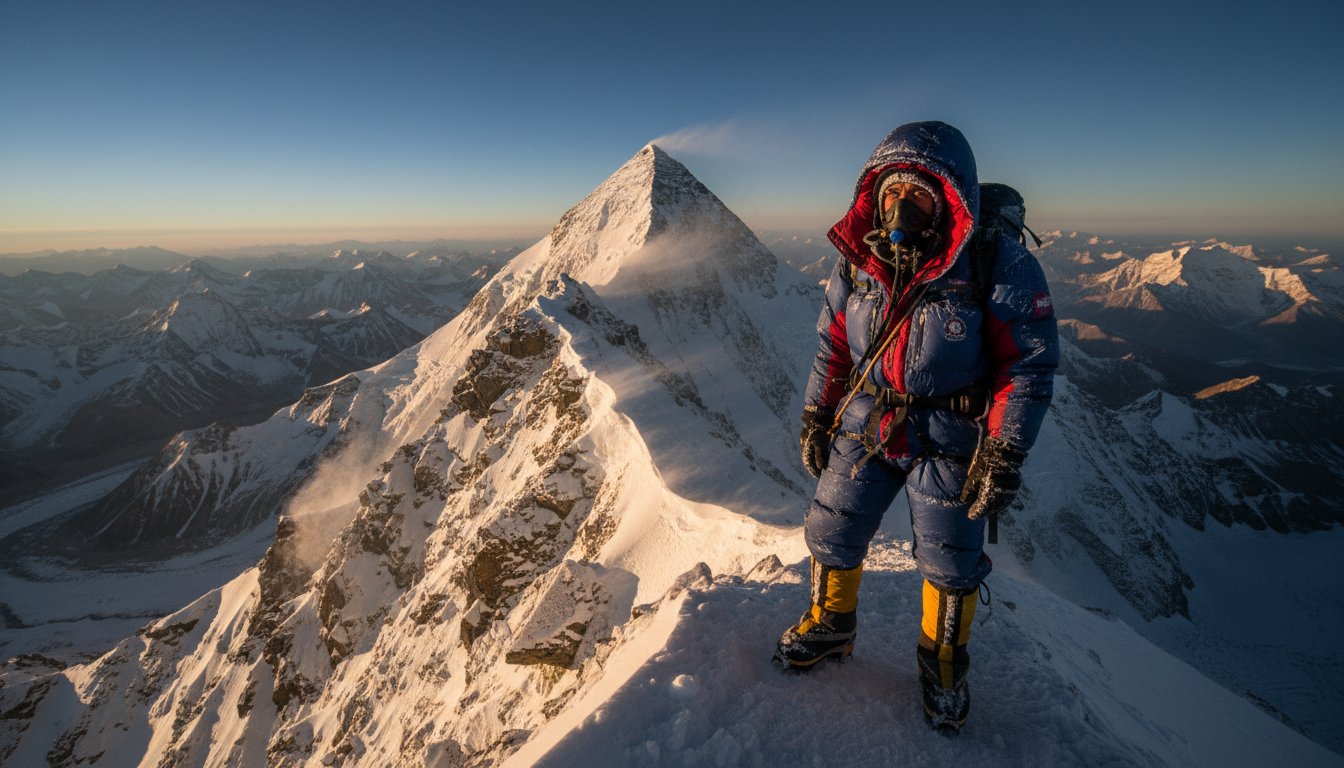
Standing on the top of Mount Everest isn’t actually about the summit day; it’s about how you manage the 60 days of psychological and physical erosion leading up to it. If you’re currently training in the 40°C heat of Dubai or Riyadh, the leap to 8848m (29,029ft) can feel like a gap too wide to bridge. You’ve probably felt overwhelmed by “Death Zone” myths and generic advice that doesn’t account for our unique sea-level starting point in the GCC.
I understand that uncertainty because I’ve lived it. I’m here to provide an unfiltered, expert-led roadmap that replaces clichéd motivation with the hard physiological facts you need to succeed. You’ll learn exactly how to transition from the desert to the thin air of the Himalayas while maintaining your strength and sanity. It’s about moving beyond the noise to find a practical path to the sky.
This guide breaks down the realistic progression steps for your 2026 expedition, from specific Middle Eastern training hacks to the brutal reality of what your body does at the world’s highest point. We’re moving past the “what” and diving straight into the “how” of professional mountain leadership.
Key Takeaways
- Understand the physical reality of standing at 8848m (29,032ft) on a platform the size of two dining tables at the top of mount everest.
- Learn how to manage the physiological shock of transitioning from 40°C+ desert heat to the -40°C conditions found within the Death Zone.
- Discover why building a massive aerobic base through slow Zone 2 training is more critical for high-altitude success than high-intensity gym workouts.
- Evaluate the logistics of the South Col and North Ridge routes to determine the most practical approach for climbers flying from the GCC.
- Gain insight into the ethical foundations of a modern expedition, focusing on fair Sherpa partnerships and responsible mountain stewardship.
Reaching 8848m (29,032ft): The Reality of the Mount Everest Summit
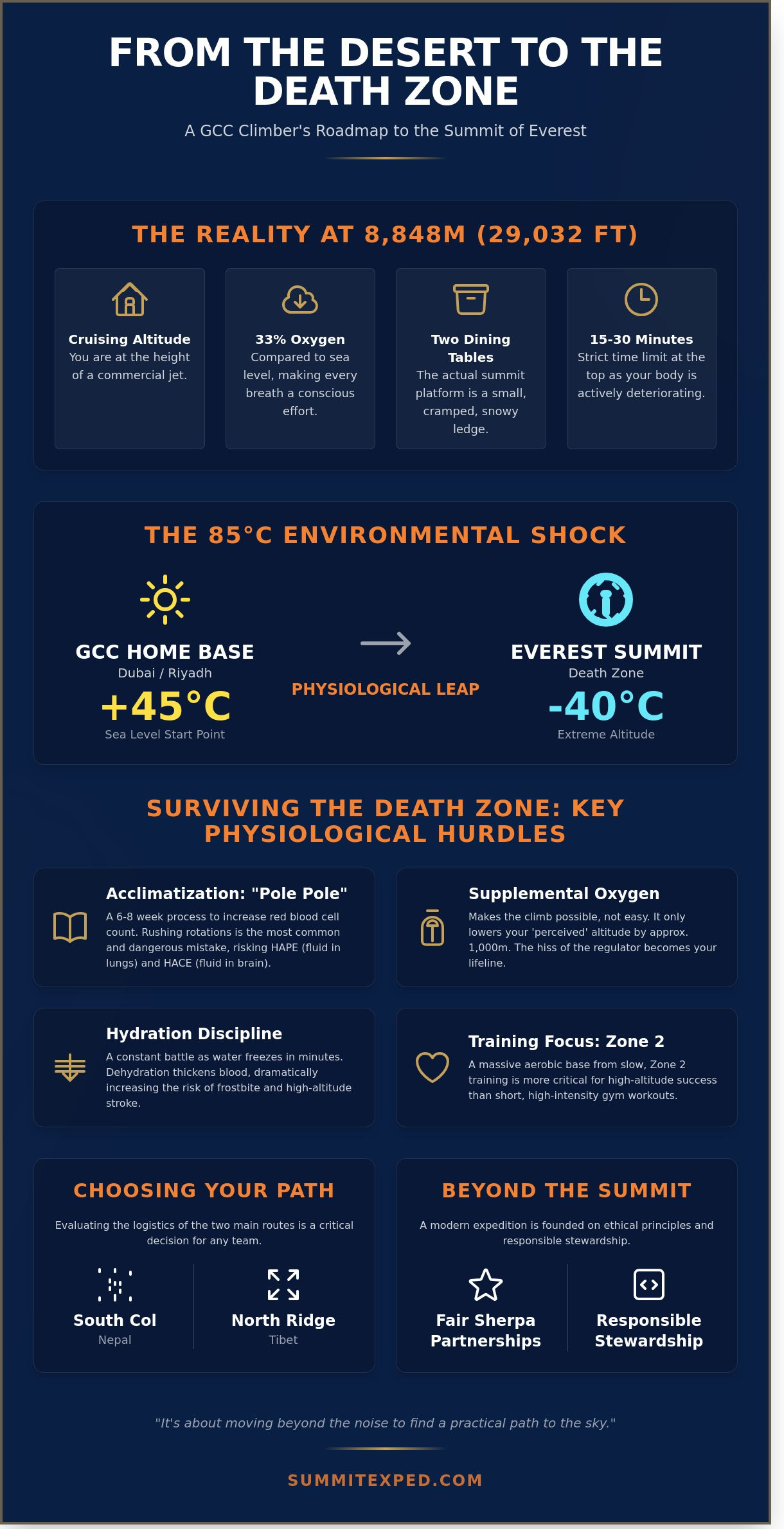
Standing at the top of mount everest isn’t the expansive, cinematic experience many imagine while sitting in a cafe in Dubai. The actual summit is a cramped, snowy platform roughly the size of two dining tables. It’s a fragile ledge at the very edge of space. When you’re at 8848m (29,032ft), you aren’t just on a mountain; you’re at the cruising altitude of a commercial jet. The atmosphere here contains only 33 per cent of the oxygen found at sea level, making every breath a deliberate, conscious act of will.
Many climbers find that the famous “view from the top” becomes a secondary memory. The primary recollection is often the sheer, crushing weight of the final step and the silence of the thin air. There’s a common myth that Everest has become a “tourist” trek, but this dismisses the brutal physical and mental tax paid by every person who stands there. No one is carried to the peak. Every individual must endure the same freezing temperatures and hypoxic exhaustion to earn those few moments above the clouds. Exploring the geography of Mount Everest reveals why this remains the ultimate test of human endurance.
To better understand the intensity of this environment, watch this footage from the peak:
The Physicality of the Highest Point on Earth
Breathing at 8000m (26,247ft) through an oxygen mask is a sensory experience unlike any other. The hiss of the regulator becomes your heartbeat, and the world shrinks to the few metres of rope directly in front of your crampons. You don’t just feel the cold; you feel the absence of heat. The horizon clearly curves away from you, a sight that reminds you how high you’ve climbed. Safety protocols dictate that “staying at the top” is strictly limited to 15 to 30 minutes. This isn’t for lack of wonder, but because your body is dying every minute it remains in the Death Zone. If you want to see what this preparation looks like in real-time, I share more about the grit required on my YouTube channel.
Historical Context: From Hillary to the Modern Arab Pioneers
The first successful ascent in May 1953 by Edmund Hillary and Tenzing Norgay relied on heavy wool layers and primitive oxygen sets. While our modern down suits and carbon-fibre bottles are lighter, the mountain hasn’t changed. The wind still bites with the same ferocity. In recent decades, the top of mount everest has become a significant milestone for GCC athletes. Raha Moharrak became the first Saudi woman to summit in May 2013, followed by Sheikh Mohammed bin Abdulla Al Thani as the first Qatari. These pioneers transformed the summit from a distant explorer’s dream into a tangible pinnacle of regional achievement, proving that those from the desert can thrive in the world’s most frozen corners.
Surviving the Death Zone: Physiological Hurdles for GCC Climbers
Reaching the top of mount everest is not merely a feat of fitness. It is a brutal lesson in biology. When you cross the 8000m (26,247ft) threshold, you enter the Death Zone. At this altitude, the partial pressure of oxygen is so low that the human body can no longer recover. You are effectively dying, and the clock is ticking. For adventurers joining us from the GCC, the shock is often visceral. You are transitioning from the 45°C heat of a Dubai or Riyadh summer to -40°C summit chills. This 85-degree temperature swing places an immense strain on your thermoregulation systems before you even factor in the lack of air.
The Science of Thin Air
Acclimatisation is the slow, deliberate process of teaching your blood to carry more life. During the six to eight weeks we spend living between Base Camp and the higher camps, your body produces a surge of red blood cells to scavenge every available molecule of oxygen. I always advocate for the “pole pole” (slowly, slowly) approach. Rushing a rotation is the most common mistake I see. It leads directly to the physiological hurdles of climbing Everest, such as HAPE or HACE, where fluid builds up in the lungs or brain. Supplemental oxygen makes the climb possible, but it does not make it easy. It only lowers your “perceived” altitude by about 1000m (3,280ft). Hydration remains your most difficult task. When your water bottle freezes solid in minutes, staying hydrated requires constant discipline. Dehydration thickens your blood, significantly increasing your risk of frostbite and stroke.
Mental Fortitude and the ‘Summit Fever’ Trap
The psychology of the climb is as thin as the air. “Summit fever” is a dangerous state of mind where the obsession with the top of mount everest clouds your judgement. You must remember that the summit is only the halfway point. Most accidents happen on the descent when the adrenaline fades and exhaustion sets in. We set a strict turnaround time, usually around 11:00 AM, to ensure everyone is off the high ridges before the afternoon weather shifts.
Managing iconic landmarks like The Balcony at 8400m (27,559ft) or the Hillary Step requires a quiet mind. My personal approach to the long, dark summit push is to “chunk” the journey. I don’t look at the peak. I focus on the next 15 minutes of breathing and foot placement. This mental compartmentalisation prevents the scale of the mountain from becoming overwhelming. If you are beginning to visualise your own path to the world’s highest peaks, you can explore my expedition resources for more practical training insights.
Choosing Your Path to the Top: South Col vs. North Ridge
Deciding which face of the mountain you’ll climb to reach the top of mount everest is your first major strategic hurdle. For those of us living in Dubai or Doha, the choice often starts with a flight path. Most GCC adventurers find the South Side in Nepal more accessible because of the daily direct flights from DXB and DOH to Kathmandu via FlyDubai, Emirates, and Qatar Airways. Reaching the North Side in Tibet is a different beast. It usually involves a multi-day transit through mainland China, often via Chengdu, and requires navigating specific group mountaineering visas that can be administratively heavy. Understanding where is mount everest located on the Nepal-China border helps clarify these logistical decisions for GCC climbers planning their 2026 expeditions.
The two routes offer entirely different sensory and physical experiences. The South is lush, spiritual, and technically varied, while the North is a high-altitude desert that feels more exposed to the elements. Here is how the two paths break down for a 2026 expedition:
- South Side (Nepal): Famous for the Khumbu Icefall and the Western Cwm. It’s technically more active at lower camps but offers better rescue infrastructure.
- North Side (Tibet): Known for being colder and windier. You drive directly to Base Camp at 5150m (16,896ft), skipping the long trek but making acclimatisation more aggressive.
The South Col Route (Nepal)
The journey through the Khumbu Valley is where the soul of the climb begins. Before we set foot on the glacier, we gather for the Puja ceremony. This isn’t just a photo opportunity; it’s a vital moment of respect where we ask the mountain for permission to climb. It sets the mental tone for the Khumbu Icefall, a 600m (1,968ft) frozen waterfall of shifting seracs. It’s the most beautiful and dangerous obstacle course you’ll ever face. I’ve found that most Summit Expeditions clients prefer this side because the Western Cwm, also called the Silent Valley, provides a protected, sun-drenched corridor that helps with morale before hitting the 1125m (3,691ft) wall of the Lhotse Face.
The North Ridge Route (Tibet)
If you choose the North, prepare for a stark, lunar landscape. The wind here is relentless because the ridge is so exposed to the jet stream. The technical crux comes late in the game on the summit ridge. You’ll have to navigate the Three Steps. The Second Step, sitting at 8600m (28,215ft), is a 40-metre (131ft) vertical challenge that requires absolute focus when oxygen is low. For the 2026 season, the China Tibet Mountaineering Association is expected to maintain its strict quota of 300 international permits. This regulatory cap makes the North Side feel less crowded, but it also means you need to secure your spot at least 8 months in advance. You can find more on my preparation strategies at caroline-leon.com to help you decide which environment suits your strength profile.
From the Dunes to the Death Zone: Preparation Strategies in the GCC
Standing at the top of mount everest requires more than just grit; it demands a physiological engine built over months of quiet, disciplined labour. Living in the GCC presents unique challenges for high-altitude prep, but the desert can be an incredible training ground if you’re strategic. You aren’t just training for a hike. You’re training to survive in an environment with 33% of the oxygen available at sea level.
I follow a five-step progression that has proven successful for my teams. First, build a massive aerobic base. Forget high-intensity interval training for a moment. You need “Zone 2” training, which means long, slow sessions where you can still hold a conversation. This teaches your body to burn fat efficiently, a critical skill when you’re moving for 12 hours straight above 7000m (22,966ft). Second, embrace weighted stair climbing. Put on a 20kg pack and find the tallest building or stadium stairs you can. It’s the best “dry” simulation for the relentless vertical gain of the Himalayas. Third, master your technical skills before you touch down in Kathmandu. You should be able to click into a fixed line or clear a frozen carabiner with thick gloves on while blindfolded.
The final two steps are about reality testing. You must climb a 6000m (19,685ft) peak, like Island Peak or Lobuche East, to see how your body handles real hypoxia. Finally, practice “suffering” in a controlled environment. Go for a 20km hike when you’re tired, hungry, or it’s slightly too hot. Mental resilience is a muscle that needs tearing before it grows back stronger.
Local Training Grounds in the UAE and Middle East
We are lucky to have Jebel Jais in Ras Al Khaimah and Jebel Hafeet in Al Ain. Jebel Jais offers the best vertical gain in the region. I recommend “repeats” on the steeper hiking trails to build leg strength. For pure endurance, the Hatta Hikes provide rugged, uneven terrain that forces your stabiliser muscles to work, much like the rocky moraine approaching Everest Base Camp. If the summer heat is too much, Dubai’s indoor altitude chambers and gym-based stair-climbing marathons are essential. They won’t replace the mountain, but they keep your red blood cell count and leg power from dipping. For a structured, field-tested approach to training for Everest Base Camp trek as a GCC adventurer, our dedicated 2026 guide walks you through exactly how to build your fitness plan from the desert up.
Gear and Nutrition: The GCC Explorer’s Kit
One common mistake I see is climbers buying a summit suit and only wearing it for the first time at Camp 3. You need to test your entire layering system in a cold chamber or during a winter training peak. If you can’t operate your zips or reach your water bottle, the gear is useless. Nutrition is equally tricky. At 7000m (22,966ft), your appetite vanishes. You need to find high-calorie foods you actually enjoy. For some, it’s dried mango; for others, it’s specific local dates that provide a quick glucose spike. For a deep dive into the technicalities of high-altitude kits, you can watch my gear breakdowns on YouTube where I show exactly what stays in my pack.
Ready to move from the sand to the snow? Book your pre-expedition fitness assessment today.
Beyond the Summit: Safety, Ethics, and Your First Steps
Reaching the top of mount everest is a moment of profound silence, not a victory lap. At Summit Expeditions, our philosophy is simple. We don’t “conquer” mountains. We are guests on them. This mindset shifts everything from how we walk to how we treat the local communities. True leadership in the Himalayas begins with humility and ends with leaving the mountain exactly as we found it. We believe that the mountain allows us to visit, and that privilege comes with a heavy responsibility toward the environment and the people who call these peaks home.
Ethical support for our Sherpa teams is non-negotiable. These men and women are the true masters of the high-altitude world. We ensure every member of our support crew receives fair pay, high-quality gear, and comprehensive medical insurance. In 2024, data from industry oversight groups indicated that nearly 30 percent of climbers still use low-cost operators that cut corners on staff welfare. We refuse to be part of that statistic. Respecting the local culture and the people who make these expeditions possible is the only way to climb. It is about partnership, not just service.
Waste management is another harsh reality we face. The Sagarmatha Pollution Control Committee (SPCC) manages tonnes of rubbish every season, and we take our role in their efforts seriously. We follow a strict “leave no trace” policy. This means packing out everything we carry in, including human waste. It isn’t a glamorous part of the expedition, but it is essential for the survival of the ecosystem. We want the climbers of 2036 to see the same pristine beauty that greeted the pioneers decades ago.
Starting Your Journey: The EBC Foundation
Success at 8848m (29,032ft) isn’t built in a gym in Dubai; it starts on the trail to Everest Base Camp. Statistics from major expedition organisers show that 90 percent of successful summiteers began their journey with this specific trek. It’s the ultimate classroom for learning how your body reacts to thin air at 5364m (17,598ft). You can review our complete Everest Base Camp trek guide for Dubai and GCC adventurers to begin planning your first expedition. Choosing a leader who prioritises safety over a “summit at all costs” mentality is the most important decision you’ll make for your long-term mountaineering career.
A Personal Invitation from Caroline Leon
The mountains have been my greatest teachers. They don’t care about your job title or your status in the GCC; they only care about your resilience and your preparation. While the top of mount everest is the ultimate goal, the person you become during the climb is what truly matters. I invite you to connect with our team in Dubai for a personal consultation. We’ll talk honestly about the grit required for this journey. The summit is just a brief moment in time, but the growth you experience during the thousands of steps it takes to get there will last forever.
Your First Step Toward the 8848m (29,032ft) Summit
Standing on the top of mount everest is a milestone that requires more than just ambition; it demands a meticulous transition from the sea-level heat of the GCC to the oxygen-thin reality of the Death Zone. We’ve explored the physiological hurdles of 8848m (29,032ft) and the critical importance of choosing between the South Col and North Ridge based on your technical experience. Success in 2026 relies on a foundation of specialised training plans designed for our desert climate, ensuring your endurance is peak-ready before you ever touch Himalayan snow.
Our approach is defined by the expertise of Omani mountaineer Nadhir Al Harthy and a 100% safety-first protocol that never wavers. We provide certified high-altitude guides who understand the unique needs of GCC adventurers, focusing on sustainable ethics and rigorous preparation. Reaching the summit is a massive achievement, but coming home safely is the only true victory. Let’s start building your expedition strategy today.
Book a Consultation with Caroline Leon and the Summit Expeditions Team to begin your journey. The mountains are waiting, and we’re ready to lead the way.
Frequently Asked Questions
How much does it cost to reach the top of Mount Everest in 2026?
Reaching the top of Mount Everest in 2026 requires a serious financial commitment, as Nepal’s Ministry of Culture, Tourism and Civil Aviation is increasing permit fees to $15,000 starting in 2025. Total expedition costs generally range from $45,000 to over $160,000. These figures cover logistics, oxygen, Sherpa support, and food, but you’ll need to budget separately for personal gear and international flights from hubs like Dubai or Doha.
Can a beginner climb to the top of Mount Everest?
Beginners shouldn’t attempt to climb to the top of Mount Everest without first building a solid foundation on smaller, technical peaks. Success on a peak of 8,848m (29,029ft) requires mastery of crampon work, fixed-line traversal, and cold-weather survival. Most reputable guides require you to have summited at least one 6,000m (19,685ft) and one 7,000m (22,965ft) peak before they’ll even review your application for an Everest expedition.
How long does it take to climb from Base Camp to the summit?
The final push from Base Camp at 5,364m (17,598ft) to the summit typically takes four to six days of climbing. This doesn’t include the six to eight weeks spent at Base Camp for acclimatisation rotations. You’ll move through four high camps, spending the final night at Camp 4, located at 7,906m (25,938ft), before making the 10 to 14 hour push for the summit. It’s an exhausting journey that tests your training.
What is the best month to stand on the top of Mount Everest?
May is the most reliable month to reach the summit because the pre-monsoon weather window offers the calmest winds. While some climbers attempt the post-monsoon season in October, historical data shows a much lower success rate due to shorter days and heavier snow. During the May window, we look for a jet stream shift that provides a 3 to 5 day period of low wind speeds below 30km/h.
Is there really a traffic jam at the top of Everest?
Crowds at the Hillary Step and the Balcony are a reality during short weather windows, but experienced leaders manage this by timing summit bids strategically. In 2019, iconic photos showed hundreds of climbers in line, which led to new safety protocols and staggered departures. We now use advanced weather forecasting to identify secondary windows, often choosing to summit a day later to avoid the 200 person queues that form during the first clear day.
What happens to your body at the top of Mount Everest?
At the summit, your body operates on roughly 33 percent of the oxygen available at sea level, pushing you into a state of extreme hypoxia. Even with supplemental oxygen, your heart rate increases significantly and cognitive functions slow down. I’ve noticed that simple tasks like clicking a carabiner take twice as long because the brain is struggling to function in the Death Zone above 8,000m (26,247ft). It’s a surreal, taxing experience.
How do you use the toilet at the top of Mount Everest?
Managing waste at high altitude is a logistical challenge that requires WAG bags or similar portable waste systems to keep the mountain clean. Above Base Camp, you’ll use these bags and carry them back down for proper disposal at lower elevations. It’s a messy reality of high-altitude life, but it’s essential for protecting the environment and ensuring the 8,848m (29,029ft) peak remains pristine for future climbers. We take environmental impact seriously.
Do you need previous climbing experience for an Everest expedition?
You absolutely need years of technical experience before considering an Everest expedition. Most successful climbers spend 3 to 5 years training on technical peaks like Ama Dablam or Manaslu to understand how their bodies react to extreme altitude. Without knowing how to self-arrest with an ice axe or manage your gear in minus 30 degree temperatures, you’re a liability to yourself and your team on the mountain. It’s about safety.