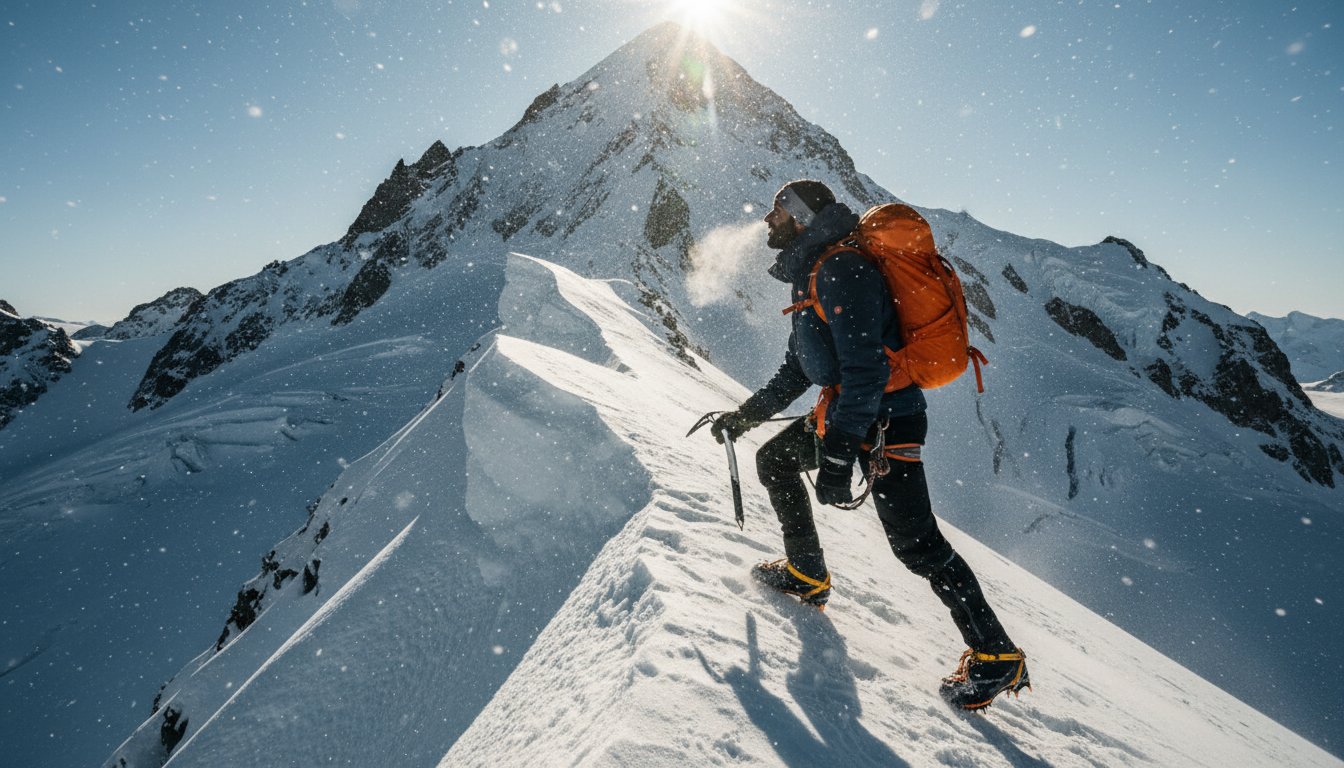
Last August, I watched a seasoned trekker from Dubai stare at their first pair of technical crampons with a mix of awe and genuine concern. Moving from the 45°C heat of a desert hike to the -15°C winds of a 4807m (15,771ft) summit is a radical shift that requires more than just fitness. It demands a total recalibration of how you move, breathe, and manage your gear. Most adventurers in the Middle East find the jump from trekking to technical alpinism daunting; honestly, it should be respected.
I’ve written this guide to Mont Blanc to bridge that gap using my years of experience leading expeditions from the GCC to the Alps. We’ll cover how to find effective technical training grounds in the desert, the exact gear you need to survive the extreme thermal shock, and which routes offer the highest safety margins for your first technical climb. You’ll gain the practical field insights needed to transition from the dunes to the “Roof of Europe” with absolute confidence.
Key Takeaways
- Understand the technical nuances between the classic Goûter Route and the aesthetic Trois Monts to select the line that best matches your experience level.
- Learn how to build “mountain legs” and manage the physiological shock of transitioning from the 40°C heat of the GCC to the -15°C environment of the Alps.
- This guide to Mont Blanc provides field-tested strategies for managing objective hazards, including the critical timing required to safely cross the Grand Couloir.
- Map out your logistics from Dubai or Doha with a 6-day itinerary that prioritises essential buffer days to account for unpredictable mountain weather.
- Gain professional insights into the physical and mental stamina required to stand on the 4810m (15,781ft) summit while maintaining a safety-first mindset.
Understanding Mont Blanc: The “Monarch” of the Alps
Mont Blanc is the undisputed crown of Western Europe. Standing at 4810m (15,781ft), it represents the birthplace of modern alpinism, where the first ascent in 1786 changed our relationship with high peaks forever. For adventurers in the GCC, it’s often the logical progression after the “Roof of Africa.” While Chamonix offers a world-class tourist experience, the summit is an entirely different beast that demands respect and preparation. This section serves as a guide to Mont Blanc context for those looking to move beyond trekking into the world of technical mountaineering. The mountain is a rite of passage, a place where you stop being a hiker and start becoming a climber.
To better understand the physical reality of this peak, watch this helpful video:
The Geography of the Mont Blanc Massif
The Mont Blanc massif is a complex web of granite and ice straddling the border between France and Italy. A long-standing cartographic dispute exists over whether the summit belongs entirely to France or is shared with Italy. For climbers, the two main gateways are Chamonix in France and Courmayeur in Italy. You’ll likely spend time at the Aiguille du Midi, which sits at 3842m (12,605ft). It’s a vital tool for your acclimatisation, allowing your body to adjust to thinner air before the final push. I often tell my teams that the time spent on these high ridges is just as important as the fitness built in the gym back in Dubai.
Why Mont Blanc is a “Step Up” from Kilimanjaro
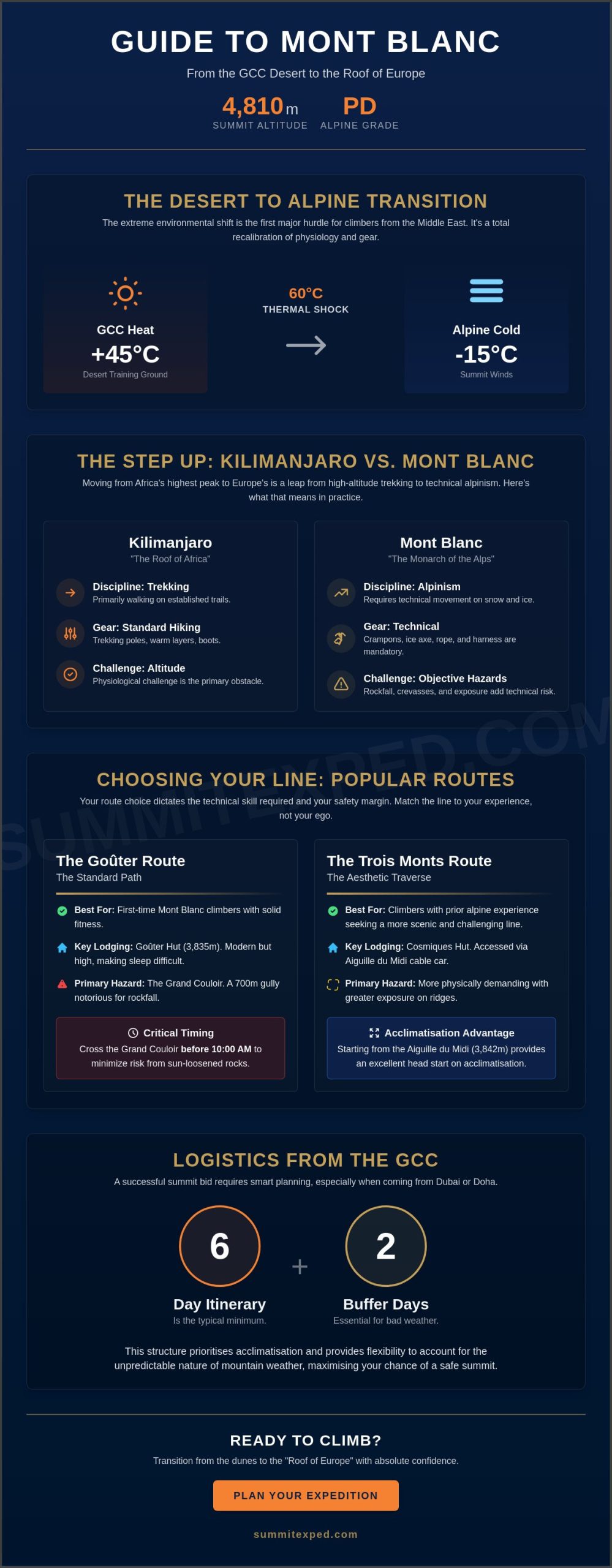
Transitioning from Kilimanjaro to the Alps is a significant leap. On Kili, you’re mostly walking; on Mont Blanc, you’re practicing alpinism. This means using technical hardware like crampons, ice axes, and ropes. The psychological shift is real. You’ll face exposure on steep snow ridges that require a steady head and precise footwork. I’ve seen many fit hikers struggle when they first feel the bite of the wind on a narrow ridge. The Alpine Grade of Mont Blanc is PD (Peu Pénible), which classifies the route as “slightly difficult” and requires technical mountaineering skills, including basic rope work and glacier travel. If you want to see more about the gear and mindset needed for these shifts, you can find my field notes on my YouTube channel.
Choosing Your Line: The Most Popular Routes to the Summit
Choosing the right path up the mountain is the most critical decision you’ll make when planning your expedition. While many see this as a simple choice based on fitness, a guide to Mont Blanc should emphasize that your route dictates your safety margin and the technical skills required. Every year, I see climbers struggle because they’ve picked a line that doesn’t match their experience level. The mountain doesn’t care about your ego; it only cares about your preparation.
The Goûter Route: The Standard Path
The Goûter Route is the most frequent choice for first-timers. It offers the most logical logistical path, starting with the Tramway du Mont-Blanc to Nid d’Aigle at 2372m (7,782ft). From here, the walk to the Tête Rousse glacier is straightforward, but the real challenge begins at the Grand Couloir. This 700m (2,296ft) stretch is notorious for rockfall. I’ve seen stones the size of refrigerators tumble down this gully. You must cross it quickly and ideally before 10:00 am when the sun begins to melt the ice holding the rocks in place.
Managing the “Rolling Stone” risk is about timing and awareness. Once across, a long scramble leads to the Goûter Hut at 3835m (12,582ft). It’s a modern, high-tech shelter, but sleeping at this altitude is tough on the body. You’ll need to have a solid plan for high-altitude acclimatization before you arrive to ensure you don’t wake up with a debilitating headache that ends your summit bid before it begins.
The Trois Monts: The Traverse of Mont Blanc
If you want a more aesthetic and varied line, the Trois Monts route is the classic traverse. It starts from the Cosmiques Hut, which you reach via the early morning cable car to the Aiguille du Midi. This route is physically demanding and feels like a true alpine expedition. You’ll navigate the steep snow slopes of Mont Blanc du Tacul and the technical cruxes of Mont Maudit.
I find that this route requires significantly better crampon technique than the Goûter. You’ll often encounter icy 40-degree slopes and large crevasses that require careful rope management. It isn’t just a walk; it’s a mountaineering challenge that tests your efficiency under pressure. Success rates on this route are often lower because it’s more exposed to high winds and requires a higher level of technical competence.
For those seeking solitude, the Italian side via the Pope Route offers a wilder experience with a much longer glacier approach. Data from the Chamonix High Mountain Office shows that while the Goûter is technically “easier,” it accounts for a higher percentage of rescues due to overcrowding and exhaustion. This guide to Mont Blanc aims to help you choose wisely. If you’re unsure about your technical readiness, you can check my expedition preparation guides for specific training advice.
The Desert-to-Alpine Transition: Training in the GCC
Training for the Alps while living in the GCC presents a unique set of hurdles. You are swapping the 45°C humidity of a Dubai August for the biting -15°C winds of the Gouter Ridge. It sounds like a recipe for a physical shock, but your body is more adaptable than you think. Training in the heat can actually be a secret weapon. Studies in sports physiology show that heat acclimatisation expands blood plasma volume. This adaptation can assist your performance when you finally hit the thin air at 4,807m (15,771ft). It is about turning the desert’s harshness into a physiological advantage before you even start your guide to Mont Blanc.
The biggest worry I hear from my clients in Doha and Abu Dhabi is the lack of vertical gain. You cannot find a mountain nearby, so you have to build one. I spent months climbing the emergency stairs of high-rise towers, carrying a 12kg pack. It is monotonous, but it builds the specific eccentric strength needed for the long descent. For a comprehensive look at technical requirements, I often recommend the British Mountaineering Council guide as a baseline for what to expect on the varied terrain.
Specific Training Protocols for Dubai and Abu Dhabi
Don’t just stick to the gym. You need to get your feet used to the weight of mountaineering boots. Ski Dubai and Snow Abu Dhabi are invaluable for this. Spend 90 minutes boot-packing up the indoor slopes before the crowds arrive. It helps your ankles adjust to the stiffness of a B3 boot. For verticality, aim for two sessions a week in a 60-storey tower. Climbing 180 floors mimics the sustained effort of the summit push. If you want to see how I structure these sessions, check out my training videos on YouTube.
The Mental Game: Preparing for Exposure
The most common objection I face is, “I’ve never walked in crampons.” It is a valid fear. Walking like a duck on a narrow ridge feels unnatural at first. Use your time in the indoor snow parks to practice the flat-foot technique. On the mountain, the Arête des Bosses requires absolute focus. I use visualisation to manage the “Summit Fever” that often clouds judgement. Remember, the summit is only the halfway point. We set a strict turnaround time, usually 10:00 am, to ensure we are off the exposed faces before the afternoon sun makes the snow bridges unstable. This is a vital part of any guide to Mont Blanc. For more on managing your body at height, see our High Altitude Acclimatisation Guide.
Life on the Mountain: Field Insights and Safety
Success on the roof of Europe isn’t just about fitness; it’s about understanding the mountain’s rhythm. My 02:00 wake-up calls at the Gouter Hut aren’t for the sake of an early start. They are a safety requirement. As the sun hits the slopes, the ice that binds loose rocks together begins to melt. This makes the Grand Couloir, a 700m (2,296ft) section of the route, incredibly dangerous. We aim to cross this “Bowling Alley” before the heat of the day turns it into a zone of frequent rockfall. If you aren’t across by mid-morning, the risk increases by over 50 percent based on seasonal safety data.
The Bosses Ridge is another reality check. In photos, it looks like a wide, snowy path. On the ground, it’s a narrow knife-edge. You’ll often have less than a metre of space between you and a 1,000m (3,280ft) drop. This is where your mental game matters. This section of our a guide to Mont Blanc focuses on the raw reality of the climb. You also need to rethink your hydration. In sub-zero temperatures, your body doesn’t trigger thirst signals like it does in the Dubai heat. Use insulated bottles; hydration bladders will freeze solid within an hour. Force yourself to drink 250ml every time we stop, even if you don’t feel the need.
Essential Gear for the GCC Alpinist
Coming from the Middle East, your body isn’t used to the biting alpine wind. You need a layering system that moves moisture away from your skin while providing heavy-duty insulation. Don’t show up in trekking boots. You need Mountaineering B3 boots; they have a rigid sole designed to take C2 crampons. This rigidity is vital for safety on steep ice. Your technical kit should include a lightweight 50cm to 60cm ice axe, which acts as your third limb on the ascent.
The Role of the Guide and Rope Teams
Safety on the mountain is built on the 1:2 guide-to-client ratio. On Mont Blanc, this is the maximum safe limit. You’ll spend much of the climb on a “short rope,” a technique where you stay close to your guide. This allows them to arrest a slip before it becomes a fall. It requires total trust and synchronized movement. For those looking to build the right mindset for such a challenge, you can explore Caroline Leon’s journey for inspiration on overcoming physical and mental barriers. When you follow a guide to Mont Blanc, the technical safety is the professional’s job, but your preparation is yours.
Planning Your Mont Blanc Expedition from the Middle East
Planning your journey starts with a solid guide to Mont Blanc that accounts for the specific needs of climbers travelling from the GCC. Flying from Dubai (DXB) or Doha (DOH) to Geneva (GVA) is the most efficient route. Major carriers like Emirates and Qatar Airways offer daily direct flights that take approximately seven hours. Once you land in Switzerland, Chamonix is only a 75-minute shuttle ride away. I always recommend arriving at least 24 hours before your expedition officially begins. This allows you to settle into the mountain time zone and handle any last-minute gear adjustments without feeling rushed.
The competitive reality of Alpine climbing centres on the mountain huts. Securing a bed in the Goûter Hut is notoriously difficult. These spots often sell out within minutes of the booking system opening in the spring. Because we manage these bookings months in advance, you can focus on your training rather than refreshing a reservation page. After you stand on the 4810m (15,781ft) summit, the return to Chamonix is a celebration of its own. Transitioning from the thin air of the “Death Zone” to a warm meal in the valley is a feeling you will never forget.
Recommended 6-Day Itinerary
A successful summit requires more than just grit; it requires a tactical approach to the weather. Our 6-day programme is built around the reality of the Alps. Days 1 to 3 are dedicated to technical training and acclimatisation. We head to the Mer de Glace or the Aiguille du Midi to practice crampon work and rope travel at altitudes around 3842m (12,605ft). This phase is essential for building the muscle memory you will need on the steeper sections of the Gouter route.
Days 4 to 6 represent your summit window. We purposely include “buffer days” because Alpine weather can change in an instant. If a storm rolls through on your planned summit morning, having that extra day allows us to wait for a clear window. This flexibility is a key part of a guide to Mont Blanc for serious adventurers. It is a different strategy than Climbing Mount Kilimanjaro, where you generally move between camps on a fixed schedule regardless of the summit day weather forecast.
Why Climb with Summit Expeditions?
Training for a technical peak while living in the desert requires a specific roadmap. We provide comprehensive pre-expedition support in Dubai and Abu Dhabi to ensure you are physically prepared for the 12-hour summit push. Our team understands the unique background of the GCC climber, from managing the transition from extreme heat to sub-zero temperatures to building the specific leg strength needed for long Alpine descents. We don’t just lead the way; we partner with you from the first training session to the final celebratory toast in Chamonix. Book your Mont Blanc summit expedition with our expert team and take the first step toward the roof of Western Europe.
Start Your Journey to the Roof of Western Europe
Standing at 4,807m (15,771ft) is about more than just the view. It’s the result of months of deliberate training in the heat of Dubai or Abu Dhabi and mastering the technical skills needed for the Gouter or Trois Monts routes. While A guide to Mont Blanc provides the roadmap, the real work happens in the months leading up to the climb. We maintain a strict 1:2 guide-to-client ratio because your safety on the Bosses Ridge is non-negotiable. Nadhir Al Harthy and I have spent years navigating these glaciers, and we’ve seen how the right transition from the desert to the snow makes all the difference. You don’t need to figure out the logistics alone. Our specialised training sessions in the UAE ensure you’re physically ready for the 1,000m (3,280ft) vertical days. The mountain is waiting for those who respect its power and prepare with purpose. We’re ready to lead the way if you’re ready to take the first step.
Join our next Mont Blanc expedition – Limited spots for 2026
Frequently Asked Questions
How hard is it to climb Mont Blanc compared to Kilimanjaro?
Mont Blanc is a technical mountaineering challenge, whereas Kilimanjaro is primarily a high-altitude trek. While Kilimanjaro takes you higher, Mont Blanc requires you to use crampons, ice axes, and ropes on exposed ridges. Statistics show that roughly 50 percent of summit attempts fail due to poor weather or lack of technical fitness. You’ll find the physical toll much higher because you’re often carrying your own gear between mountain huts.
Do I need previous technical climbing experience to summit Mont Blanc?
You don’t need to be a professional climber, but you must learn basic alpine skills before the summit push. Most reputable 6-day courses dedicate the first 3 days to training on glaciers. This guide to Mont Blanc emphasises that you’ll need to be comfortable with rock scrambling and moving while roped to a partner. If you’ve never worn crampons, I recommend a winter skills course or a dedicated training week in the Alps.
What is the best month for a Mont Blanc expedition from Dubai?
The primary climbing season runs from mid-June to mid-September when the mountain huts are open. July and August offer the most stable weather, but these months also see the highest temperatures. Since 2022, extreme heat has occasionally forced the closure of the Gouter Route due to rockfall risks in the Grand Couloir. I prefer late June for better snow coverage or early September for quieter trails and cooler climbing conditions.
How much does a guided Mont Blanc climb cost in 2026?
A guided 6-day expedition typically costs between €2,500 and €3,200 based on 2024 and 2025 industry standards. This fee usually covers your mountain guide, hut fees, and some meals, but doesn’t include flights from Dubai or personal gear hire. You should also budget approximately €500 for local transport, lifts, and additional nights in Chamonix. Prices for 2026 will likely reflect a 5 to 10 percent increase in line with local Alpine hospitality inflation.
Is it possible to climb Mont Blanc in a weekend from the Middle East?
Attempting the summit in a weekend from the Middle East is dangerous and almost guarantees failure. You need at least 5 or 6 days to safely reach the 4,807m (15,771ft) summit while allowing for proper acclimatisation. This guide to Mont Blanc recommends a slow approach to avoid Acute Mountain Sickness. Flying from sea level in Dubai straight to high altitude without a 3-day adjustment period is a mistake I’ve seen many climbers regret.
What happens if the weather is bad during our summit window?
Your guide makes the final safety call, and if the wind exceeds 50km/h or visibility is zero, the summit bid is cancelled. Professional guides usually have a Plan B, often involving a climb on Gran Paradiso in Italy where weather patterns differ. Around 30 percent of expeditions are diverted to secondary peaks for safety reasons. It’s frustrating, but the mountain will always be there, and your safety is the absolute priority during any Alpine storm.
What are the symptoms of altitude sickness on Mont Blanc?
The most common early symptoms are persistent headaches, nausea, and a total loss of appetite. These signs of Acute Mountain Sickness affect approximately 25 percent of climbers who ascend above 3,500m (11,483ft) too quickly. If you notice your coordination slipping or a dry cough developing, you must tell your guide immediately. We use the Lake Louise Scoring System to monitor these changes, ensuring we descend before symptoms become life-threatening or turn into pulmonary oedema.
Can I rent mountaineering gear in Chamonix or should I buy it in Dubai?
Rent your technical hardware in Chamonix but buy your boots and base layers in Dubai. Shops like Snell Sports in Chamonix offer full rental kits, including crampons and ice axes, for about €200 per week. However, you should buy your mountaineering boots at least 3 months early to break them in. I’ve seen too many expeditions end early because of preventable blisters caused by brand-new rental boots that didn’t fit the climber’s feet properly.