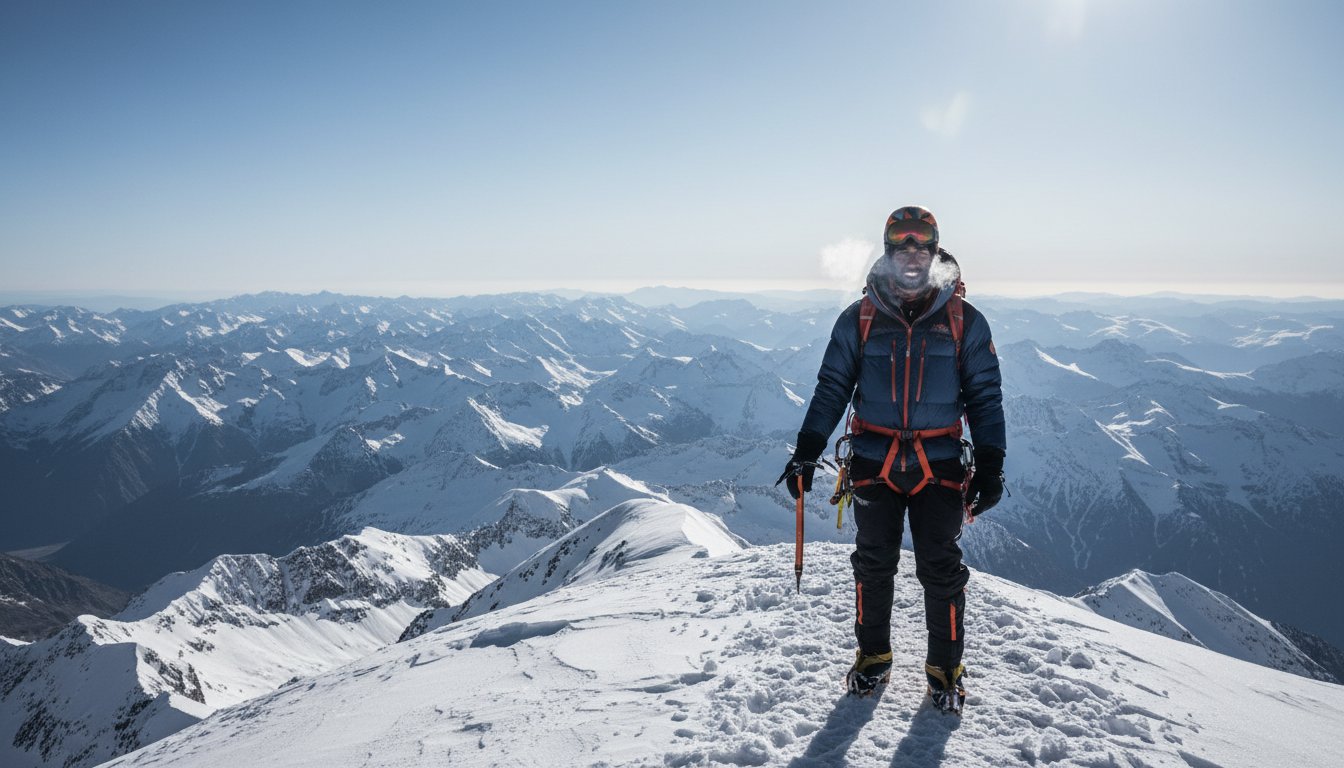
Standing on the summit of Aconcagua at 6961m (22,837ft) after months of training in the 45°C humidity of the UAE, I realised that the desert prepares you for the mountains in ways most people don’t expect. Most climbers think living at sea level is a massive disadvantage, but the mental grit you develop while pushing through a summer trek in Hatta is exactly what you need when the oxygen gets thin. If you’re sitting in Dubai or Riyadh dreaming of the big seven, you’ve likely felt overwhelmed by conflicting gear lists and the debate over which mountains actually count. This guide has The Seven Summits Explained from a perspective that respects the unique challenges we face in the GCC.
I know it’s daunting to plan for -35°C winds when your current reality is air-conditioned malls and sand dunes. I’m going to give you a field-tested breakdown of the world’s highest continental peaks, specifically tailored for those of us training in the Middle East. We’ll look at the technical difficulty of each mountain, clarify the confusion between the Bass and Messner lists, and share practical training tips that don’t require a backyard mountain range.
Key Takeaways
- Gain a clear understanding of the world’s highest continental peaks through The Seven Summits Explained, helping you distinguish between accessible trekking mountains and those requiring advanced technical skills.
- Learn how to turn local sand dunes into your most effective training tool, building the essential endurance and “time on feet” required for peaks exceeding 6000m (19,685ft).
- Discover why standard outdoor kit often fails at -40°C and get field-tested advice on selecting gear that survives the extreme conditions of the Alaska Range or Antarctica.
- Map out a realistic, long-term roadmap that takes you from your first summit on Kilimanjaro to the technical demands of the world’s highest peaks in the Himalayas.
- Benefit from local GCC-based leadership that understands your specific training constraints and provides the logistical expertise needed to transition from the desert to the ice.
What are the Seven Summits? Defining the Ultimate Mountaineering Challenge
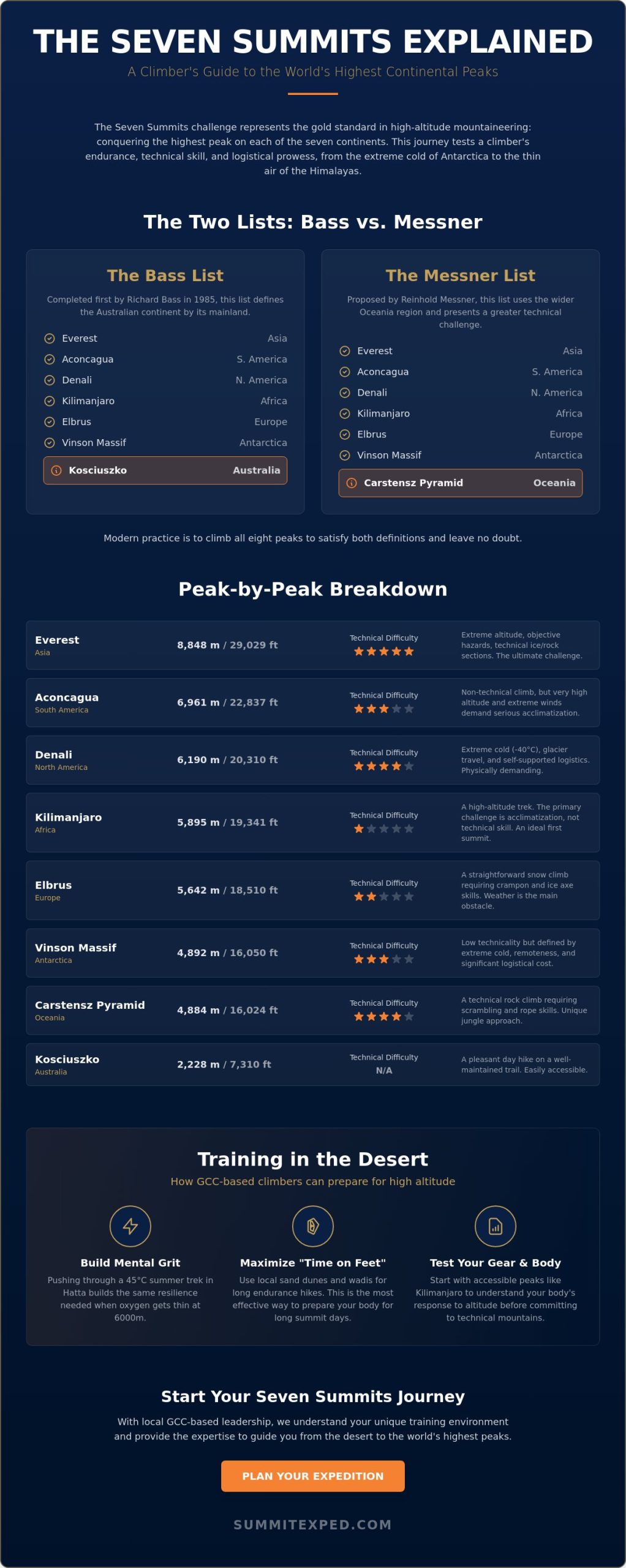
The Seven Summits refers to the highest mountain on each of the seven continents. It’s a journey that takes you from the frozen plains of Antarctica to the oxygen-thin air of the Himalayas. Since Richard Bass first completed the circuit on 30 April 1985, it’s remained the gold standard for anyone serious about high-altitude mountaineering. For us in the Middle East, this challenge has a special resonance. Pioneers like Suzanne Al Houby, who became the first Arab woman to finish the list in 2011, and Raha Moharrak, who followed in 2013, have shown that climbers from the GCC can thrive in these extreme environments. Having The Seven Summits Explained helps you understand that this isn’t just about height; it’s about the logistical mastery required to reach peaks as far apart as Alaska and the Vinson Massif.
To better understand this concept, watch this helpful video:
The path to completion is rarely a straight line. Every peak demands a different version of you. You might start with the trekking peaks, but you’ll eventually need to master crampon work, rope management, and the mental grit to endure weeks in a tent. This collection of peaks represents the ultimate test of a mountaineer’s versatility. You can find more details on the history and geography of The Seven Summits to see how the list has evolved over the decades.
Bass vs. Messner: Which List Should You Follow?
The debate over the “true” seventh summit comes down to how you define the Australian continent. The Bass list includes Mount Kosciuszko in Australia, standing at a modest 2228m (7,310ft). It’s a beautiful hike, but it lacks the technical bite most climbers crave. Reinhold Messner proposed a more challenging alternative: Carstensz Pyramid (Puncak Jaya) in Indonesia. At 4884m (16,024ft), it’s a limestone beast that requires genuine rock climbing skills. At Summit Expeditions, we prioritize the Messner list because it represents a higher standard of mountaineering. If you want to avoid any “asterisks” on your achievement, my advice is simple; do both. Most modern adventurers climb all eight to ensure their claim is undisputed across all geological and political definitions.
The “Eighth” Summit: Why Mont Blanc and Others Enter the Conversation
Geography in the mountains is often subjective. While Mount Elbrus at 5642m (18,510ft) is technically the highest point in Europe, many traditionalists still look toward Mont Blanc at 4810m (15,781ft) as the spiritual heart of European alpinism. When you begin your journey, you need to define your own goals early. Don’t just chase a list because it’s famous. I always suggest starting with peaks that build foundational skills. Kilimanjaro at 5895m (19,341ft) is often the first step for Dubai-based trekkers because it offers a high-altitude experience without technical rope work. Use these early expeditions to test your gear and your body’s response to thin air before committing to the more technical demands of Denali or Everest.
A Peak-by-Peak Breakdown: From Kilimanjaro to Everest
When I look at The Seven Summits Explained from a climber’s perspective, I don’t just see a list of peaks. I see a roadmap of personal growth. Each mountain offers a unique lesson in survival, gear management, and mental grit. For those of us living in the GCC, the transition from the 45°C heat of the desert to the sub-zero winds of a high-altitude camp is the first major hurdle you’ll face. Understanding The World’s Highest Mountains by Continent helps us categorise these challenges into trekking milestones and technical expeditions that require years of preparation.
The Trekking Entries: Kilimanjaro and Elbrus
Mount Kilimanjaro in Tanzania stands at 5895m (19,341ft). It’s the perfect first step for Dubai residents because of the direct flights and non-technical terrain. On Kili, you learn the “pole pole” philosophy; it’s about slow, rhythmic movement to manage oxygen. Mount Elbrus in Russia, at 5642m (18,510ft), is where you first step into crampons. The weather is notoriously fickle. Don’t underestimate these peaks. Altitude is the ultimate equaliser. If you don’t respect the thin air, your fitness won’t save you. Most GCC climbers head to Elbrus in July to escape the summer heat, though the cold on the summit plateau still catches many off guard.
The Technical Extremes: Aconcagua, Denali, and Vinson
Aconcagua in Argentina rises to 6961m (22,837ft). It’s a brutal test of endurance. You’ll face the “Viento Blanco” winds that can stop an expedition in its tracks for days. Denali in the USA, at 6190m (20,310ft), is a massive step up. You carry all your own gear and haul a sled. It’s often considered harder than Everest because you’re entirely self-sufficient. Then there’s Vinson Massif at 4892m (16,050ft) in Antarctica. It’s a logistical and financial hurdle that takes you to the bottom of the world. These peaks are best climbed during the GCC winter, which aligns with the southern hemisphere summer in December and January.
The Final Frontier: Mount Everest and Carstensz Pyramid
Mount Everest in Nepal reaches 8848m (29,029ft). It’s the pinnacle of The Seven Summits Explained, requiring a deep well of mental resilience and months of acclimatisation. While Everest is about high-altitude endurance, Carstensz Pyramid in Indonesia, at 4884m (16,024ft), is about technical skill. It’s a jagged limestone spire that demands rock climbing experience and a head for heights. For the truly ambitious, the Explorer’s Grand Slam involves reaching all seven summits and trekking to both the North and South Poles. This is a feat fewer than 75 people have ever achieved. If you’re ready to push your limits, you can begin your journey by preparing for your first expedition with expert guidance.
Training for High Altitude While Living in the Desert
The most common question I get from climbers in Doha or Kuwait City is how they can possibly prepare for 6000m (19,685ft) peaks and sub-zero temperatures while living in a furnace. It’s a fair concern. When the mercury hits 45°C, the idea of training for the icy slopes of Aconcagua feels like a distant dream. However, the desert offers unique advantages if you know how to use them. Success in pursuit of the Seven Summits depends less on your ability to run fast and more on your “time on feet.”
Sand dunes are your best training tool. Walking up a shifting dune mimics the exhausting “two steps forward, one step back” reality of high-altitude scree slopes or deep snow. I recommend a 12-month training cycle that respects the GCC climate. Use the scorching months from June to September for heavy strength work in air-conditioned gyms, focusing on your posterior chain and core. When the temperatures drop in October, move your training outdoors for long, slow endurance sessions. You don’t need a marathon runner’s pace. You need the grit to carry a 20kg (44lb) pack for six hours straight. Consistency is the goal; 75% of expedition success is built on this foundation of low-intensity, high-volume movement.
Simulating Elevation in Dubai and Abu Dhabi
Vertical gain is the hardest thing to find in the desert, but it isn’t impossible. In Ras Al Khaimah, the “Stairway to Heaven” provides 1,500m (4,921ft) of technical ascent that tests your footing and your head for heights. For those based in Dubai, hypoxic training facilities allow you to exercise in an oxygen-depleted environment, which is vital for understanding how your body reacts to thin air. Don’t underestimate the power of a 20kg (44lb) pack on a stair-climber machine. It’s boring, but it builds the specific cardiovascular efficiency required when The Seven Summits Explained becomes your lived reality on the mountain.
The Mental Game: Preparing for Isolation and Hardship
Expeditions are often defined by monotony. You spend days walking at a “pole pole” pace or huddled in a tent waiting for weather windows. To prepare for this in a fast-paced city, you must practice being uncomfortable. Shift your mindset from “conquering” the peak to “partnering” with it. This humility keeps you alive when conditions turn. For a deeper look at the psychological demands of these climbs, you can watch Caroline Leon’s training insights on YouTube. Real preparation happens when you embrace the slow grind of the desert long before you ever see the snow.
Logistics, Gear, and the Reality of Expedition Life
Living in the UAE, our bodies are fine-tuned for the desert heat. We thrive in 40°C humidity, but that metabolic adaptation doesn’t help when you’re pinned down in a tent on Denali at -40°C. Having The Seven Summits Explained by an expert is one thing, but living it is another. One subtle insight I’ve gained is that gear bought in a climate-controlled mall in Dubai often fails in the Alaska Range. Plastic components become brittle and snap; moisture from your breath freezes zippers shut instantly. You aren’t just fighting the mountain; you’re fighting the physics of extreme cold.
Budgeting for these peaks requires a realistic look at costs beyond the permit. You need to account for high-altitude insurance, specialised gear, and “warm-up” peaks. I recommend a phased approach. Attempting more than one peak every 1 to 2 years often leads to physical burnout or “mountain fatigue.” This journey is a marathon, not a sprint. Taking your time allows your bank account and your nervous system to recover between massive efforts.
Safety on the mountain often comes down to ego management. “Summit Fever” is a documented killer in high-altitude mountaineering. It’s the irrational drive to reach the top even when the weather turns or the clock passes the turnaround time. In my experience, the strongest climbers are those who know when to turn back at 6000m (19,685ft) to ensure they live to climb again next season.
Essential Kit for Extreme Cold (When You Live in the Heat)
Moisture management is your primary defence. If you sweat into your base layers while moving, that moisture will freeze the moment you stop, leading to rapid hypothermia. Focus on a versatile layering system rather than one thick jacket. Transition from standard trekking boots to triple-layer high-altitude boots before you hit the big peaks. Always test your kit in a cold-room or on a peak like Elbrus at 5642m (18,510ft) before heading to the 6190m (20,310ft) summit of Denali.
Managing Acclimatization and Safety Protocols
We embrace the “Pole Pole” philosophy, which means slowly, slowly in Swahili. It’s non-negotiable for success. Rapid ascent is the fastest way to trigger Acute Mountain Sickness (AMS). You must learn to recognise early signs like persistent headaches or loss of appetite in yourself and your teammates. For a deeper dive into staying healthy at height, read The Ultimate Guide to High Altitude Acclimatization. Safety is a collective responsibility, and your awareness can save a life.
Ready to start your journey toward the highest points on Earth? Explore my comprehensive expedition planning resources to begin your preparation today.
Starting Your Seven Summits Journey with Summit Expeditions
Embarking on this quest requires more than just physical grit. It demands a partnership with a team that understands your specific context as a climber based in the Middle East. At Summit Expeditions, we don’t just provide a service; we act as your local link to the world’s highest points. Having The Seven Summits Explained from a GCC perspective means acknowledging the unique transition from sea-level desert heat to the sub-zero reality of high-altitude peaks. We manage the heavy lifting of logistics, from securing complex permits in Nepal to coordinating flights out of Dubai, so you can focus entirely on your acclimatisation and mindset.
Our approach is rooted in lived experience. We know the challenges of training in 40-degree heat for a -30-degree summit. We understand the nuances of regional travel and the importance of having a support system that feels like home, even when you’re thousands of miles away. This journey is a massive undertaking, but with the right roadmap, the impossible becomes a series of manageable steps. We provide the expertise to ensure your gear is right, your fitness is peaked, and your safety is never compromised.
The Logical Progression for GCC Mountaineers
Success in the mountains is built on a foundation of incremental wins. We always suggest starting with Mount Kilimanjaro at 5895m (19,341ft). It is the ideal environment to learn how your body reacts to thin air without the need for technical climbing skills. Once you’ve mastered the “pole pole” pace in Tanzania, we move to the glaciated slopes of Elbrus at 5642m (18,510ft) or the high-altitude winds of Aconcagua at 6961m (22,837ft). These peaks serve as critical benchmarks before you tackle technical “bridge” mountains like Ama Dablam at 6812m (22,349ft) or Island Peak at 6189m (20,305ft), which are essential for anyone aiming for the top of the world.
Join a Community of Middle Eastern Explorers
There is an immense psychological advantage to climbing with a team that shares your cultural background and understands your training constraints in the city. Our expeditions foster a sense of camaraderie that often lasts long after the descent. You aren’t just a number on a permit; you’re part of a growing movement of regional explorers. To begin, you can explore Caroline Leon’s personal mountaineering journey to see the grit required behind the scenes. We offer one-on-one assessments to tailor your training plan to your current fitness level and long-term goals.
The pursuit of these peaks is rarely about the summit alone. It is a process of stripping away the noise of daily life to find out who you are when things get difficult. While having The Seven Summits Explained provides the map, the actual journey is one of profound personal transformation. You’ll return from these wilderness spaces with a renewed perspective and a quiet confidence that only the mountains can provide. Let’s take that first step together. Reach out today to book your initial consultation and start your roadmap to the roof of the world.
Take Your First Step Toward the Peak
Standing on the roof of the world isn’t about luck. It’s about the 500 hours of training you put in before you even pack your bags. We’ve explored The Seven Summits Explained through the unique lens of a GCC adventurer, covering everything from the 5,895m (19,341ft) peak of Kilimanjaro to the technical demands of Vinson. Living in the desert doesn’t mean you’re at a disadvantage. It means you need to be smarter about your heat acclimation and specific gym sessions. My partner Nadhir Al Harthy and I have spent over 10 years combined navigating these logistics. We ensure you don’t have to guess which boots work or how to manage your oxygen flow at high altitudes. Our team maintains a 100% focus on safety and authentic mountain experiences. We handle the complex logistics specifically for those travelling from Dubai or Muscat, so you can focus on your breath and your stride. Whether you’re a beginner or looking to tick off your fourth peak, the right support makes the difference between a failed attempt and a successful climb. I’ll see you on the trail.
Start your Seven Summits journey with an expert-led expedition
Frequently Asked Questions
Which of the Seven Summits is the easiest to climb first?
Mount Kilimanjaro at 5,895m (19,341ft) is the most accessible peak to start your journey. Since it’s a non-technical trek, you won’t need ropes or harnesses to reach the crater rim. It’s a five-hour flight from Dubai, making it a perfect testing ground for your high-altitude performance. I always suggest starting here to see how your body handles the thin air before committing to more technical expeditions.
How much does it cost to climb all Seven Summits from Dubai?
When you look at The Seven Summits Explained in terms of logistics, you’ll see that Everest and Vinson are the most expensive. Vinson alone often costs upwards of $45,000 USD due to Antarctic flights. Budgeting for the full circuit from Dubai usually totals over $170,000 USD. Flights from the GCC to South Africa or South America also add several thousand dollars to your total spend.
Do I need technical rock climbing experience for the Seven Summits?
You’ll need technical skills for at least two of the peaks on the list. Carstensz Pyramid requires proficient rock climbing and rappelling skills, while Denali demands mastery of glacier travel and crevasse rescue. While peaks like Aconcagua at 6,961m (22,838ft) are often called walk-ups, they still require immense physical stamina. You must be able to move safely in crampons on steep, icy slopes.
How long does it take to complete the Seven Summits challenge?
Completing the challenge usually takes between five and seven years for most UAE-based climbers. While the world record is under four months, real life often gets in the way of back-to-back expeditions. You have to wait for specific weather windows, such as the May window for Everest or the December window for Vinson. Spacing out your climbs allows your body to recover and your skills to evolve.
What is the success rate for climbers from the GCC region?
Success rates for GCC-based adventurers vary, but roughly 60 percent of climbers reach the top of their target peaks on the first try. Kilimanjaro has a higher success rate of nearly 85 percent on longer routes. Training in the Dubai heat can actually build incredible mental resilience. You must focus on specific cardiovascular work to handle altitudes above 4,000m (13,123ft) where oxygen levels drop significantly.
Can I climb the Seven Summits if I have a full-time job in the Middle East?
You can definitely manage this with a full-time job if you’re disciplined with your calendar. Most of the peaks, including Elbrus and Aconcagua, fit into a three-week window which works well with UAE annual leave. Everest is the only peak that requires a two-month sabbatical. I’ve known many professionals in the GCC who use long Eid breaks to tick off their smaller peaks while maintaining their careers.
What is the difference between the Bass and Messner lists?
The difference lies in which peak represents the continent of Australia. The Bass list includes Mount Kosciuszko, which is a simple hike. The Messner list replaces it with Carstensz Pyramid in Indonesia at 4,884m (16,024ft). Most climbers prefer the Messner version because Carstensz is a far more rewarding and technical challenge. It’s the list I personally recommend for anyone seeking a true mountaineering achievement and a diverse skill set.
Is it safe to climb Mount Elbrus in 2026?
Safety for an Elbrus expedition in 2026 will depend on the political climate and international travel sanctions at that time. Since 2022, many operators have paused trips to the 5,642m (18,510ft) peak due to regional instability. You must monitor your home country’s travel advisories closely before booking. If Elbrus remains off-limits, many climbers pivot to Mont Blanc as a high-altitude alternative in Europe, even if it isn’t technically a Seven Summit.