The "easiest" way up a mountain is almost always the first choice you can make for your summit success. You’re likely sitting in Dubai or Doha right now, staring at a screen and feeling overwhelmed by the sheer volume of conflicting reviews about kilimanjaro routes. It’s frustrating to plan for a 5,895m (19,341ft) peak when your daily reality involves 45 degree heat and a landscape that’s stubbornly flat. You want to stand on that roof of Africa, but the fear of altitude sickness and the confusion over which path to take is keeping you stuck at sea level.
I’m going to show you exactly how to choose a route that respects your body’s need for acclimatisation while fitting your personal experience level. We’ll compare all seven paths through the lens of a Middle East based climber, providing a realistic 2026 training plan that works in a desert climate. By the end of this guide, you’ll have a definitive plan to move from the heat of the GCC to the glaciers of the summit with total confidence.
Key Takeaways
-
Understand how to choose a path based on your specific mountain experience, moving beyond basic maps to account for the jump from sea level to 5895m (19,341ft).
-
Compare the advantages of the various kilimanjaro routes to see why the Northern Circuit and Lemosho offer the highest summit success rates for 2026.
-
Learn why the "Coca-Cola" route is often a trap for beginners and why a longer itinerary is actually a safer, more effective choice for your first high-altitude expedition.
-
Discover why your marathon times matter less than the "Climb High, Sleep Low" principle when it comes to avoiding altitude sickness on the way to Uhuru Peak.
-
Get practical, field-tested training advice for climbers based in the GCC to help you build mountain fitness while living in a flat, sea-level environment like Dubai or Doha.
Table of Contents
-
The High-Success Contenders: Machame vs Lemosho vs Northern Circuit
-
The Specialist Routes: Marangu, Rongai, and the Steep Umbwe Challenge
-
The Science of Success: Why Acclimatisation Beats Physical Fitness
-
From the Desert to the Glaciers: Planning Your 2026 Expedition from the GCC
Choosing Your Path to Uhuru Peak: More Than Just a Map
Selecting the right path up Mount Kilimanjaro is the most critical decision you’ll make before leaving home. For those of us living in sea-level hubs like Dubai or Abu Dhabi, the jump to 5895m (19,341ft) is a massive physiological shock. Most people focus on their cardio while ignoring the fact that their choice of kilimanjaro routes dictates their oxygen intake and recovery. Your success isn’t just about grit; it’s about giving your blood chemistry time to adapt.
Every step we take is guided by the philosophy of Pole Pole. This Swahili phrase means "slowly, slowly." It serves as the heartbeat of a successful expedition. In my experience, the climbers who rush are the ones who end up in a rescue litter. We move at a pace that feels almost too slow, but this deliberate movement is what allows your body to build the red blood cells needed for the summit push. We aren’t just walking; we’re managing a biological process.
The Seven Established Routes
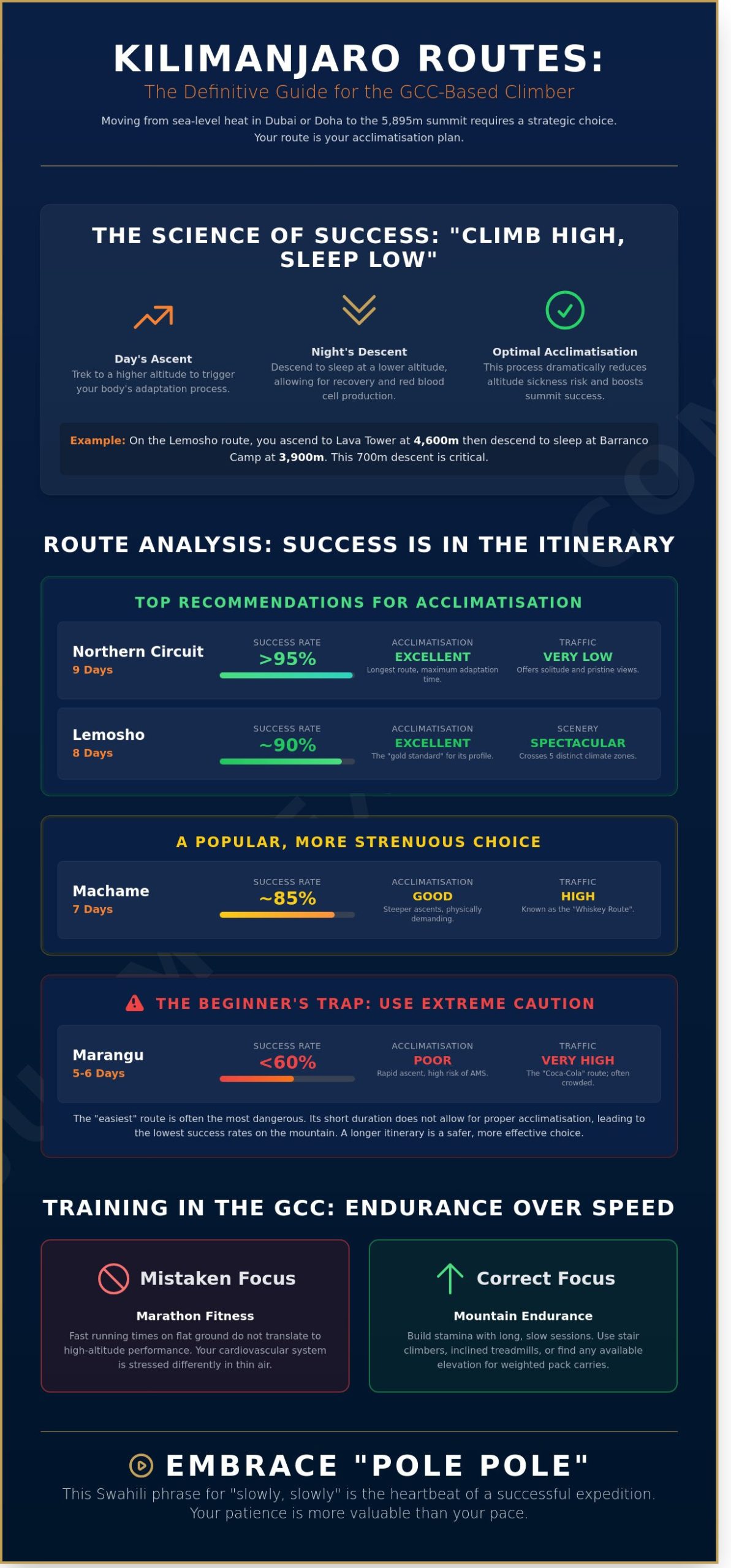
Kilimanjaro offers seven official paths. Most trekkers funnel into the "Big Three": Machame, Lemosho, and Marangu. While these are classic, many climbers in 2026 are overlooking the Northern Circuit. This is the newest and longest route, boasting a summit success rate of over 95% due to its superior acclimatisation profile. Remember, this is a high-altitude trek, not a technical mountaineering feat. You won’t need ice axes or ropes, but the "crux" is the thin air once you pass 4500m (14,764ft).
Defining Your Priorities
What do you actually want from this experience? If you’re seeking solitude, you should avoid the Marangu "Coca-Cola" route, which sees roughly 30% of all mountain traffic. If you’ve never been above 3000m (9,843ft), a 5-day itinerary is a dangerous gamble. I always tell my clients to prioritise ethical operators. Look for those certified by the Kilimanjaro Porters Assistance Project (KPAP). A team that’s well-fed and fairly paid creates a safer, more supportive environment when you’re struggling on that final 1000m (3,280ft) climb.
-
Success Probability: Longer routes like the 9-day Northern Circuit offer the highest stats.
-
Scenery: Lemosho and Machame provide the most dramatic transitions through five distinct eco-zones.
-
Experience Level: Be honest about your fitness. High-altitude experience is more valuable than a fast marathon time.
The High-Success Contenders: Machame vs Lemosho vs Northern Circuit
Choosing between the various kilimanjaro routes isn’t just about the view; it’s about how your blood chemistry handles the thinning air. Data from the 2023 climbing season shows that success rates jump by nearly 30% when you add just one extra day for acclimatisation. Professional guides favour the Machame, Lemosho, and Northern Circuit because they follow the ‘climb high, sleep low’ rule perfectly. We find moments of stillness by departing camp at 07:30, just slightly off-pace from the larger commercial groups. This allows us to witness the morning mist lifting off the Shira Plateau in silence.
The Barranco Wall often intimidates people. It is a 257m (843ft) rock face that looks vertical from the valley floor. Don’t let the sight of it rattle you. It’s a ‘Class 2’ scramble, meaning you’ll use your hands for stability, but there’s no technical climbing involved. Most of my clients find it the most enjoyable part of the trek because it breaks up the rhythm of walking.
Lemosho: The Gold Standard for Acclimatisation
I consistently recommend the 8-day Lemosho route for first-time climbers. It begins in the lush rainforest on the western side of the mountain before crossing the vast Shira Plateau. The 8-day itinerary allows your body to ‘climb high, sleep low’ effectively. On day four, you’ll reach 4,600m (15,091ft) at Lava Tower before descending to sleep at 3,900m (12,795ft). This 700m (2,296ft) descent is the secret to a headache-free summit night.
Machame: The Classic Challenge
The ‘Whiskey Route’ is steep and physically demanding. It’s a rewarding path, but I urge you to avoid the 6-day version. Choosing a 7-day Machame trek increases your safety margin significantly compared to the shorter option. You’ll encounter higher traffic at Shira 2 and Barranco camps, which can host over 200 tents during peak season. Embrace the camaraderie here; the shared energy in these camps often carries tired climbers through the tougher days.
The Northern Circuit: Kilimanjaro’s Hidden Gem
The Northern Circuit is the longest of all kilimanjaro routes, typically spanning 9 days. It offers nearly 360 degrees of vistas, circling the quiet northern slopes near the Kenyan border. Because it’s remote, you’ll escape the ‘conga lines’ found on southern paths. This 9-day duration leads to a 98% success rate for our teams. It’s the ultimate choice for those who want solitude.
The Specialist Routes: Marangu, Rongai, and the Steep Umbwe Challenge
Choosing between the various kilimanjaro routes requires an honest assessment of your experience and what you want from the mountain. Some climbers seek the comfort of a roof over their heads, while others want to avoid the crowds or test their grit on vertical ridges. These three routes serve very specific niches and shouldn’t be chosen lightly if you want to reach the 5895m (19,341ft) summit safely.
The Marangu Route: Huts vs Tents
Marangu is often called the ‘Coca-Cola’ route, a nickname that suggests it’s a casual stroll. This is a dangerous misconception. While it’s the only path offering communal A-frame huts instead of tents, the 5-day itinerary has a success rate of just 42 per cent. You’ll spend less time acclimatising here than on any other route. The logistics are also less scenic; you walk up and down the same path, meaning you miss the 360-degree views found on a traverse. Choose this for the relative comfort of a mattress, but only if you opt for the 6-day version to give your body a fighting chance.
-
Pros: No sleeping on the ground; well-defined paths.
-
Cons: High traffic; poor acclimatisation profile; same scenery on descent.
Rongai: Solitude on the Northern Slopes
If you’re planning a climb during the shorter rainy seasons of April or November, Rongai is your best bet. It approaches from the north, near the Kenyan border, which receives significantly less rainfall than the southern faces. It’s a quiet, wilderness-heavy trek where you’re far more likely to see wildlife than other climbing groups. A major highlight is the camp beneath Mawenzi Peak at 4330m (14,206ft), offering a close-up view of the mountain’s jagged second volcanic cone. You’ll eventually descend via the Marangu route, giving you a full cross-section of the mountain’s diverse ecosystems.
Umbwe: The Direct Ascent
I only recommend Umbwe to climbers who have been at 4000m (13,123ft) or higher within the last 14 days. It’s the most taxing of all kilimanjaro routes because it’s incredibly steep and fast. You gain altitude rapidly with very little time for your red blood cells to catch up. For the experienced mountaineer, it offers a raw, quiet beauty. The initial days through the dense rainforest are spectacular, leading to narrow ridge lines that offer some of the best views on the mountain before you merge with the southern circuit. Don’t let ego drive this choice; let your recent training and altitude history be the guide.
Pro Tip: If you’re flying from the Middle East, the temperature shift on Rongai is less jarring. The northern side is drier and the transition from the heat of the plains to the alpine desert feels more gradual than the humid southern starts.
The Science of Success: Why Acclimatisation Beats Physical Fitness
I’ve stood at the base of the mountain with marathon runners who assumed their sub-three-hour personal best would carry them effortlessly to Uhuru Peak. It didn’t. While physical conditioning is a vital foundation, high altitude cares very little for your aerobic capacity if your blood chemistry isn’t right. Success on the various kilimanjaro routes depends almost entirely on how well your body adapts to the thinning air. Once you cross the 3000m (9,842ft) mark, the effective oxygen level drops significantly. Your heart rate increases and your breathing deepens as your kidneys work overtime to adjust your blood’s pH balance. This isn’t a process you can rush with sheer willpower.
The most effective itineraries integrate the ‘Climb High, Sleep Low’ principle. On a structured route like Lemosho, you might trek to the Lava Tower at 4630m (15,190ft) before descending to Barranco Camp at 3960m (12,992ft) to sleep. This deliberate stress-and-recovery cycle is the only proven way to safely trigger the production of extra red blood cells. Rushing this process is the most frequent mistake I see. If you try to power through the early days, you aren’t being tough; you’re simply depriving your body of the time it needs to survive the final push.
Understanding AMS (Acute Mountain Sickness)
A mild headache is often part of the mountain experience, but you must distinguish it from true AMS. If a litre of water and a snack don’t shift the pain within thirty minutes, it’s a signal to slow down. Our guides monitor your oxygen saturation and pulse twice daily using medical-grade oximeters because data doesn’t lie. You must also prioritise nutrition even when your appetite disappears. Aim for four litres of fluids daily to keep your blood thin enough to circulate oxygen effectively to your extremities.
Subtle Insights from the Field
Your breathing should always be controlled enough to hold a full conversation without gasping for air. This is the "golden rule" of pacing that prevents early burnout. I often tell my climbers that summit night is 80% mental and only 20% physical; it is about the grit to keep moving when your brain is screaming for sleep. On shorter trekking days, avoid the temptation to collapse in your tent for hours. Use ‘active recovery’ by taking a short, gentle walk around the camp to keep your circulation moving and aid the acclimatisation process.
From the Desert to the Glaciers: Planning Your 2026 Expedition from the GCC
Living in the Gulf offers a unique set of challenges when you’re preparing for the Roof of Africa. You’re swapping the 45°C heat of a Dubai summer for -15°C summit nights. It’s a massive physiological and mental shift. Most of us in cities like Doha or Kuwait City live at sea level, which means your body hasn’t felt thin air in a long time. Logistics are actually the easy part of the journey. Qatar Airways offers daily flights from Hamad International, and FlyDubai or Emirates connect you directly from Dubai to Kilimanjaro International Airport (JRO) in about 5.5 hours. It’s a remarkably short hop from the desert to the base of a 5895m (19,341ft) giant.
Training in the Heat for the Cold
You won’t find 5000m peaks in the middle of Abu Dhabi. You have to get creative with your environment. I recommend spending at least three days a week on a stair-climber at your local gym. Start with a 5kg pack and work up to 12kg by your 2026 departure date. If you’re based in the UAE, make the drive to Ras Al Khaimah. Hit the steep switchbacks of Jebel Jais or the rocky, technical trails of Wadi Showka every single weekend. Wear your actual trekking boots during these sessions. It might feel strange in a temperature-controlled gym, but it’s the only way to ensure you don’t end up with debilitating blisters on day two. For specific drills on leg strength and the right mental approach, I’ve put together some videos on my YouTube channel that break down the exact movements you’ll need. For a comprehensive approach to building the specific endurance and mental grit required for high-altitude success, check out my detailed guide on training for Kilimanjaro from Dubai and the Middle East.
Gear and Mindset for the 2026 Season
Don’t get distracted by the flashy, overpriced gear in the high-end malls. You don’t need the most expensive carbon-fibre gadgets. You need a high-quality sleeping bag rated to -20°C and a solid four-layer system. The psychological transition is often the hardest part for GCC climbers. You’re moving from a world of 24/7 convenience and five-star luxury to a small tent on a windy ridge. It’s rugged and intentionally simple. On the mountain, your job title or social standing doesn’t mean a thing. The mountain only cares about your grit and your willingness to take the next step. We’re already seeing a 30% increase in permit applications for the 2026 season. If you’re ready to move from planning to action, our professional framework for how to book your Kilimanjaro climb for 2026 covers everything from selecting a safety-first operator to managing your logistics from the Middle East.
Ready to start your journey? Book your Kilimanjaro Summit climb with the experts at Summit Expeditions.
Your 2026 Summit Starts with the Right Path
Selecting from the various kilimanjaro routes is the most critical decision you’ll make before leaving the GCC. My time on the mountain has taught me that success isn’t about being the fastest; it’s about choosing a 7 or 8-day itinerary that respects the 5895m (19,341ft) peak. We’ve seen that longer routes like the Northern Circuit increase success rates to over 90% by allowing your body to adapt naturally. Don’t rush the process; the mountain rewards patience.
Start your Kilimanjaro journey with Summit Expeditions
Frequently Asked Questions
Which Kilimanjaro route has the highest success rate?
The Lemosho and Northern Circuit routes consistently deliver success rates exceeding 90 percent for our teams. These kilimanjaro routes provide the necessary time for your body to adapt to the thinning air. I always recommend the 8-day Lemosho variation. It gives you a much better chance of reaching the 5,895m (19,341ft) summit compared to shorter, steeper options that rush the process.
How many days does it take to climb Kilimanjaro safely?
You should plan for a minimum of seven or eight days to climb safely. While some operators offer five-day treks, the failure rate on those itineraries is nearly 50 percent due to altitude sickness. Taking eight days allows you to walk high and sleep low, which is the golden rule for acclimatisation. It ensures you arrive at the high camp feeling strong rather than depleted.
Is the Machame route or the Lemosho route better for beginners?
The Lemosho route is the superior choice for beginners because it offers a gentler gradient and better acclimatisation. Machame is beautiful but involves steeper climbs early on, which can be taxing if you aren’t used to trekking with a pack. Lemosho starts at an elevation of 2,100m (6,890ft) and winds through diverse ecosystems, giving your legs and lungs more time to sync up before the final push.
Can I climb Kilimanjaro without a guide?
No, it is impossible to climb Kilimanjaro without a registered guide. Tanzanian National Park regulations established in 1991 mandate that every climber must be accompanied by a licensed guide and a support crew. This isn’t just about red tape; it’s about your safety. My teams include local experts who monitor your oxygen levels and heart rate twice every day to ensure you’re coping with the altitude.
What is the hardest part of the Kilimanjaro climb?
The summit night from Barafu Camp to Uhuru Peak is undoubtedly the most demanding phase of the expedition. You’ll start at midnight, climbing 1,295m (4,248ft) in freezing temperatures that often drop to -20 degrees Celsius (-4 degrees Fahrenheit). It’s a mental game as much as a physical one. Most climbers find the final scree slope before Stella Point to be the ultimate test of their resolve.
How much does it cost to climb Kilimanjaro in 2026?
Expect to pay between $3,500 and $4,500 for a high-quality, ethical expedition in 2026. This price range covers park fees, which account for roughly $800 to $1,000 of the total, along with fair wages for porters and quality mountain gear. Beware of budget operators charging less than $2,000. They often compromise on safety equipment or underpay the local crew who make your journey possible.
What is the best time of year for a Middle East resident to climb?
January, February, and September are the ideal months for climbers travelling from the Middle East. These windows offer clear skies and avoid the heavy rains of April and May. If you’re coming from Dubai or Riyadh, these months also provide a welcome escape from the extreme summer heat at home. You’ll experience daytime temperatures on the lower slopes around 25 degrees Celsius (77 degrees Fahrenheit).
Do I need technical mountaineering gear for any of the routes?
You don’t need technical mountaineering gear like ropes, harnesses, or ice axes for any of the standard kilimanjaro routes. It’s essentially a high-altitude trek rather than a technical climb. However, don’t underestimate the environment. You’ll need high-quality thermal layers, a -20 degrees Celsius rated sleeping bag, and broken-in trekking boots. Proper gear is the difference between a successful summit and a miserable retreat.