What if the cheapest quote for your Himalayan dream is actually the most dangerous shortcut you’ll ever take? I’ve seen trekkers arrive at Lukla, 2,860m (9,383ft), only to realise their budget didn’t cover medical oxygen or a guide who knows how to use it. It’s confusing when one operator quotes $1,400 and another asks for $4,500 for the same route. You’re right to be wary of hidden costs that only appear once you’re breathless at high altitude.
This guide breaks down the real everest base camp trek cost for 2026, specifically for adventurers flying out of Dubai or the wider GCC. I’ll show you where to invest in safety and where you can save on gear by shopping at specific outlets in the UAE. We’re going to map out a line-item budget that covers everything from your flights from DXB to the technical layers required for the 5,364m (17,598ft) finish line, ensuring you step onto the trail with absolute confidence and a grounded understanding of the investment required for success.
Key Takeaways
- Understand the realistic range of an everest base camp trek cost and how to avoid the hidden expenses that often catch GCC-based adventurers off guard.
- Learn why the “cheapest” expeditions often result in failed summits and how investing in extra acclimatisation days provides the best return on your investment.
- Identify which pieces of high-altitude gear are worth purchasing at Dubai Mall and what is more practical to rent once you land in Kathmandu.
- Master the “Mountain Economy” to accurately budget for food and basic comforts as prices fluctuate for every 500m (1,640ft) of elevation gained.
- Navigate the essential logistics of permits and regional flight hubs, ensuring your journey from the Middle East to the Khumbu is seamless and stress-free.
The Real Cost of Everest Base Camp for Middle East Trekkers in 2026
I’ve spent years moving between the desert heat of the UAE and the thin air of the Himalayas. When you’re planning for 2026, you’ll see a wide range for the everest base camp trek cost, typically sitting between £1,200 and £4,000 ($1,500 to $5,000). This disparity isn’t just about profit margins. It reflects the level of safety, hygiene, and ethical support you receive on the trail. For those of us flying from hubs like Dubai, Abu Dhabi, or Doha, we have a logistical advantage with frequent flights, but regional preparation costs still add up. You’ll need to factor in high-altitude training and specialized gear that isn’t always easy to find in the GCC.
I’ve seen trekkers choose the cheapest option only to find themselves paying $10 for a single battery charge or $5 for a hot shower every day. Worse, budget operators often cut corners on emergency oxygen and guide training. A “cheap” trek usually ends up being the most expensive mistake you’ll make at 5000m (16,404ft). You aren’t just paying for a walk; you’re paying for a safety net in one of the world’s most volatile environments.
Total Budget Breakdown: From Dubai to 5364m (17,598ft)
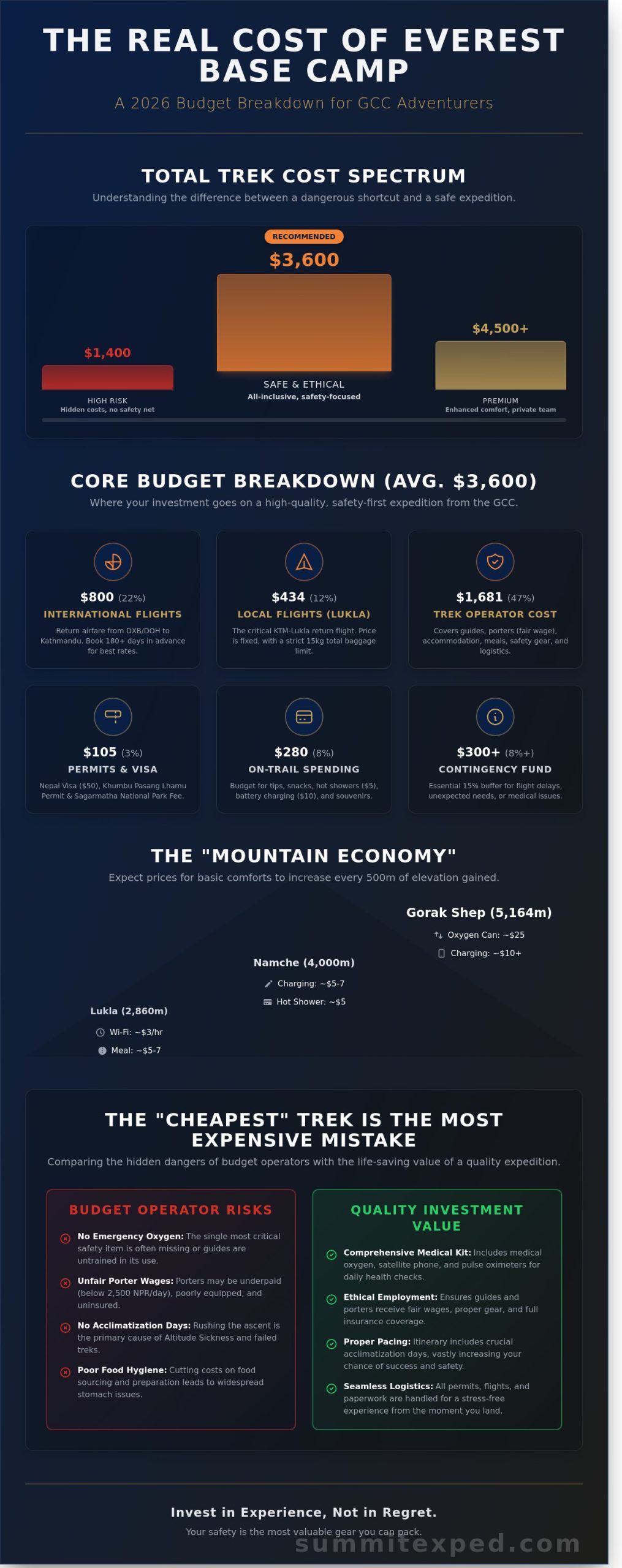
Expect to pay between $2,500 and $4,500 for a door-to-door experience starting from cities like Abu Dhabi or Doha. This range covers international flights, gear upgrades, and the trek itself. You must include a 15% contingency fund to cover Lukla flight delays or unexpected medical needs that insurance might not pay upfront. For 2026, a high-quality guided trek that prioritises safety and ethical porter treatment will average approximately £2,850 ($3,600) per person.
Why Price Variation Exists in the Khumbu
International expert-led expeditions cost more because they provide western-standard medical kits, satellite communications, and rigorous food hygiene protocols. Local agencies might offer lower rates, but they often lack the same safety redundancies. That extra £1,000 ensures your porters are paid a fair wage of at least 2,500 NPR per day and that your team has enough pulse oximeters to monitor everyone’s health daily. If you want to understand more about the logistics of these high-altitude journeys, you can find detailed guides at caroline-leon.com. True value in the mountains isn’t found in the lowest price, but in the expertise that gets you home safely.
- Budget Tier: Basic tea houses, no included showers or charging, minimal safety gear.
- Standard Tier: Quality tea houses, internal flights included, experienced English-speaking guides.
- Luxury Tier: Heated rooms where available, private porters, and premium food options.
Essential Logistics: Permits, Flights, and the ‘Lukla Factor’
Logistics are the backbone of any successful expedition. I’ve seen many trekkers arrive in Kathmandu only to realise they’ve missed a critical permit or haven’t budgeted for the “Lukla tax.” When calculating your everest base camp trek cost, these fixed expenses are non-negotiable. They are the price of entry to one of the most protected and rugged environments on earth.
In 2026, expect to pay $50 for a 30-day Nepal tourist visa upon arrival. Once you reach the Khumbu region, you’ll need the Khumbu Pasang Lhamu Rural Municipality permit (NPR 3,000) and the Sagarmatha National Park entry fee (NPR 3,000). These fees directly support local infrastructure and conservation at 4000m (13,123ft). While solo trekkers often lose a full day in Kathmandu chasing stamps, we handle every piece of paperwork for our teams to ensure we hit the trail without delay.
Permits and Paperwork for 2026
The total permit package for 2026 sits at approximately $105 per person. This includes the TIMS (Trekkers’ Information Management Systems) card, which is now mandatory for all hikers. You’ll need four passport-sized photos and a digital copy of your passport for the Lukla flight manifest. If you’re feeling overwhelmed by the paperwork, you can view my expedition planning resources to see how we streamline the process for GCC adventurers.
The Airfare Reality: FlyDubai, Qatar Airways, and Local Connections
If you’re flying from Dubai (DXB) or Doha (DOH), book your tickets at least 180 days in advance. Direct flights on FlyDubai or Qatar Airways typically range between $650 and $950. Waiting until the last minute can double that price. Once in Nepal, the internal flight to Lukla costs roughly $434 return. This is where the everest base camp trek cost requires strict discipline; you have a 15kg (33lb) weight limit for all your gear. Before you start planning your route to the mountain, it’s essential to understand where is Mount Everest located on the Nepal-China border and how this affects your travel logistics from the GCC.
- Weight Management: Your checked duffel and daypack combined must not exceed 15kg. Extra weight costs about $1.50 per kilo, but planes often won’t take the excess if they’re at capacity.
- Weather Insurance: High-altitude weather is volatile. If planes are grounded, a helicopter shuttle is your only option. These cost between $400 and $600 per person for a shared seat.
- The Buffer Fund: I always advise clients to keep a $500 emergency fund. It’s better to have it and not need it than to be stuck in Lukla watching your flight home depart from Kathmandu without you.
Planning these details 6 months out is the difference between a stressed trekker and a prepared mountaineer. Don’t let a missing permit or a heavy bag ruin the journey before it even begins.
Life on the Trail: Budgeting for the ‘Mountain Economy’
Once you leave the tarmac of Kathmandu behind, your financial reality shifts. I call this the ‘Mountain Economy.’ In the Khumbu region, every egg, crate of beer, and roll of toilet paper is carried up on the back of a porter or a mule. This logistical feat reflects directly in your daily everest base camp trek cost. Tea houses provide the backbone of this journey, but they vary wildly. In Namche Bazaar at 3,440m (11,286ft), you might find ‘luxury’ lodges with heated blankets and en-suite showers for $60 a night. By the time you reach Gorak Shep at 5,164m (16,942ft), you’re paying for a simple plywood room with two narrow beds and a shared toilet for roughly $10, provided you eat your meals at the lodge.
Food prices follow the trail’s gradient with mathematical precision. I use the ‘Dal Bhat Index’ to track inflation. A plate of Dal Bhat, the traditional lentil and rice staple, costs roughly 700 NPR ($5) in Lukla. By the time you reach the higher camps, that same plate hits 1,300 NPR ($10). It remains the most cost-effective fuel because it comes with free refills of rice and lentils. Expect to pay extra for every comfort. A hot shower at 4,000m (13,123ft) costs about $7, while a single Snickers bar can set you back $4. These small expenses add up quickly over a 12 day trek.
Daily Spending Guide: Food and Hydration
Budget between £30 and £50 ($40 to $65) per person each day for meals and incidentals. This range covers three hearty meals and the occasional ginger tea. Don’t forget the cost of power. Charging a large 20,000mAh power bank can cost up to £5 ($7) at high altitude lodges because solar power is a finite resource. Caroline’s Tip: I always carry two 1-litre Nalgene bottles and Katadyn purification tablets. Buying bottled water is a mistake. It costs $4 per litre at high altitude and creates a massive plastic waste crisis. Using tablets and a reusable bottle saves you roughly $150 over the trip and protects the wilderness.
Tipping Culture: The Unspoken Requirement
Tipping is a vital part of the local economy and reflects the hard physical labour your crew performs. For a standard trek, I suggest budgeting $150 to $200 per trekker for the entire support team. You should distribute this on your final night in Lukla. Aim for roughly $15 per day for your lead guide and $10 per day for your porter. Always carry small denomination Nepalese Rupees for these payments. It’s much more practical for the crew than Dirhams or USD. For more advice on preparing your kit and mindset for the high mountains, you can find my full gear lists at caroline-leon.com.
Pre-Expedition Investment: Gear, Training, and Insurance in the GCC
Your total everest base camp trek cost begins long before you touch down on the narrow runway at Lukla. Preparing for the Himalayas while living at sea level in the desert presents unique logistical and financial hurdles. I’ve seen many trekkers overspend on flashy gear they don’t need while neglecting the critical safety nets that actually matter when things get tough at 5000m (16,404ft). It’s about being smart with your dirhams or riyals to ensure you’re spending on what keeps you safe and comfortable.
Equipping Yourself in the Middle East
Dubai and Kuwait offer excellent access to technical brands. Visit shops like Adventure HQ in Dubai Mall or Extreme Sports in Kuwait for your base layers and moisture-wicking fabrics. I recommend spending approximately 900 to 1,200 AED on high-quality trekking boots at least four months before your trip. You need this time to break them in on the rocky terrain of Hatta or the stairwells of your apartment block. For heavy items like -20°C sleeping bags and thick down jackets, the rent vs buy debate is simple. Unless you plan on becoming a regular mountaineer, rent these in Kathmandu for about $3 USD per day. It saves you 2,000 AED in retail costs and keeps your luggage weight down for the flight to Lukla. Female adventurers should look at Caroline Leon’s gear advice for specific tips on layering and hygiene essentials that are often overlooked in standard kits.
Altitude Training and Insurance Logistics
Insurance is the one area where you cannot afford to cut corners. Standard travel insurance policies issued in Qatar or the UAE often cap their coverage at 3,000m (9,842ft), which is useless the moment you leave Namche Bazaar. You must secure a policy that includes helicopter evacuation up to 6000m (19,685ft). This specialized coverage typically adds $180 to $250 USD to your everest base camp trek cost, but it protects you from a $5,000 USD private rescue bill. For physical prep, don’t feel like you need a pricey gym membership. Climbing the stairs of a 50-storey tower in Dubai Marina three times a week is one of the most effective ways to build the vertical endurance required for the Khumbu. For a comprehensive, field-tested approach to training for the Everest Base Camp trek as a GCC-based adventurer, our dedicated guide covers exactly how to prepare your body for the thin air when you’re starting from sea level in the desert. Finally, visit a clinic in Bahrain or Abu Dhabi for a full cardiovascular check-up and vaccinations for Hepatitis A and Typhoid, which usually cost around 600 AED in total.
Why the ‘Cheapest’ Trek Often Costs the Most
Choosing a budget operator might save you $500 upfront, but it frequently leads to a $5,000 mistake. When you evaluate the everest base camp trek cost, you aren’t just paying for a guide and a tea house bed; you’re investing in a safety net. I’ve seen far too many trekkers evacuated from the trail because their itinerary lacked enough acclimatisation days. At 5,364m (17,598ft), your body requires time, not just grit. A rushed 12-day itinerary has a success rate of roughly 60%, whereas our 15-day structured approach pushes that figure above 95%.
We carry medical-grade oxygen and professional pulse oximeters on every expedition. These aren’t optional extras. They are essential tools that catch the early signs of altitude sickness before they escalate into a life-threatening emergency. Our commitment to safety also extends to our team. We ensure our porters carry a maximum of 15kg (33lbs) and receive fair wages that exceed the local industry average. Cutting costs on staff welfare or safety equipment is a gamble that no adventurer should take. If you’re ready to move beyond budgeting and into full expedition planning, our ultimate 2026 Everest Base Camp trek guide for Dubai and GCC adventurers covers every stage of the journey from desert preparation to the Khumbu trail.
The Value of Expert Leadership
Managing the transition from the high-end comforts of Dubai or Doha to the rugged reality of the Khumbu Valley requires a specific type of leadership. I act as a bridge between those two worlds, ensuring your 2026 itinerary is designed to maximise your physical investment. We include two dedicated acclimatisation days before you cross the 4,000m (13,123ft) threshold. This strategy significantly reduces the risk of a $3,000 helicopter rescue, which many “cheap” insurance policies won’t fully cover if you’ve ignored standard safety protocols.
Booking Your Journey of a Lifetime
For our 2026 departures in April and October, we use a transparent deposit structure. A 20% payment secures your spot, permit, and the critical fixed-wing flights from Lukla. The remaining balance is due 90 days before we meet in Kathmandu. You won’t just be joining a trek; you’ll be joining a community of like-minded professionals from across the GCC who value preparation over shortcuts. It’s time to stop dreaming about the Himalayas and start training for them. Book your Everest Base Camp trek with Summit Expeditions to ensure your journey to the roof of the world is safe, ethical, and successful.
Move From Planning to the Khumbu Path
Standing at 5,364m (17,598ft) isn’t just a physical feat; it’s the result of months of meticulous financial and physical preparation. We’ve broken down why the everest base camp trek cost for 2026 involves more than just a permit or a plane ticket. You’re investing in quality gear that handles -20°C temperatures and a schedule that respects the 130km (80 mile) journey. Cutting corners on logistics often leads to more expensive emergency evacuations or a failed attempt before you even reach the base of the world’s highest peak.
By choosing a partner with deep roots in the GCC, you gain a support system that understands the specific needs of Dubai-based adventurers. Our expeditions are led by Omani mountaineer Nadhir Al Harthy, ensuring you have world-class expertise from the moment you start training. We prioritise your safety with 24/7 satellite tracking and rigorous medical protocols. This grounded approach turns a daunting logistics list into a manageable, life-changing reality. We’ve navigated these trails for years and know that the right preparation is what separates a difficult slog from a transformative journey. For those considering the ultimate challenge beyond base camp, our comprehensive guide to reaching the top of Mount Everest from the GCC provides the psychological and physical roadmap needed to transition from desert heat to the Death Zone at 8,848m.
Start your Everest journey with Summit Expeditions and let’s get you ready for the trail. The mountains are waiting, and you’re more ready than you think.
Frequently Asked Questions
Is the Everest Base Camp trek cost different for 2026 compared to previous years?
You should budget for a 7% to 10% increase in the Everest Base Camp trek cost for 2026 compared to 2024 prices. This rise reflects higher fuel surcharges for Lukla flights and updated Sagarmatha National Park permit fees. I’ve seen local tea house rates climb by about $5 per night over the last 12 months. Planning ahead helps you lock in current rates before the next seasonal adjustment hits the market.
Can I do the EBC trek for under £1,000 ($1,300)?
It’s technically possible to trek for under £1,000 ($1,300) if you go completely independent, but I don’t recommend it for safety reasons. This tight budget usually excludes your return flights from Kathmandu to Lukla, which currently cost around $360. You’d be sacrificing quality gear and experienced support. Most reliable 12 day expeditions start at £1,400 ($1,800) to ensure you have a qualified lead guide and proper emergency protocols in place.
How much should I tip my guide and porter at the end of the trek?
Plan to set aside 10% to 15% of your total Everest Base Camp trek cost for tips, as this is the standard industry benchmark in Nepal. For a 12 day journey, this usually works out to $150 or $200 per trekker. Your porter should receive about $10 to $15 per day, while your lead guide typically receives $20 to $25 per day. I always suggest giving tips in small, clean US Dollar bills or Nepalese Rupees on your final night in Lukla.
Are flights from Dubai to Kathmandu included in the trek price?
Most expedition packages exclude international flights from Dubai or Doha to Kathmandu. You’ll need to book these separately, with FlyDubai and Air Arabia offering direct routes that typically cost between AED 1,800 and AED 2,800. I advise my GCC clients to arrive at least 24 hours before the trek starts. This buffer handles potential baggage delays and gives you a moment to breathe before we fly to the trailhead at 2,846m (9,337ft).
How much does a helicopter rescue from Everest Base Camp cost?
A private helicopter evacuation from Everest Base Camp to Kathmandu costs between $2,500 and $5,000 depending on the weather and availability. If you’re at 5,364m (17,598ft) and need a lift, the pilot often requires a cash guarantee or an insurance clearance before take-off. This is why I insist every climber has specific high-altitude cover. It’s a massive expense that can ruin your finances if you aren’t properly insured before leaving home.
Do I need to carry cash on the trek, or can I use a card in the tea houses?
You must carry physical Nepalese Rupees because card machines are almost non-existent once you leave Kathmandu. While there are two ATMs in Namche Bazaar at 3,440m (11,286ft), they frequently run out of cash or reject international cards. I recommend withdrawing $30 to $50 per day in Kathmandu for extras like hot showers, charging your phone, and Wi-Fi. Small denominations are easier for local tea house owners to change when you’re buying snacks.
Is travel insurance for high altitude expensive for residents of the UAE or Qatar?
Specialised high-altitude insurance for UAE and Qatar residents typically costs between $150 and $300 for a three-week trip. You need a policy that specifically covers trekking up to 6,000m (19,685ft) and includes helicopter evacuation. Many standard holiday policies stop at 2,500m (8,202ft), which is useless for Everest. I’ve found that providers like World Nomads or Global Rescue are the most reliable for our region’s expats who want comprehensive mountain cover.
What happens to my money if the Lukla flight is cancelled?
If weather grounds your Lukla flight, your ticket remains valid for the next available slot, but you’ll cover your own extra hotel nights in Kathmandu. Many trekkers opt to split a $500 helicopter seat to avoid losing days on the mountain. If the delay lasts more than two days, I usually help my groups pivot to an alternative itinerary to save the trip. Your insurance might reimburse these trip interruption costs if the delay exceeds 12 hours.