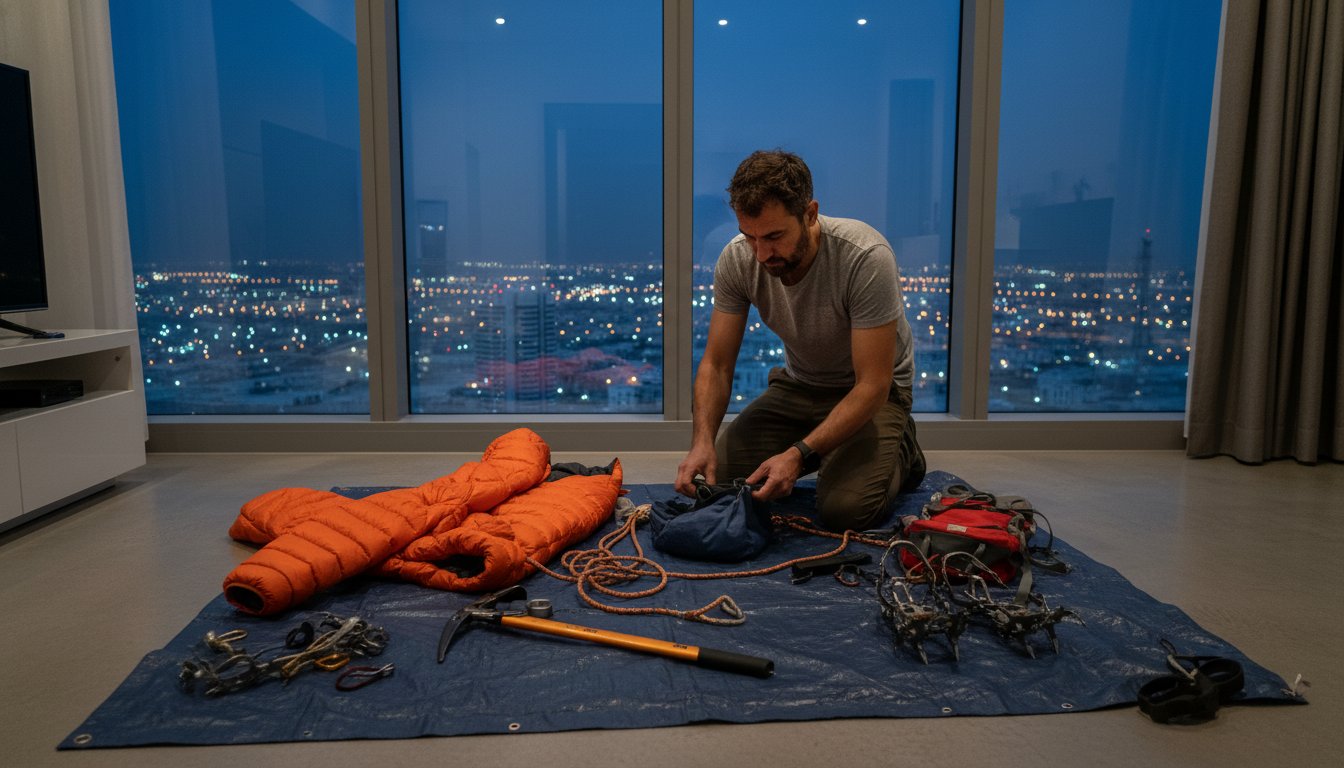
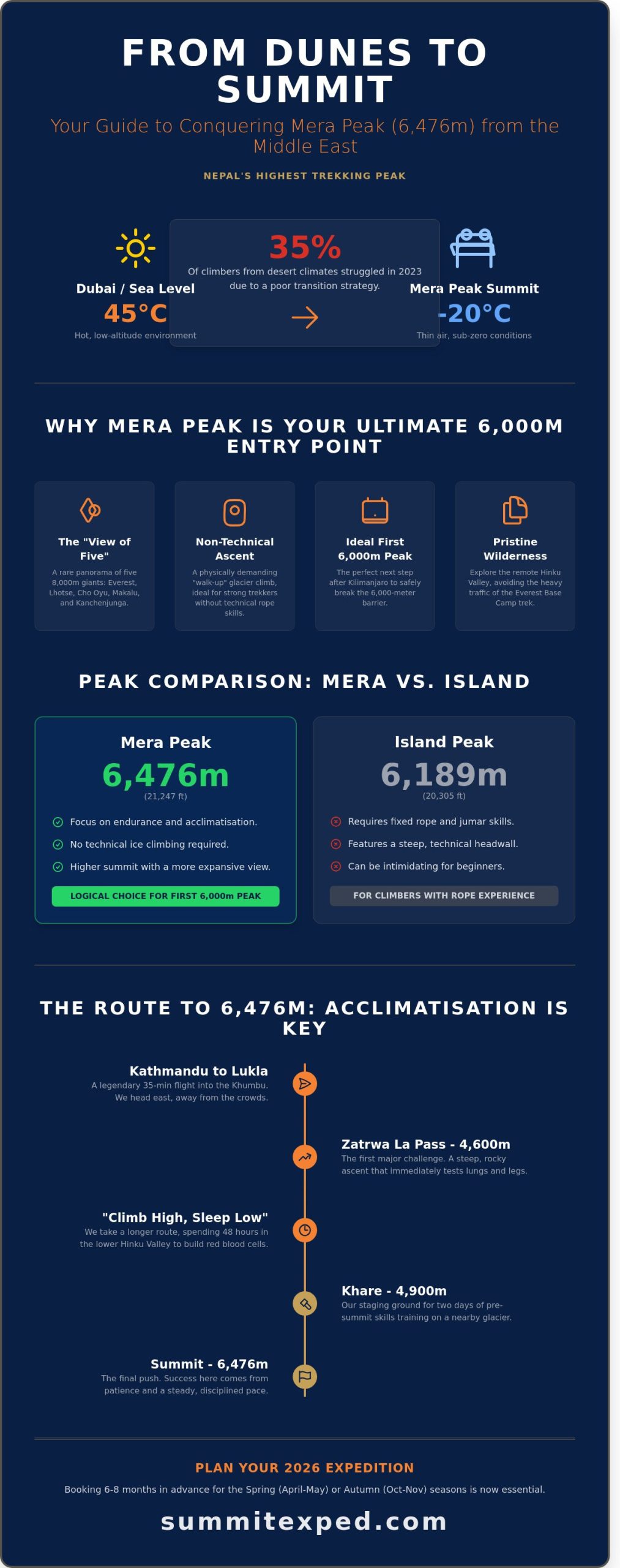
Training for a 6,000m peak while living at sea level in the 45°C heat of Dubai isn’t just difficult; it’s a mental game most people lose before they even reach Kathmandu. You’re likely wondering how your morning runs on the Kite Beach track or weekend hikes in Jebel Jais can possibly prepare you to climb mera peak, a staggering 6,476m (21,247ft) giant. It’s a valid concern. In 2023, approximately 35% of climbers on high-altitude peaks in Nepal struggled not because of fitness, but because they lacked a transition strategy from a desert environment to the thinning, sub-zero air of the Himalayas.
I know that feeling of standing in a shopping centre, staring at heavy down jackets while it’s sweltering outside, feeling completely disconnected from the reality of the mountain. This guide is built to bridge that gap. I’ll show you exactly how to transition from the dunes to the 6,476m (21,247ft) summit of Nepal’s highest trekking peak using field insights I’ve gathered over years of leading expeditions. We’ll break down the specific gear you need to pack when living in the Gulf, how to manage altitude sickness without local training peaks, and the logistics of a seamless 2026 expedition. This is your actionable roadmap to stand on the roof of the world and return home safely.
Key Takeaways
- Understand why 6,476m (21,247ft) is the ideal first 6,000m objective for Middle Eastern adventurers, offering a rare panorama of five 8,000m giants including Everest and Lhotse.
- Learn how to effectively train for high-altitude endurance while living at sea level by utilising specific urban terrain and stair-climbing techniques found in Dubai and Doha.
- Get a professional breakdown of the gear and layering systems needed to climb Mera Peak, transitioning comfortably from 30°C in Kathmandu to -20°C on the summit glacier.
- Navigate the logistical realities of the Hinku Valley approach and the Zatrwa La pass at 4,600m (15,091ft) with field insights on acclimatisation and safety protocols.
Why Climb Mera Peak? The Ultimate 6,000m Entry Point for GCC Explorers
For many of my friends and clients based in the GCC, the journey into high-altitude mountaineering begins on the popular slopes of the Marangu or Machame routes. Once you’ve finished climbing Mount Kilimanjaro, the question is always: what comes next? The answer is frequently found in the heart of the Himalayas. At 6,476m (21,247ft), Mera Peak stands as the highest official trekking peak in Nepal. It’s a massive, glaciated dome that offers a non-technical but physically gruelling ascent for those looking to break the 6,000m barrier.
The draw isn’t just the summit photo. It’s the “View of Five.” From the top, you’re looking at a panorama that includes five of the world’s six highest mountains: Everest, Lhotse, Cho Oyu, Makalu, and Kanchenjunga. Unlike the crowded teahouses and busy trails of the Everest Base Camp trek, the Hinku Valley remains remarkably pristine. You won’t find the same heavy tourist traffic here. Instead, you’ll encounter remote forests and high-altitude pastures that feel like a step back in time. It’s a place where the air is thin and the silence is absolute, providing a much more authentic wilderness experience.
Mera Peak vs. Island Peak: Which should you choose?
I often get asked which peak is better for a first Himalayan expedition. Island Peak involves a technical headwall and fixed rope work, which can be intimidating for beginners. In contrast, you can climb mera peak as a “walk-up” glacier ascent. While Mera is higher by over 200m (656ft), it doesn’t require the same level of technical mountaineering skills. For those with strong endurance but limited rope experience, Mera is the logical choice. It allows you to focus on your acclimatisation and movement on snow without the added stress of vertical ice climbing.
The 2026 Expedition Landscape
Looking ahead to the 2026 seasons, permit regulations in Nepal are tightening to manage climber safety and environmental impact. Booking your slot 6 to 8 months in advance for the spring (April to May) or autumn (October to November) windows is now essential. We’re seeing a clear shift toward smaller, expert-led teams of 4 to 6 climbers. This setup provides better safety margins in the remote Hinku Valley, where rescue logistics are more complex than in the Khumbu region. If you want to climb mera peak successfully, remember my favourite mantra: “Mera is about the rhythm of the breath, not the strength of the pull.” Success here comes from patience and a steady, disciplined pace.
The Route to 6,476m (21,247ft): Navigating the Hinku Valley
The journey begins with the legendary 35-minute flight from Kathmandu to Lukla. While most trekkers turn north toward the crowded Everest Base Camp trails, we head east into the Hinku Valley to climb mera peak. This transition marks the start of a more rugged, wilderness-focused expedition. Our first major challenge is the Zatrwa La pass at 4,600m (15,091ft). It is a steep, rocky ascent that immediately tests your lungs and legs. Many climbers underestimate this early stage, but crossing the pass is a vital introduction to the physical demands of the Khumbu region’s high-altitude terrain.
The Crucial Acclimatisation Strategy
We purposefully avoid the “direct” route to the Hinku Valley. For our climbers traveling from sea-level environments like Dubai, the body needs time to adapt to the significant drop in oxygen. We follow a strict “climb high, sleep low” philosophy, ensuring our team spends 48 hours in the lower valley before pushing higher. Understanding high-altitude health and safety is essential; your physiology changes rapidly above 3,000 metres. By taking a longer approach, we ensure that by the time we reach the snow line, your red blood cell count has increased sufficiently to support the final push.
Khare, situated at 4,900m (16,076ft), serves as our primary staging ground. We spend two full days here for pre-summit skills training. We don’t just sit in the tea houses; we head to the nearby glacier to practice using crampons, ice axes, and jumars on fixed lines. It’s about building muscle memory so that when you’re exhausted on summit night, your movements remain efficient and safe. From Khare, we move to High Camp at 5,800m (19,028ft). This camp is a surreal, rocky shelf perched above the clouds. Space is limited, and the wind can be fierce, but the view of five of the world’s six highest peaks-including Everest and Lhotse-is a reward that few ever witness.
Summit Night: What to expect at the sharp end
Summit night typically starts at 2:00 AM. The temperature often drops to -15°C (5°F), making the initial hours a battle against the cold and your own internal dialogue. We call the long, steady trek across the open glacier the “Mera Grind.” It is not technically difficult, but the sustained effort at 6,000 metres requires immense discipline. The only technical section is the final 30-metre (98ft) snow slope. This pitch is steep enough to require a fixed rope and a jumar to reach the narrow summit ridge.
A subtle insight I’ve gained from years on the mountain is that the summit is only the halfway point. You must intentionally reserve 50% of your mental energy for the descent. Gravity makes the way down faster, but tired legs and fading concentration are where most mistakes happen. If you want to see how we prepare for these high-altitude conditions, you can find my training resources at caroline-leon.com.
Training in the Desert: Preparing for Mera Peak in Dubai and Doha
Living at sea level in the GCC presents a unique challenge when you decide to climb Mera Peak. You are essentially trying to build a “mountain engine” in a landscape that is famously flat. To succeed at 6476m (21,247ft), your training must focus on aerobic capacity and muscular endurance rather than just raw strength. I often tell my clients in Dubai that the heat is actually a secret weapon. Training in the 40°C plus GCC summer increases your plasma volume and improves mitochondrial efficiency. These physiological shifts act as a proxy for altitude adaptation, helping your body handle the thin air of the Hinku Valley more effectively.
Your biggest hurdle isn’t just the lack of oxygen; it is the sheer volume of vertical gain. If you don’t have access to the Burj Khalifa stairs, find a 40-storey hotel tower and start climbing. Treadmills at a 15% incline are useful, but they don’t train your stabilizer muscles for the descent. Beyond the physical, you must prepare for the mental silence. The trek through the Hinku Valley is remote and often quiet. Spending hours on a stair climber without music or distractions is the best way to simulate the mental grit required for a 12-hour summit day.
The technical side of your preparation is equally important. The Nepal Mountaineering Association classifies Mera Peak as a trekking peak, but the physical demand remains elite. You need to be comfortable in your gear long before you reach Lukla.
Your 6-Month GCC Training Plan
- Months 1-2: Focus on building a massive aerobic base. Aim for 3-4 sessions of Zone 2 cardio (keeping your heart rate between 120 and 140 bpm) and two heavy leg days in the gym focusing on step-ups and lunges.
- Months 3-4: It is time to head to the Hajar Mountains. Start doing weekly weighted pack hikes at Jebel Jais or Jebel Hafeet. Start with 8kg (17lbs) and work your way up to a 15kg (33lbs) pack.
- Months 5-6: This is the specificity phase. You need long, back-to-back days on your feet. Simulate “summit pushes” by doing 6-hour sessions on the stair climber or steep mountain trails to harden your feet and your mind.
Local Training Spots in the UAE and Oman
Jebel Jais is your best resource for vertical gain. The Ghaf Summit trail provides the rugged terrain and elevation needed to test your kit and your pacing. For pure endurance, head to Wadi Bih. The uneven, rocky ground is very similar to the approach trails you will encounter before you reach the glacier. It’s the perfect place to practice using your trekking poles correctly.
If you want to see how I managed my own gear transitions during high-altitude expeditions, you can find more detailed breakdowns on my YouTube channel. Practical experience always beats theory when you are standing at 6000m (19,685ft).
Gear and Logistics: Moving from the Gulf to the Glacier
Starting a journey to climb mera peak usually begins at DXB or DOH. Flying from 30°C (86°F) in the Gulf to the humidity of Kathmandu, and then the thin air of Lukla, requires precise planning. The most immediate hurdle is the Lukla flight weight limit. These small Twin Otter planes strictly enforce a 15kg (33lb) limit per person. This includes 10kg (22lb) for your duffel and 5kg (11lb) for your daypack. Wear your heavy boots and down jacket on the flight if you’re over; it’s a common mountaineer’s trick to save weight during transit.
The “Mera Layering System” is about managing moisture and heat. You’ll start trekking in tropical heat but finish in arctic conditions. Your base layers must be high-quality merino wool to wick sweat, while your outer shell needs to be completely windproof. If you don’t manage your layers, you’ll sweat through your clothes during the day and freeze the moment the sun drops behind the ridges.
The Essential Gear List
Your desert hiking kit won’t work here. When you climb mera peak, your feet are your most important asset. You need 6,000m-rated double boots like the La Sportiva G2SM or Scarpa Phantom 6000. Single leather boots often lead to frostbite at the 6,476m (21,247ft) summit where temperatures hit -20°C (-4°F). For technical hardware, you’ll need a mountaineering ice axe, C2 crampons, and a climbing harness. While you can rent these in Khare, I recommend owning your harness and boots for a guaranteed fit. A high-quality sleeping bag rated to -20°C (-4°F) is non-negotiable for the cold nights at High Camp.
Caroline’s “Secret” Packing List
Appetite loss is a real side effect of altitude. Many GCC climbers find the repetitive “teahouse food” of dal bhat and pasta difficult after a week. I always pack familiar snacks from Spinneys or Waitrose. Think nut butters, high-quality jerky, or your favourite chocolate. Electrolyte powders are essential to stay hydrated without the flat taste of boiled water. Also, bring a reliable solar charger. The Hinku Valley is often sun-drenched, and keeping your phone or camera charged for summit photos is vital. You can find a full gear walkthrough on Caroline Leon’s YouTube where I break down every item in my duffel bag.
Preparing for the physical and logistical shift is the first step toward the summit. If you want to ensure your kit is expedition-ready, you can book a consultation through Caroline Leon’s website to review your preparation.
The Summit Expeditions Difference: Expert Leadership for the Middle East
Summit Expeditions was born from a shared passion between Nadhir Al Harthy and myself. We didn’t want to create just another trekking agency; we wanted to build a bridge for adventurers from the Middle East to reach the world’s highest points. As a team that lives and trains in the region, we understand the specific physiological hurdles you face when moving from sea level to the thin air of the Himalayas. When you decide to climb mera peak with us, you’re joining a team that prioritises your individual journey over mass-market tourism numbers.
Safety isn’t a buzzword for us, it’s a rigorous daily practice. We implement strict medical protocols, including pulse oximetry checks every morning and evening. These readings allow us to spot early signs of altitude sickness before they become emergencies. We also carry medical-grade emergency oxygen on every expedition above 5,000m (16,404ft). This level of preparation provides a safety net that smaller, budget-focused operators often skip. Our small group sizes, typically limited to eight climbers, ensure that I can maintain a direct line of communication with every person on the rope.
Ethical mountaineering sits at the core of everything we do. We’ve built long-term relationships with our Sherpa teams and the local communities within the Hinku Valley. This means paying fair wages that exceed industry standards and ensuring every porter has the right technical gear for the conditions. We believe that a successful summit is only truly achieved if the people supporting us are treated with the respect and dignity they deserve. It’s about leaving a positive footprint on the trails we love.
Why a Guided Expedition is Essential
The Zatrwa La pass, reaching 4,600m (15,091ft), is a notorious gateway that requires expert navigation. It’s often the difference between a safe crossing and a forced retreat. Our team’s local knowledge ensures we time this crossing perfectly, avoiding the worst of the afternoon winds. Our logistics also include a strategic High Camp at 5,800m (19,028ft), which significantly shortens your summit day and increases your chances of success. If you’re ready to book your Mera Peak climb, we’re here to guide you through every step of the preparation.
Beyond Mera: What comes next?
Completing Mera Peak is a massive achievement, but for many, it’s just the beginning. The technical skills and altitude experience you gain here are the perfect foundation for an Ama Dablam expedition, one of the most iconic climbs in the world. For GCC residents looking to complete the Seven Summits, this peak serves as a vital training ground for the physical and mental demands of Aconcagua or Denali. Those ready to take on a more technical Khumbu challenge should also explore the option to climb Lobuche East, a demanding 6,119m objective that builds directly on the fixed-line skills and acclimatisation experience gained on Mera. You can find more resources and join our community of explorers at Caroline-Leon.com to plan your next vertical milestone.
Take Your First Step Toward the Himalayan Giants
Standing on the summit of Mera Peak at 6,476m (21,247ft) isn’t just about the panoramic view of Everest and Lhotse. It’s about the months of deliberate preparation that lead to that moment. We’ve covered why this peak is the ideal 6,000m (19,685ft) entry point and how to adapt your training in the gym or on the stairs of Dubai’s skyscrapers. Remember that your gear choice for the Hinku Valley can make or break your comfort; don’t skimp on a high quality 4 season sleeping bag or broken-in boots.
When you choose to climb mera peak, you’re stepping into a world that requires both physical grit and mental patience. At Summit Expeditions, we lean on our 100% safety record on Himalayan trekking peaks to ensure every climber feels supported. I’ve designed specialised training plans specifically for GCC residents to help you transition from the desert heat to the glacier. We’ll spend 18 days navigating this rugged terrain together, ensuring your acclimatisation is handled with professional care. I’m ready to share the lessons I’ve learned from years of high altitude expeditions to help you reach your goals safely.
Join Caroline Leon on our next Mera Peak Expedition
The mountains are waiting, and I’ll be there to help you find your rhythm on the ice.
Frequently Asked Questions
How hard is it to climb Mera Peak compared to Kilimanjaro?
Mera Peak is significantly more demanding than Kilimanjaro because it requires basic technical skills and reaches a higher altitude. While Kilimanjaro stands at 5,895m (19,341ft) and is a non-technical hike, the journey to climb mera peak takes you to 6,476m (21,247ft) across glaciated terrain. You’ll need to manage the cold of the Hinku Valley and the physical strain of using crampons and an ice axe for the final 581m (1,906ft) of vertical gain.
Do I need previous mountaineering experience to climb Mera Peak?
You don’t need a background in technical alpinism, but you must be comfortable in rugged environments. We spend 2 days in Khare teaching you how to use a harness, jumar, and ice axe. It’s a “trekking peak,” so the challenge is largely about your physical endurance and how your body handles the thin air. If you’ve successfully trekked to Everest Base Camp or summited Mount Toubkal, you’ve got the right foundation for this expedition.
What is the best time of year for a Mera Peak expedition from Dubai?
The best windows are the pre-monsoon season from March to May and the post-monsoon season from late September to November. Most of my climbers from the UAE prefer October because it avoids the 40 degree heat in Dubai during their final training weeks. During these months, the 10 day trek through the Hinku Valley usually sees clear skies and daytime temperatures around 12°C (54°F), though summit night often drops to -20°C (-4°F).
Can I use my regular hiking boots for the Mera Peak summit?
No, you cannot use standard trekking boots for the summit because they don’t provide enough insulation against frostbite. You’ll use your regular boots for the initial trek, but you must switch to double-insulated mountaineering boots rated for 6,000m (19,685ft) once we reach the snow line. I recommend the La Sportiva G2 SM or Scarpa Phantom 6000. These boots feature a removable inner liner that you can keep in your sleeping bag to stay warm at night.
How do I handle the flight from Dubai to Lukla with all my gear?
Fly from Dubai (DXB) to Kathmandu (KTM) on FlyDubai or Emirates, then take the 35 minute domestic flight to Lukla. The domestic flight has a strict weight limit of 15kg (33lbs), which includes your duffel bag and daypack. Wear your heaviest items, like your trekking boots and down jacket, on the plane to save weight. We store your city clothes and any non-essential gear at the hotel in Kathmandu to ensure your kit stays within the limit.
What happens if I get altitude sickness on the way to Mera Peak?
We follow a strict “climb high, sleep low” protocol and monitor your oxygen saturation levels twice daily with a pulse oximeter. If you develop symptoms of Acute Mountain Sickness (AMS), such as a persistent headache or nausea, we stop your ascent immediately. If symptoms don’t improve within 4 to 6 hours, our guides will lead you down to a lower elevation. Safety is our absolute priority; we never push for the summit if a climber isn’t acclimatising properly.
How much does a Mera Peak expedition typically cost for a UAE resident?
The Nepal Department of Tourism sets the climbing permit fee at 250 USD during the spring and 125 USD in the autumn. You’ll also need to pay 50 USD for a 30 day tourist visa upon arrival in Kathmandu. While total package prices vary, ensure your travel insurance specifically covers mountaineering and helicopter evacuation up to 6,500m (21,325ft). Most policies for standard trekking only cover up to 4,000m (13,123ft), so check your fine print carefully.
Is there mobile phone or internet coverage in the Hinku Valley?
Connectivity is extremely limited and unreliable once you leave Lukla. You might find a weak Ncell signal in the village of Khare, but it rarely supports more than a basic text message. Most tea houses charge between 5 USD and 10 USD for satellite Wi-Fi access, though the speeds are slow. I carry a Garmin InReach satellite communicator to provide daily updates to my team in Dubai and I suggest you do the same if you need constant contact.