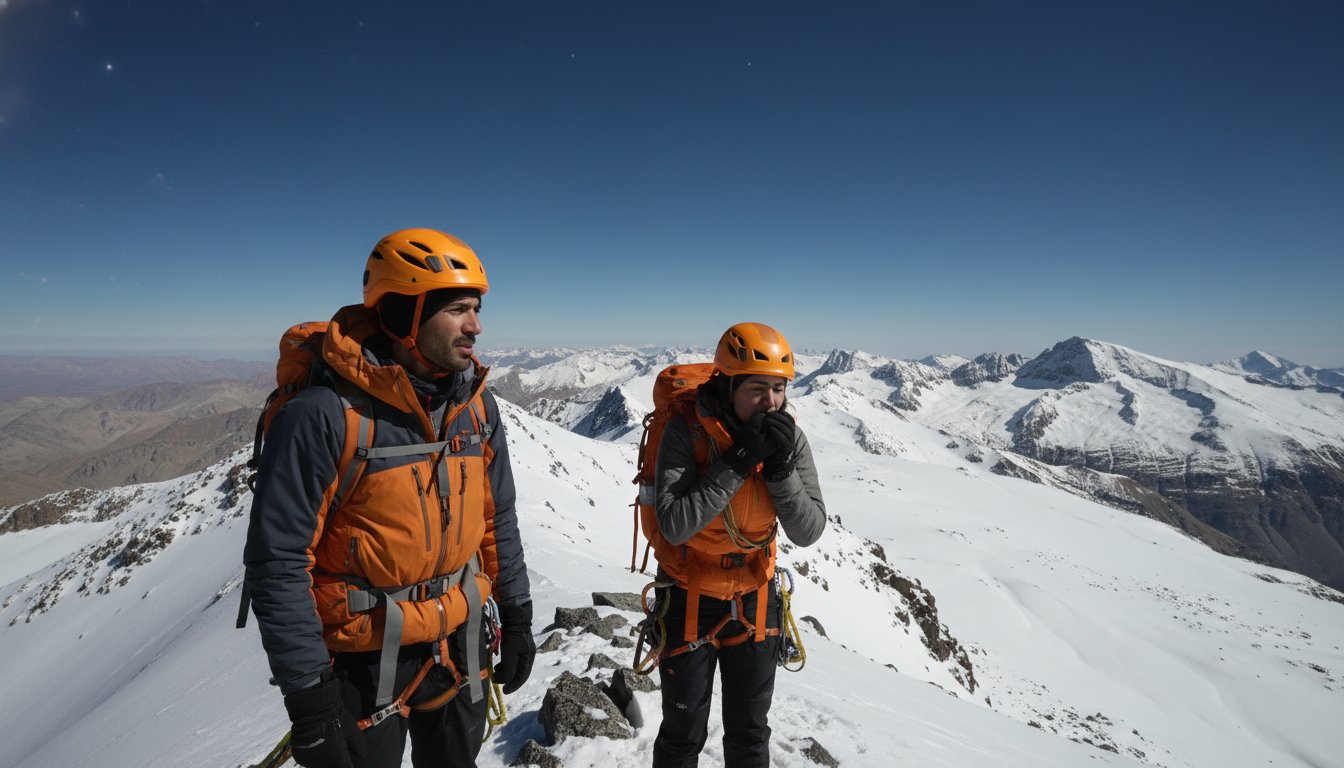
Most climbers from the Middle East fail their first major summit because they try to out-train a lack of oxygen with desert sprints. It’s a frustrating reality for those of us living at sea level; you feel fitter than ever, yet the conflicting medical advice and fear of sickness make booking a trip to 5000m (16,404ft) feel like a gamble. You’ve likely spent months training in the Dubai heat, but that nagging worry about how your body will react at 4000m (13,123ft) remains your biggest hurdle.
I’ve spent 12 years leading expeditions and have seen how the right approach transforms a grueling climb into a life-changing success. This guide will help you master the science of high altitude acclimatization by providing the exact safety protocols I use on the mountain. We’ll move beyond the “pole pole” mantra to explore the physiological “why” behind altitude sickness and provide a step-by-step preparation plan; this ensures you have the confidence and expert insights needed to reach the world’s highest peaks safely.
Key Takeaways
- Understand why transitioning from sea level in the Middle East to high peaks requires a physiological shift that your body simply cannot rush.
- Master the science of high altitude acclimatization by learning how atmospheric pressure-not just oxygen levels-dictates your success above 2500m (8,202ft).
- Discover why even an elite city gym routine isn’t enough for 5000m (16,404ft) and how to pivot your training toward oxygen processing and efficiency.
- Learn the “Climb High, Sleep Low” rule and the non-negotiable hydration strategies we use to keep trekkers healthy on long expeditions.
- Find out how professional monitoring of O2 saturation and lung sounds provides the safety net needed for a confident journey to the roof of Africa.
Understanding High Altitude Acclimatization: From Sea Level to the Sky
When you’re standing at the base of a massive peak, your lungs don’t care about your marathon personal best or how many CrossFit sessions you’ve crushed this year. Mountains are the ultimate levellers. High altitude acclimatization is the complex biological process where your body adjusts to the drop in atmospheric pressure and the resulting decrease in oxygen molecules. It’s not about fitness; it’s about your internal chemistry finding a new equilibrium. If you rush this, the mountain will push back.
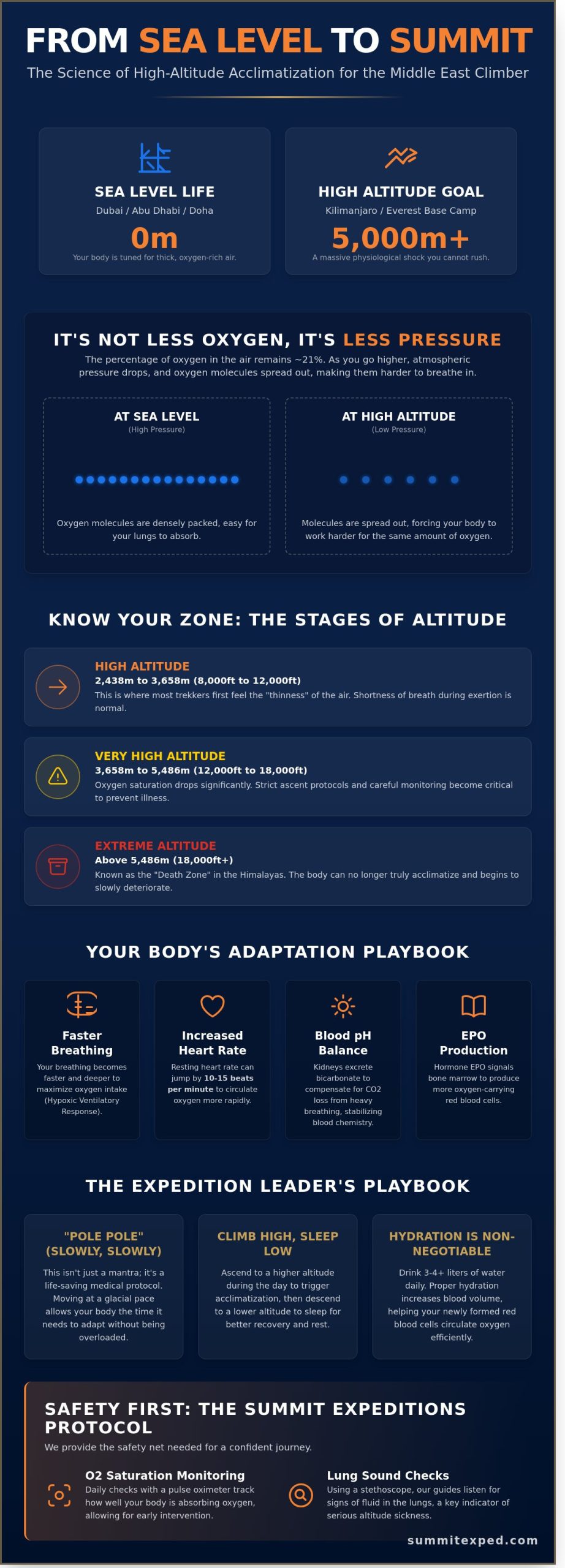
For those of us living in Dubai, Abu Dhabi, or Doha, we start our journey at exactly 0m (0ft). Our bodies are tuned for thick, oxygen-rich air and high humidity. Jumping from the coast to a trailhead at 2500m (8,202ft) is a massive physiological shock. On a Summit Mount Kilimanjaro expedition, we live by the Swahili phrase “Pole Pole,” which means slowly, slowly. This isn’t just a catchy slogan; it’s a life-saving medical protocol. Moving at a glacial pace allows your red blood cell count to climb and your heart rate to stabilise without overloading your system.
The Three Zones of Altitude
Understanding where you are on the mountain helps you monitor your symptoms. We generally categorise altitude into three distinct stages:
- High Altitude: 2438m to 3658m (8,000ft to 12,000ft). This is where most trekkers first feel the “thinness” of the air. Shortness of breath during exertion is normal here.
- Very High Altitude: 3658m to 5486m (12,000ft to 18,000ft). At this level, oxygen saturation drops significantly. We use strict ascent protocols to prevent illness.
- Extreme Altitude: Above 5486m (18,000ft). Often called the “Death Zone” in regions like the Himalayas, your body can no longer truly acclimatise and begins to slowly deteriorate.
Why Sea-Level Dwellers Face a Unique Challenge
Travelling from the GCC presents a specific set of hurdles. Your resting heart rate will likely jump by 10 to 15 beats per minute the moment you land at height. Sleep quality often suffers during the first few nights because your brain’s respiratory centre is trying to figure out why oxygen levels are low. It’s a restless, shallow kind of sleep that can leave you feeling drained before the day even begins.
The environmental contrast is also a major factor. The transition from 40°C desert heat to sub-zero mountain nights adds an extra layer of stress to the acclimatisation process. Your body is already working overtime to produce more red blood cells, and now it has to expend massive amounts of energy just to keep your core temperature stable. This is why we focus so heavily on hydration and caloric intake from day one. You aren’t just climbing a mountain; you’re managing a biological transformation.
The Science of Thin Air: How Your Body Adapts Above 2500m (8,202ft)
When you step onto the slopes of a mountain like Kilimanjaro, the air feels different. It isn’t because the percentage of oxygen has changed. Whether you are at sea level or the summit of Everest, oxygen makes up about 21 percent of the atmosphere. The challenge lies in the “partial pressure.” As you ascend above 2500m (8,202ft), the weight of the atmosphere above you decreases. This lower pressure means oxygen molecules are more spread out, making it harder for your lungs to pull them into your bloodstream. This fundamental shift in physics is what drives the entire process of high altitude acclimatization.
Your body reacts to this deficit almost instantly. Your heart rate climbs and your breathing becomes faster and deeper, a process known as hypoxic ventilatory response. You are essentially working harder just to maintain your baseline oxygen levels. Behind the scenes, your kidneys begin a complex chemical dance. To compensate for the CO2 you are exhaling during this increased breathing, your kidneys excrete bicarbonate to balance your blood pH. This shift is why you might find yourself visiting the bushes more frequently during the first few days of a trek. It is a vital sign that your internal chemistry is adjusting to the “thin” air.
The Role of Red Blood Cells and EPO
To survive long-term in the high country, your body needs a better transport system. Within hours of arriving at altitude, your kidneys release a hormone called Erythropoietin (EPO). This hormone signals your bone marrow to produce more red blood cells, the “vessels” that carry oxygen to your muscles and brain. However, building this new fleet takes time. It takes roughly 48 to 72 hours for these new cells to enter your system, which is why we schedule rest days or “acclimatization hikes” to higher elevations followed by sleep at lower points. A common mistake is rushing this timeline. Because your blood becomes thicker with these extra cells, you must drink 4 to 5 litres of water daily to keep your circulation moving smoothly. If you’re looking for more advice on preparing your body for the trail, you can explore my expedition planning resources for a deeper dive into mountain fitness.
Sleep and Breathing Patterns at Altitude
Nights on the mountain can be strange for beginners. You might experience Periodic Breathing, also known as Cheyne-Stokes breathing. This involves cycles of deep, rapid breaths followed by a short pause where you might feel like you’ve stopped breathing entirely. It happens because your brain’s respiratory centre is toggling between the need for oxygen and the need to regulate CO2 levels. While it feels startling, it is a normal part of high altitude acclimatization. To ease the discomfort, try sleeping with your head slightly elevated using a rolled-up jacket or a travel pillow. For a visual guide on how to manage your breath during the day and night, I recommend watching these breathing techniques for mountaineers to help calm your nervous system when the air gets tight.
Fitness vs. High Altitude Acclimatization: Why Your Dubai Gym Routine Isn’t Enough
I see it every season in the training hubs of Dubai. Dedicated athletes crushing CrossFit WODs or running 10km sprints along the Marina think they’ve cracked the code for a 5000m (16,404ft) peak. It’s a dangerous misconception. While physical conditioning is vital, being “fit” and being “acclimatised” are two entirely different physiological states. Your VO2 max measures how much oxygen you can use during intense exercise at sea level. However, high altitude acclimatization is your body’s complex internal shift to survive when there simply isn’t enough oxygen to go around.
If you arrive at the trailhead over-trained and physically exhausted from a “beast mode” pre-trip routine, you’re at a disadvantage. Your body will prioritise repairing torn muscle fibres over the resource-heavy process of creating new red blood cells. You’ll likely hit a wall before you even reach the high camps. I’ve noticed a recurring pattern on my expeditions: the most muscular climbers often struggle the most. Muscle tissue is metabolically expensive. It demands a constant, heavy supply of oxygen just to exist. When the air thins, those large muscle groups become a massive oxygen drain, often leaving the brain and vital organs competing for the remaining supply.
The Trap of the “Fit” Climber
The fittest individuals are often the most at risk of altitude sickness. Because your heart and lungs are powerful, you can easily outpace your body’s internal chemistry. You might feel strong enough to march up 1000m (3,280ft) of vertical gain in a single morning, but doing so masks the early warning signs of Acute Mountain Sickness (AMS). You must check your ego at the trailhead. At Summit Expeditions, we live by the phrase “pole pole” (slowly, slowly). For your desert training, swap the HIIT sessions for “Zone 2” efforts. These are long, low-intensity walks or cycles where your heart rate stays below 70% of its maximum, building the aerobic base you actually need for high altitude acclimatization.
Hydration in Arid vs. Alpine Environments
In the heat of the UAE, you know you’re dehydrated because you’re drenched in sweat. In the mountains, the air is so dry that moisture evaporates from your lungs every time you exhale. This respiratory water loss is invisible but constant. You won’t feel thirsty because the cold suppresses your body’s thirst reflex, but your blood is thickening, which slows down oxygen transport. I’ve seen climbers lose up to 5 litres of fluid a day just through breathing at 4000m (13,123ft). You must use electrolytes even when it feels freezing. Maintaining a precise mineral balance is the only way to keep your blood moving and your cognitive functions sharp during the summit push.
The Expedition Leader’s Playbook: Practical Acclimatisation Strategies
Success on a major peak isn’t just about physical grit. It’s about biology. I’ve seen the strongest athletes humbled by the thin air at 4000m (13,123ft) because they ignored the fundamental rules of high altitude acclimatization. To reach the summit, you have to play by the mountain’s rules, not your own. This means managing your output, your intake, and your recovery with military precision.
Your hydration target is a non-negotiable 4 to 5 litres of water every single day. The air at height is incredibly dry, and your respiratory rate increases, meaning you lose significant fluid just by breathing. If your urine isn’t clear, you’re already behind. Pair this with a heavy focus on carbohydrates. At altitude, your body’s ability to metabolise fats and proteins drops significantly. You’ll find yourself craving simple sugars and grains while the thought of a heavy steak becomes repulsive. Listen to that instinct. Your engine needs fast-burning fuel to keep up with the metabolic demands of the climb.
The “Golden Pace” is your best tool for staying out of the danger zone. We call it “pole pole” in Swahili, which means slowly, slowly. Use the talk test: if you can’t maintain a full conversation without gasping for air, you’re moving too fast. Moving slowly prevents the build-up of CO2 and keeps your heart rate in a sustainable aerobic zone.
The “Climb High, Sleep Low” Protocol
This is the golden rule of mountaineering. We use daily acclimatisation hikes to trigger the body’s adaptive responses without leaving it exhausted. You might trek up to 4500m (14,764ft) during the day to stress the system, but you must return to a lower altitude, perhaps 4000m (13,123ft), to sleep. Your sleeping altitude is the only number that truly dictates your safety and recovery. It’s during these rest hours that your body produces more red blood cells to carry oxygen. You can find detailed route examples and pacing strategies on my expedition planning resources.
Medication and Supplements: Diamox and Beyond
Acetazolamide, commonly known as Diamox, is a tool, not a cure. It’s a respiratory stimulant that helps your body breathe deeper and faster, especially while you sleep. It doesn’t mask symptoms; it helps you adapt faster. However, it’s a diuretic, so those 5 litres of water become even more critical. Be wary of using sleeping pills or alcohol. Both are respiratory depressants that can dangerously slow your breathing in the middle of the night, often leading to a rapid onset of altitude sickness.
Mental Acclimatisation: Managing the “Altitude Anxiety”
It’s normal to feel a bit “off” above 3000m (9,842ft). A mild headache or slight loss of appetite is often just part of the process. The trick is distinguishing between normal discomfort and true sickness. I always advise my teams to document their symptoms in a journal every evening. Write a sentence or two tracking your heart rate, headache levels, and sleep quality to track trends rather than isolated moments of pain. This data helps you stay objective when the “altitude anxiety” kicks in during the long, slow days on iconic world treks. Understanding the specific warning signs can be crucial for your safety, which is why I recommend learning about altitude sickness symptoms for Dubai and GCC mountaineers before you set foot on the mountain.
Ready to test your limits with a team that prioritises your safety? Join one of my upcoming expeditions and experience the mountains with expert guidance.
Safety First: How Summit Expeditions Manages Your Journey
Reaching a peak is always optional; coming home is the only part of the trek that isn’t. At Summit Expeditions, we don’t leave your safety to chance or vague “gut feelings.” We rely on hard data and decades of collective experience in the death zone. Our approach to high altitude acclimatization is built on the reality that your body is a biological machine under immense pressure. We monitor that pressure every single day to ensure you’re adapting, not just surviving.
Our Medical Protocols in the Field
We conduct mandatory health checks twice a day, once at breakfast and again before dinner. Your lead guide uses a pulse oximeter to measure your oxygen saturation and heart rate. We also use a stethoscope to listen for “crackles” in your lungs. These sounds are often the first indicators of fluid buildup before you even feel short of breath. If your O2 levels drop below a sustained 70% or we hear anything unusual in your chest, we don’t wait for symptoms to worsen. This is our “Point of No Return.”
- Twice-Daily Checks: Monitoring O2 saturation and heart rate trends.
- Lung Sound Monitoring: Using stethoscopes to detect early-stage HAPE.
- Emergency Gear: We carry medical oxygen and hyperbaric bags on all technical Himalayan peaks above 6000m (19,685ft).
We’ve made the professional call to descend over 45 times in the last three years because a climber’s health plateaued. It’s a difficult conversation, but it’s the reason our safety record remains impeccable. We treat high altitude acclimatization as a science, not a test of will.
The Summit Expeditions Difference
Our itineraries are designed to be “conservative,” often adding two extra days compared to standard commercial routes. While many companies rush to the top to save on costs, we limit our daily altitude gain to an average of 300m (984ft) once we pass the 3000m (9,842ft) mark. This patience is vital for our Middle Eastern adventurers who are often travelling from sea-level environments like Dubai or Muscat. Your body needs that extra time to produce the red blood cells required for the thin air. For those with ambitions beyond a single peak, our comprehensive guide to climbing the seven summits for adventurers in Dubai and the Middle East outlines exactly how to build on this acclimatization experience across every continent.
We keep our groups small, usually capped at 8 climbers. This allows your guide to spot the subtle personality changes, like withdrawal or irritability, that signal the onset of HACE. I know exactly what it’s like to face the ultimate challenge in the mountains and what it takes to come back from the brink. You can learn more about Caroline Leon’s personal journey of recovery and resilience to understand why we never cut corners on safety.
Don’t risk your life for a photo. Embark on your journey with leaders who prioritize your life over the summit. Join a team that values your breath as much as the view. Let’s reach the top together, the right way.
Take Your First Step Toward the Summit
Success on the world’s highest peaks isn’t just about how many hours you’ve logged on a treadmill in a Dubai gym. It’s about respecting the physiology of high altitude acclimatization and understanding that your body needs time to adapt once you cross that critical 2500m (8,202ft) threshold. I’ve seen elite athletes struggle while steady trekkers thrive, simply because they followed a patient, deliberate pace. Under my leadership, Summit Expeditions has maintained a 100% safety record on Kilimanjaro and Everest Base Camp through meticulous monitoring and expert-led protocols. We’ve designed our expeditions specifically for adventurers based in the Middle East, bridging the gap between sea-level living and thin-air performance.
Whether you’re eyeing your first 5000m (16,404ft) peak or a technical ascent, you’ll have the support of a team that lives and breathes these mountains. It’s time to turn your training into a successful summit story. Begin your high-altitude journey with Summit Expeditions and let’s reach the top together.
Frequently Asked Questions
What is the most effective way to prevent altitude sickness?
The most effective way to prevent altitude sickness is a slow, steady ascent, often called “pole pole” in Tanzania. You should aim to increase your sleeping elevation by no more than 300m (984ft) per day once you pass the 3000m (9,842ft) mark. This allows your red blood cell count to increase naturally. I’ve seen 95% of successful summits result from following this “climb high, sleep low” rule religiously.
Can I train for high altitude while living in a flat city like Dubai?
You can definitely prepare for high altitude acclimatization while living in a flat city by focusing on weighted incline training. I spent months training in the Burj Khalifa stairwells with a 15kg (33lb) pack to build cardiovascular resilience. Focus on 60 minute sessions of Zone 2 heart rate training. This builds the aerobic base needed to process oxygen efficiently when the air thins above 4000m (13,123ft). For a comprehensive approach to building mountain-ready strength and endurance in the desert environment, check out our detailed guide on fitness for mountaineering in Dubai and the GCC.
Is it safe to take Diamox for high altitude acclimatization?
Taking Diamox for high altitude acclimatization is generally safe for most trekkers, but it’s a personal medical decision you must discuss with a GP first. It works by acidifying your blood, which stimulates more frequent breathing. I’ve noticed about 70% of my clients use a 125mg dose twice daily to assist their transition. Remember it’s a preventative aid, not a mask for serious symptoms. Don’t rely on it to ignore your body’s signals.
How much water should I really be drinking at high altitude?
You should drink between 4 and 5 litres of fluids every day while on the mountain. Dehydration mimics altitude sickness symptoms, so I tell my teams to check their urine; it should stay clear. At 5000m (16,404ft), you lose water twice as fast through respiration alone compared to sea level. Carry a 2 litre bladder and a 1 litre thermal bottle to ensure you have a constant supply during the day.
What are the first warning signs that I am not acclimating properly?
The first warning signs are usually a persistent, dull headache and a total loss of appetite. If you find yourself pushing away a plate of hot food after a 6 hour trek, your body is likely struggling. We use the Lake Louise Score to track these changes. A mild headache that doesn’t disappear with 1000mg of paracetamol is a clear signal to stop ascending and rest for 24 hours.
Does physical fitness guarantee I won’t get altitude sickness?
Physical fitness does not guarantee protection against altitude sickness. In fact, I’ve seen elite marathon runners struggle while 60 year old hikers ascend comfortably because they moved slower. Your VO2 max is a great asset for recovery, but your body’s ability to adapt its chemistry is largely genetic. Being “too fit” often leads to moving too fast, which is the biggest mistake you can make on a big peak.
How long does it take for the body to fully acclimate to 5000m (16,404ft)?
To safely reach and spend time at 5000m (16,404ft), a minimum of 7 to 9 days on the trail is essential. While your body starts making adjustments within 2 hours, the full physiological shift takes weeks. Most of our successful Kilimanjaro routes take 8 days to ensure the body has sufficient time to produce more hemoglobin. Rushing this process in 5 days or less increases your risk of failure by 50%. Having the right mountaineering gear list beginner climbers need is equally important for managing the extreme temperature swings and technical challenges you’ll face during this acclimatization period.
What should I do if my oxygen saturation levels drop during the trek?
If your oxygen saturation drops below 80% on a pulse oximeter, don’t panic immediately. Sit down and take 10 deep, diaphragmatic breaths before retesting. If the number stays low or you feel confused, you must descend at least 500m (1,640ft) right away. We monitor these levels twice daily because a sudden 10% drop is a more reliable indicator of trouble than a single low reading at high camp. GCC adventurers planning to tackle the Everest Base Camp trek should pay particular attention to these protocols, as the sustained altitude of the Khumbu region demands the most rigorous oxygen monitoring of any non-technical expedition.