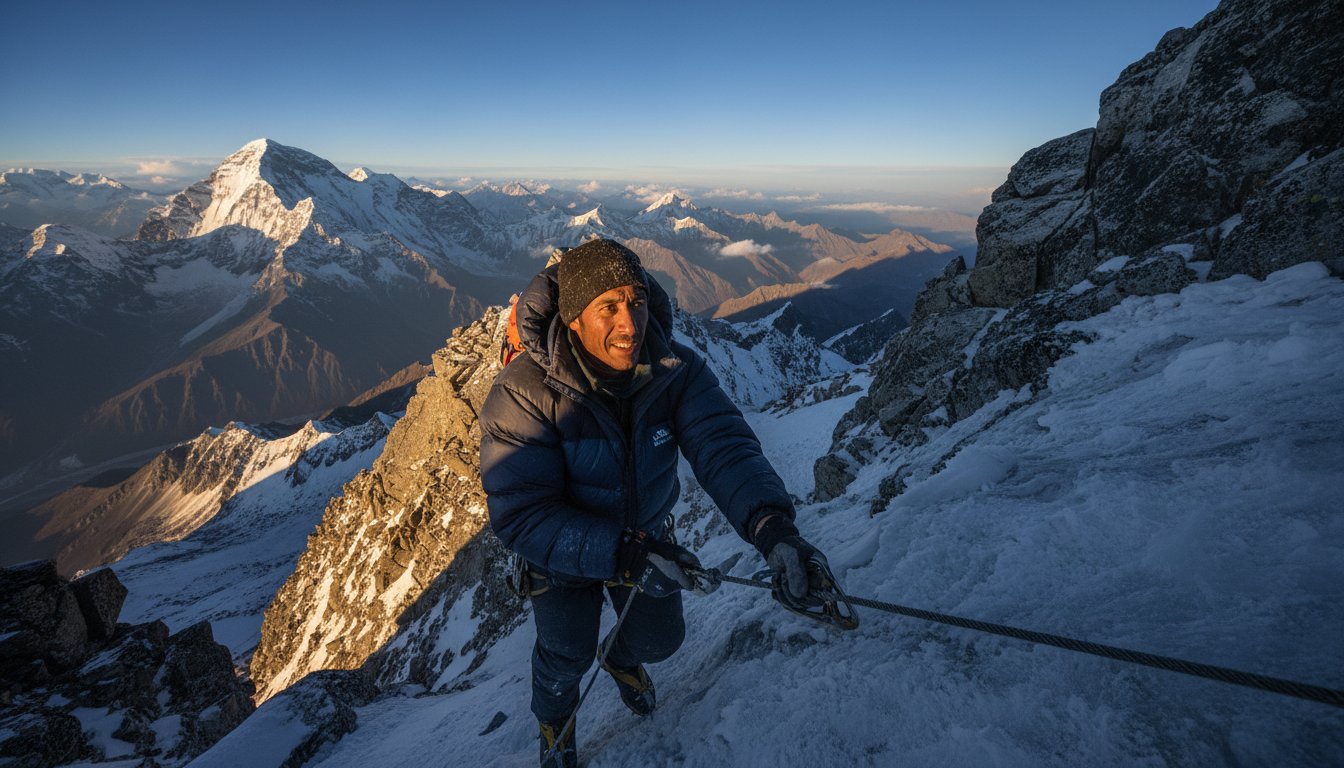
What if the biggest obstacle to summiting the ‘Matterhorn of the Himalayas’ isn’t the 6,812m (22,349ft) altitude, but the false sense of security built on the trekking peaks of Nepal? You’ve likely stood on the summit of Kilimanjaro or Mera Peak and felt ready for the next level. Living in the GCC, you’re used to the long weekend grinds in the Hajar mountains, yet you know that vertical rock and sub-zero ice are a different beast entirely. It’s a common concern for climbers in Dubai who feel the lack of local ice walls or high-altitude cold holds them back from a serious attempt on ama dablam.
I’ve spent years transitioning from the heat of the desert to the technical ridges of the Himalayas, and I’m here to tell you that your location doesn’t have to be a limitation. This guide provides a deep dive into the technical demands of the Southwest Ridge and a realistic training blueprint designed specifically for Middle East residents. We’ll explore how to build a 12-week preparation phase using local geography and ensure you have the confidence to choose a guide who understands the specific profile of a desert-based mountaineer.
Key Takeaways
- Understand the technical transition from trekking to climbing, specifically where the fixed ropes begin at 5,700m (18,700ft) on the Southwest Ridge.
- Learn how to simulate Himalayan conditions while living in the Middle East by utilising local terrain like Jebel Jais and high-rise stairwells for conditioning.
- Identify the specific technical skills you need to master before attempting ama dablam, moving far beyond basic hiking to proficiency with jumars and ice axes.
- Navigate the logistical realities of planning from the Gulf, including direct flight routes from DXB or DOH and specific visa considerations for GCC residents.
- Discover why an honest self-assessment of your high-altitude experience is the most critical step in ensuring a safe and successful expedition.
What is Ama Dablam? The “Matterhorn of the Himalayas” Explained
Ama Dablam stands as a sentinel over the Khumbu Valley at 6,812m (22,349ft). While Everest and Lhotse command respect for their sheer height, this peak captures the heart through its near-perfect symmetry. It is the most striking silhouette in the Everest region. For many of us who live and train in the Middle East, this mountain represents the ultimate transition from high-altitude trekking to true technical mountaineering. It is steep, exposed, and demands your absolute respect from the moment you step onto its ridges.
The name itself carries deep cultural weight. In the local Sherpa dialect, “Ama” means mother and “Dablam” refers to a traditional pendant or necklace. The long, sweeping ridges on either side of the peak are seen as the protecting arms of a mother wrapped around her child. The hanging glacier that sits high on the Southwest Face represents the Dablam pendant worn by Sherpa women. This isn’t just a pile of rock and ice; it’s a sacred presence that watches over the villages of Pangboche and Khumjung.
For those who have already stood on the summits of Island Peak at 6,189m (20,305ft) or Mera Peak at 6,476m (21,247ft), ama dablam is a significant step up. Those peaks are primarily “trekking peaks” where basic crampon skills and fitness can carry you to the top. This mountain is different. It requires technical competence on vertical rock, hard blue ice, and narrow, exposed snow crests. You’ll be moving on fixed lines using a jumar, but the physical demand of hauling yourself up at nearly 7,000m (22,965ft) is a different beast entirely.
Location and Geography of the Khumbu Icon
You’ll find this peak situated in the heart of the Sagarmatha National Park. It sits directly across the valley from the massive Lhotse-Everest massif, providing what I consider the best view in the entire Himalaya. The mountain’s geography is defined by its isolation. Unlike many peaks that blend into a range, it stands alone. Reaching Base Camp at 4,600m (15,091ft) follows the classic Everest Base Camp trail through Namche Bazaar, making the approach one of the most culturally rich journeys on earth.
The Best Time to Climb: Autumn vs Spring
Timing your expedition is everything. The post-monsoon Autumn season, specifically October and November, is the gold standard for ama dablam. During these months, the weather is generally stable and the skies are crystal clear. For climbers coming from Dubai or Riyadh, this window often aligns perfectly with the cooler months in the Gulf, making the transition to the cold much easier to manage. Most successful summits happen in this period because the rock is drier and the winds are more predictable.
Spring climbing in April and May is possible, but it presents a different set of challenges. You’ll often face more snow on the route, which can make the technical rock sections like the Yellow Tower much harder to navigate. The weather windows are also tighter as the monsoon approaches. If you’re planning your leave from a busy professional role in the Middle East, the reliability of the Autumn window makes it the far safer bet for your first attempt.
The Technical Reality: Climbing the Southwest Ridge
Climbing ama dablam is a masterclass in high-altitude movement. While many people mistake it for a glorified trekking peak, the reality is far more demanding. The standard route via the Southwest Ridge was first climbed in 1961 by a team including Barry Bishop and Mike Gill. It remains one of the most aesthetically perfect lines in the Himalayas, but it demands respect. You aren’t just walking uphill here; you are engaging with vertical rock, mixed ice, and some of the most dramatic exposure on the planet.
The transition from trekking to genuine mountaineering happens abruptly at 5,700m (18,700ft). This is where the fixed ropes typically begin. You’ll swap your trekking poles for a jumar and your approach shoes for 8,000m boots. From this point forward, your safety depends on your ability to manage your personal anchor system and move efficiently on a fixed line. While most commercial expeditions use fixed ropes, don’t let that fool you into thinking it’s easy. You still need the technical leading skills to navigate around other climbers or manage yourself if a rope section is damaged.
Psychological resilience is just as vital as physical strength. On the ridge, you’ll often have 1,000m (3,280ft) of air beneath your heels. This level of exposure can be draining. I’ve seen incredibly fit athletes freeze up because their minds couldn’t process the sheer verticality of the terrain. Success on this mountain comes to those who can maintain focus while standing on a knife-edge.
The Crux Points: Yellow Tower and Mushroom Ridge
The technical reality of ama dablam is defined by three distinct sections. First is the Yellow Tower. Located at approximately 6,000m (19,685ft), this is 15 metres (49ft) of vertical rock climbing. It is graded at about IV or V (UIAA), which feels significantly harder when you are wearing thick down layers and heavy boots. Next is the Grey Tower, a complex section of mixed rock and ice that requires precise crampon technique to avoid burning out your calves.
Finally, you reach the Mushroom Ridge. This is arguably the most spectacular part of the climb. You’ll navigate precarious snow cornices and knife-edge traverses where the ridge narrows to the width of a single boot. It is breathtaking and terrifying in equal measure. Every step requires absolute concentration on your footwork.
Camp Life at Vertical Extremes
Living on the Southwest Ridge is an exercise in minimalism. Camp 1 sits at 5,700m (18,700ft) on scattered rocky platforms. It’s relatively comfortable compared to what follows. Camp 2, situated at 5,900m (19,357ft), is the most famous camp in the Himalayas. Space is so limited that tents are often perched on tiny ledges with their vestibules hanging over the abyss. It’s cramped, loud, and exhilarating.
- Camp 1: Your last “flat” ground. Use this time to hydrate and eat as much as possible.
- Camp 2: A logistical bottleneck. We keep stays here short to minimize the physical toll of the altitude and the cramped conditions.
- The Camp 3 Dilemma: Most modern expeditions now skip Camp 3 at 6,300m (20,669ft). The “Dablam” hanging glacier above it poses a significant objective risk. We prefer a longer summit push from Camp 2 to stay out of the firing line.
Building your technical foundation before arriving in the Khumbu is the best way to ensure success. I often work with climbers on these specific skills through my mountaineering mentorship programmes to ensure they are ready for the verticality of the ridge.

Is Ama Dablam for You? Assessing Your Readiness
I often meet climbers in Dubai who’ve just returned from Kilimanjaro feeling invincible. Reaching 5,895m (19,341ft) is a massive milestone, but ama dablam is a different beast entirely. It isn’t just a high-altitude trek; it’s a technical masterclass. You aren’t just walking up a scree slope here. You’re moving on steep, exposed rock, ice, and snow. If the idea of hanging off a fixed line with 1,000m (3,280ft) of air beneath your boots makes your heart race in the wrong way, you need more time on smaller peaks first.
Your technical toolkit must be second nature before you arrive at Base Camp. You need to be proficient with a Jumar (ascender) for the steep vertical sections and comfortable rappelling (abseiling) on a figure-eight or ATC while wearing heavy mittens. Beyond the gear, your body must handle the 6,000m (19,685ft) threshold. In my 2023 season, I saw several strong athletes struggle because their bodies simply didn’t acclimatise well above 6,100m (20,013ft). This mountain demands psychological grit. The ridges are narrow, the camps are perched on ledges, and the exposure is sustained for days on end.
The Stepping Stone Peaks
I never recommend jumping straight to ama dablam without a “warm-up” technical peak. Climb Island Peak 6,119m (20,075ft) is the gold standard for preparation. It allows you to test your gear and your lungs in the same valley. The difference between a trekking peak and a technical mountain is the verticality. On Lobuche East, where you’ll encounter a genuine 45-degree summit headwall, you’ll learn if you can handle the “steps” that define the Himalayan experience. If you can’t move efficiently on a 45-degree snow slope there, the 70-degree headwalls of Ama Dablam will be a dangerous shock.
Common Mistakes Aspiring Climbers Make
- The “Jumar Pull”: Many climbers rely entirely on their upper body to pull themselves up the fixed lines. This is a fast track to exhaustion. You must use your footwork to drive your weight upward, saving your arms for the truly vertical sections.
- Heavy Boot Clumsiness: Climbing Grade 4 or 5 rock in big, double mountaineering boots feels like climbing in ski boots. Practice scrambling in your actual expedition boots on smaller crags before you leave.
- Neglecting Core Strength: Most people focus on cardio, but carrying a 12kg (26lb) pack while leaning into a steep rock face requires immense core and lower back stability.
- Ignoring the Descent: Reaching the summit is only half the battle. Roughly 60% of accidents happen on the way down when fatigue sets in and rappelling mistakes occur.
Be honest with yourself during your training. It’s better to spend another year building your skills than to find your limit halfway up the Yellow Tower. The mountain will always be there; I want to make sure you’re ready to enjoy the view from the top.
The Middle East Training Blueprint: Preparing in the Heat
Training for ama dablam while living in the GCC feels counterintuitive. You are swapping sub-zero glaciers and biting winds for the 45°C humidity of Dubai or Doha. However, the desert is a secret weapon for those who know how to use it. Heat stress forces your body to expand its plasma volume, which significantly aids your cardiovascular efficiency once you hit the thin air. I have found that 10 to 14 days of consistent heat exposure can boost your VO2 max by up to 5%, providing a physiological cushion when you start the long trek into Base Camp.
Physical Conditioning in the GCC
Focus your efforts on the posterior chain to handle the 15kg (33lb) packs required between camps. I recommend spending 70% of your training time in Zone 2 aerobic base building. Long desert hikes are perfect for this, but they must be slow and steady. If you are based in Dubai, the stairs at high-rise buildings like those in Dubai Marina provide the vertical gain missing from the coastal flats. A single session of 50 floors with a weighted vest mimics the relentless incline of the lower slopes. While altitude chambers in Al Quoz offer a controlled environment for pre-acclimatisation, they cannot replace the raw leg strength built on the rugged trails of Jebel Jais (1,934m / 6,345ft).
Technical Skill Building Locally
Ama dablam is a technical peak that demands more than just fitness. You must master your knots and anchor systems until they become muscle memory. Use local climbing gyms to practice these skills weekly. On weekends, head to the Hajar Mountains or cross the border into Oman. The limestone walls of Wadi Daykah offer the perfect playground for multi-pitch traditional climbing. It is vital to practice your Jumar transitions on a fixed line in a controlled environment. You don’t want to be figuring out how to bypass a knot for the first time while hanging over a 1,000m (3,280ft) drop on the Yellow Tower.
Mental Preparation and Mindset
The transition from the constant noise of city life to the absolute silence of the mountain is often jarring. I use visualisation to bridge this gap. Picture yourself navigating the narrowest sections of the summit ridge while you are stuck in Sheikh Zayed Road traffic. This mental anchoring keeps you focused on the goal. You can learn more about high altitude acclimatisation to understand how your brain reacts when oxygen levels drop, helping you stay calm when the pressure mounts. This preparation ensures that when you finally stand at the foot of the mountain, you feel like you have already climbed it a thousand times in your mind.
Planning Your Expedition: Logistics from Dubai to Kathmandu
Getting from the desert heat of the UAE to the crisp, thin air of the Khumbu Valley is surprisingly straightforward. If you’re based in Dubai, FlyDubai and Emirates offer direct four-hour flights to Kathmandu, while Qatar Airways provides excellent connections from Doha. I always suggest booking at least 40kg of checked baggage. Between your high-altitude boots and technical hardware, you’ll exceed standard weight limits faster than you expect. Most GCC residents and expats can secure a 30-day or 90-day tourist visa on arrival at Tribhuvan International Airport. I recommend bringing crisp USD bills for the visa fee, as the airport ATMs are notoriously unreliable and the queues for card payments can take hours.
Gear and Equipment Essentials
Your gear list for ama dablam is non-negotiable because the mountain doesn’t forgive shortcuts. You need the “Big Three”: 6000m or 7000m rated double boots, a high-loft down suit or a heavy down jacket and trousers combination, and your technical climbing hardware. I’ve seen too many climbers forced to turn back because of cold toes or poorly fitted crampons. While Adventure HQ in Dubai stocks some high-end brands, sourcing technical mountaineering gear in the Middle East remains a challenge. I often help my clients with a full gear audit before we leave, and for specialised items, we can check out Caroline Leon’s gear tips on YouTube to see what works in high-altitude environments.
The Summit Expeditions Difference
We don’t believe in crowded teams or generic itineraries. Safety on a technical peak relies on a high guide-to-client ratio, typically 1:1 or 1:2, ensuring your guide knows exactly how you’re moving on the fixed lines. Our Sherpa team members are our family; they’re paid fairly and treated with the respect their immense expertise deserves. We advocate for a “Pole Pole” pace, a Swahili term meaning slowly, slowly. This philosophy, which I’ve carried from my time on Kilimanjaro, is vital for success. Moving with intention and allowing your body to adapt to the 6812m (22,349ft) altitude is the only way to reach the summit and return safely. For a complete breakdown of the 2026 season logistics, timelines, and team structure, our Ama Dablam expedition 2026 definitive guide for Middle East climbers covers everything you need to plan your attempt from the Gulf.
Final Call to Action
The journey to the summit of ama dablam starts long before you reach the Khumbu. Join our next expedition briefing in Dubai to meet the team and understand the specific training blocks required for 2026. If you’re ready to commit to the climb, I’m available for 1-on-1 strategy sessions to review your climbing history and technical skills. We’ll make sure you’re physically and mentally prepared for the exposure of the Yellow Tower and the Mushroom Ridge.
Your Journey to the Southwest Ridge Starts Now
Standing at 6,812m (22,349ft), ama dablam isn’t a peak you simply hike; it’s a technical masterclass that rewards meticulous preparation. You’ve seen how the Southwest Ridge demands respect and how your training in the Middle East can be your greatest asset. Success depends on mastering fixed-line skills and building cardiovascular endurance that holds up when the air gets thin. We’ve helped dozens of climbers transition from the desert heat to the frozen heights of the Himalayas through our bespoke training support.
Our expeditions are led by world-record holder Nadhir Al Harthy, providing a level of leadership that’s deeply rooted in our regional climbing community. We maintain an unmatched safety record on technical peaks because we don’t take shortcuts with your life or your dreams. It’s time to move beyond the theory and start the practical work required for the summit. We’ll be with you every step of the way, from the first training session in Dubai to the final push above the clouds.
Join our next Ama Dablam technical expedition with expert leadership
The mountains have a way of changing you, and I can’t wait to see you find out what you’re truly capable of out there.
Frequently Asked Questions
How hard is Ama Dablam compared to Mount Everest?
Ama Dablam is technically more demanding than the standard South Col route on Everest because it requires sustained rock, ice, and mixed climbing. While Everest challenges you with extreme altitude and the “Death Zone” above 8000m (26,247ft), Ama Dablam demands proficiency in moving over vertical terrain at 6000m (19,685ft). You’ll face Class 4 and 5 rock climbing and steep ice sections that you simply don’t find on the commercial Everest tracks.
Do I need oxygen to climb Ama Dablam?
Most climbers don’t use supplemental oxygen on Ama Dablam because the summit sits at 6812m (22,349ft), which is below the threshold where bottled O2 becomes a safety standard. However, roughly 15% of commercial teams now offer it for the summit push to increase the margin of safety and warmth. I personally recommend focusing on a 28 day acclimatisation schedule instead of relying on a tank; it’s a more authentic way to experience the mountain.
How long does an Ama Dablam expedition typically take?
A standard expedition takes 28 to 32 days from your arrival in Kathmandu to your final departure. This timeframe includes a 10 day trek through the Khumbu Valley to ensure your body adapts to the thinning air. We typically spend 14 days on the mountain itself, rotating between camps and waiting for a clear weather window. Rushing this process is the quickest way to end your trip early with altitude sickness.
What is the summit success rate for Ama Dablam?
The average summit success rate for ama dablam fluctuates between 50% and 65% depending on the autumn weather patterns. In 2023, high winds and heavy snow early in the season turned back many teams, highlighting that this isn’t a “guaranteed” peak. Success depends heavily on your ability to move efficiently over fixed lines. If you’re slow on the technical sections, you’ll likely miss your turnaround time and have to descend.
Can I climb Ama Dablam without prior technical experience?
No, you shouldn’t attempt Ama Dablam without a solid foundation in technical rock and ice climbing. You need to be comfortable jumaring on fixed lines, rappelling with a heavy pack, and using crampons on 50 degree ice slopes. I suggest having at least two or three technical peaks like Island Peak or Lobuche East under your belt. Experience with multi-pitch climbing is also vital for sections like the Yellow Tower.
What is the best training for Ama Dablam if I live in Dubai?
Training in Dubai requires creativity, so focus on high-volume stair climbing at towers like the Burj Khalifa or Index Tower while carrying a 15kg (33lb) pack. You should aim for 1,000 metres (3,280ft) of vertical gain in a single session at least twice a week. Since we lack natural elevation, spend your weekends at the climbing gyms in Al Quoz to master your knot work and rope handling skills.
Is Ama Dablam more dangerous than other Himalayan peaks?
Ama Dablam carries objective risks like any Himalayan peak, but it’s often considered safer than mountains like Manaslu because it has fewer avalanche-prone slopes. The primary risks here are falls on technical terrain and extreme cold during the summit push. Statistics from the Himalayan Database show that most accidents occur during the descent. Staying clipped into the fixed lines at all times is your best insurance policy on this mountain.
What kind of boots do I need for the technical rock sections?
You need a high-altitude double boot like the La Sportiva G2 SM or Scarpa Phantom 6000 for the entire climb. These boots provide the warmth required for the 6812m (22,349ft) summit while remaining stiff enough for technical front-pointing on ice. Don’t try to switch to lighter trekking boots for the rock sections; the transition is dangerous and unnecessary. Ensure your boots are a half-size larger than your normal fit to prevent frostbite.